Showing posts with label a1c. Show all posts
Showing posts with label a1c. Show all posts
Hemoglobin A1C Predicts Diabetes
Thursday, March 20, 2014
 Boy, does it predict diabetes.
A study appearing in the August issue of the American Journal of Medicine found that women, aged 45 or older, whose HbA1c was >7.0%, and who did not have diabetes, had an 81 times greater risk of being diagnosed with type 2 diabetes in the following 10 years, than women whose HbA1c was 5.0% or less.1
Participants were 26,563 women who took part in the Womens Health Study (WHS). They were followed for median of 10.1 years.
Findings
The risk for diabetes increased as HbA1c levels increased:
For women whose HbA1c was:
- <5.0%, there was no greater risk.
- 5.0% to 5.4%, the risk was 2.9 times greater.
- 5.5% to 5.9%, the risk was 12.1 times greater.
- 6.0% to 6.4%, the risk was 29.3 times greater.
- 6.5% to 6.9%, the risk was 28.2 times greater.
- >7.0%, the risk was 81.2 times greater.


Convert A1C To Average Blood Sugar And Vice Versa
Sunday, March 16, 2014
Heres ACCU-Cheks A1C calculator. (The pic should take you to their site.)

A handy tool. But their caveat is important:
* This tool uses average plasma blood sugar readings — the measure used by most meters available today. It should not be used to predict an A1C and is not a substitute for a clinical test performed by your doctor. It is intended to show the relationship between a healthy A1C and self-monitoring results, and give you an idea of how you can help prevent long-term diabetes complications.
________
A handy tool. But their caveat is important:
* This tool uses average plasma blood sugar readings — the measure used by most meters available today. It should not be used to predict an A1C and is not a substitute for a clinical test performed by your doctor. It is intended to show the relationship between a healthy A1C and self-monitoring results, and give you an idea of how you can help prevent long-term diabetes complications.
Conversion Tool A1C to Blood Glucose
Sunday, March 2, 2014
An A1C test is not a direct measure of blood glucose, although the two can be correlated. Because of differences among labs in how they calculate A1C, and differences among individuals, conversions of A1C to blood glucose arent exact. But they can give you an idea of what your average blood sugar has been over the last few months.
The Diabetes Tool Box, a service of the Diabetic Drug Store, has an online calculator that can convert your A1C reading to an average blood sugar reading. Try it!

Update - June 2008: If the above doesnt work, try ACCU-CHEKs:

Or you can get a sense of the relationship between A1C and blood glucose from the following table, excerpted from the American Diabetes Associations (ADA) 2005 position statement on Standards of Medical Care in Diabetes:
and Mean Plasma Glucose Levels
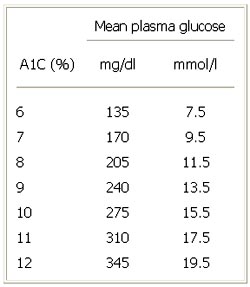
For the ADAs 2005 Position Statement:
Standards of Medical Care in Diabetes, Diabetes Care, 2005
Subscribe to:
Posts (Atom)


