Showing posts with label back. Show all posts
Showing posts with label back. Show all posts
10 Ways to Manage Low Back Pain at Home
Wednesday, April 23, 2014
Perhaps you bent the wrong way while lifting something heavy. Or youre dealing with a degenerative condition like arthritis. Whatever the cause, once you have low back pain, it can be hard to shake. About one in four Americans say theyve had a recent bout of low back pain. And almost everyone can expect to experience back pain at some point in their lives.
Chill it. Ice is best in the first 24 to 48 hours after an injury because it reduces inflammation, says E. Anne Reicherter, PT, DPT, PhD, associate professor of Physical Therapy at the University of Maryland School of Medicine. "Even though the warmth feels good because it helps cover up the pain and it does help relax the muscles, the heat actually inflames the inflammatory processes," she says. After 48 hours, you can switch to heat if you per. Whether you use heat or ice -- take it off after about 20 minutes to give your skin a rest.
Keep moving. "Our spines are like the rest of our body -- theyre meant to move," says Reicherter. Keep doing your daily activities. Make the beds, go to work, walk the dog. Once youre feeling better, regular aerobic exercises like swimming, bicycling, and walking can keep you -- and your back -- more mobile. Just dont overdo it. Theres no need to run a marathon when your back is sore.
Stay strong. Once your low back pain has receded, you can help avert future episodes of back pain by working the muscles that support your lower back, including the back extensor muscles. "They help you maintain the proper posture and alignment of your spine," Reicherter says. Having strong hip, pelvic, and abdominal muscles also gives you more back support. Avoid abdominal crunches, because they can actually put more strain on your back.
Stretch. Dont sit slumped in your desk chair all day. Get up every 20 minutes or so and stretch the other way. "Because most of us spend a lot of time bending forward in our jobs, its important to stand up and stretch backward throughout the day," Reicherter says. Dont forget to also stretch your legs. Some people find relief from their back pain by doing a regular stretching routine, like yoga.
Think ergonomically. Design your workspace so you dont have to hunch forward to see your computer monitor or reach way out for your mouse. Use a desk chair that supports your lower back and allows you to keep your feet planted firmly on the floor.
Watch your posture. Slumping makes it harder for your back to support your weight. Be especially caul of your posture when lifting heavy objects. Never bend over from the waist. Instead, bend and straighten from the knees.
Watch your weight. Use diet and exercise to keep your weight within a healthy range for your height. Being overweight puts excess stress on your spine.
Try an over-the-counter pain reliever. Anti-inflammatory drugs such as ibuprofen (Advil, Motrin), naproxen (Aleve, Naproxyn), and aspirin can help reduce back pain and swelling. Acetaminophen (Tylenol) is another over-the-counter option for pain management. Be sure to check with your doctor or pharmacist about any interactions over-the-counter pain relievers may have with other medications you are taking. People with a history of certain medical conditions (such as ulcers, kidney disease, and liver disease) should avoid some medicines
Sometimes it’s clearly serious: You were injured, or you feel numbness, weakness, or tingling in the legs. Call the doctor, of course. But for routine and mild low back pain, here are a few simple tips to try at home.
Chill it. Ice is best in the first 24 to 48 hours after an injury because it reduces inflammation, says E. Anne Reicherter, PT, DPT, PhD, associate professor of Physical Therapy at the University of Maryland School of Medicine. "Even though the warmth feels good because it helps cover up the pain and it does help relax the muscles, the heat actually inflames the inflammatory processes," she says. After 48 hours, you can switch to heat if you per. Whether you use heat or ice -- take it off after about 20 minutes to give your skin a rest.
Keep moving. "Our spines are like the rest of our body -- theyre meant to move," says Reicherter. Keep doing your daily activities. Make the beds, go to work, walk the dog. Once youre feeling better, regular aerobic exercises like swimming, bicycling, and walking can keep you -- and your back -- more mobile. Just dont overdo it. Theres no need to run a marathon when your back is sore.
Stay strong. Once your low back pain has receded, you can help avert future episodes of back pain by working the muscles that support your lower back, including the back extensor muscles. "They help you maintain the proper posture and alignment of your spine," Reicherter says. Having strong hip, pelvic, and abdominal muscles also gives you more back support. Avoid abdominal crunches, because they can actually put more strain on your back.
Stretch. Dont sit slumped in your desk chair all day. Get up every 20 minutes or so and stretch the other way. "Because most of us spend a lot of time bending forward in our jobs, its important to stand up and stretch backward throughout the day," Reicherter says. Dont forget to also stretch your legs. Some people find relief from their back pain by doing a regular stretching routine, like yoga.
Think ergonomically. Design your workspace so you dont have to hunch forward to see your computer monitor or reach way out for your mouse. Use a desk chair that supports your lower back and allows you to keep your feet planted firmly on the floor.
Watch your posture. Slumping makes it harder for your back to support your weight. Be especially caul of your posture when lifting heavy objects. Never bend over from the waist. Instead, bend and straighten from the knees.
Wear low heels. Exchange your four-inch pumps for flats or low heels (less than 1 inch). High heels create a more unstable posture, and increase pressure on your lower spine. According to research, nearly 60% of women who consistently wear high-heeled shoes complain of low back pain.
Kick the habit. Smoking can increase your risk for osteoporosis of the spine and other bone problems. Osteoporosis can lead to compression fractures of the spine. One study found that smokers are about a third more likely to have low back pain compared with nonsmokers.Watch your weight. Use diet and exercise to keep your weight within a healthy range for your height. Being overweight puts excess stress on your spine.
Try an over-the-counter pain reliever. Anti-inflammatory drugs such as ibuprofen (Advil, Motrin), naproxen (Aleve, Naproxyn), and aspirin can help reduce back pain and swelling. Acetaminophen (Tylenol) is another over-the-counter option for pain management. Be sure to check with your doctor or pharmacist about any interactions over-the-counter pain relievers may have with other medications you are taking. People with a history of certain medical conditions (such as ulcers, kidney disease, and liver disease) should avoid some medicines


Walking Away from Back Pain
Thursday, April 10, 2014
Home aerobic program as effective as clinical therapy in treating lower back pain, finds TAU researcher
Lower back pain is a common complaint, and treatment often requires many hours of physical therapy over multiple weekly clinic visits — a costly commitment. Now Dr. Michal Katz-Leurer of Tel Aviv Universitys Stanley Steyer School of Health Professions at the Sackler Faculty of Medicine says that a simple aerobic walking program is as effective in alleviating lower back pain as muscle strengthening programs that require specialized equipment in rehabilitation clinics. The program includes walking two to three times a week for a period of 20 to 40 minutes.
Dr. Katz-Leurer and her colleague Ilana Shnayderman, a graduate student at the Department of Physical Therapy and a practicing physiotherapist at Maccabi Health Care, say that their treatment option fits easily into a daily routine and allows those with back pain to be more responsible for their own health.
Their study was published in the journal Clinical Rehabilitation.
According to Dr. Katz-Leurer, research has shown that when people walk actively, abdominal and back muscles work in much the same way as when they complete exercises that target these areas. And unlike muscle strengthening programs, which often call for specific equipment and can involve exercises that require expert supervision, walking is a simple activity that can be done alone.
For the study, the researchers recruited 52 patients with lower back pain to participate in a randomized control trial. Through questionnaires, they were initially assessed for pain levels, feelings of disability, and avoidance of daily activities, as well as muscle and walking endurance.
Then, half of the participants completed a typical clinic-based muscle strengthening program, with two to three exercise sessions a week for six weeks. The other half completed a six-week aerobic walking program, walking two to three times weekly. Participants started with 20 minutes of walking, then progressed to 40 minutes as their endurance improved.
Results showed that both groups improved significantly in all areas of assessment, demonstrating that the walking program was "as effective as treatment that could have been received in the clinic," says Dr. Katz-Leurer.
The path to a healthier lifestyle
Dr. Katz-Leurer says that the walking program has the additional advantage of encouraging patients to follow a healthier lifestyle overall. In terms of physical fitness, those in the walking group were able to walk an average of 0.05 miles farther during a six-minute walking test at the end of the program compared to the pre-program assessments.
She also notes that that regularly active people are less likely to suffer typical aches and pains over their lifetime. Walking, a low-impact activity, also lowers blood pressure, boosts brain and immune system functioning, and reduces stress, she says.
The Health Wonk Review Come Back Well Leave The Light On For You Edition
Wednesday, March 5, 2014
 The Disease Management Care Blog (DMCB) welcomes readers to this edition of the Health Wonk Review. The DMCB is a physician-writer with knowledge and experience in primary care, health insurance, population health and health information technology. Thats why its delighted to host this compendium of recent writings from the best health policy bloggers offering insights you wont find anywhere else. Read this and the DMCB assures your Huff Po addled colleagues will admire you and your USA Today reading opponents will envy you.
For example, this HWR has a conservative who actually likes health insurance exchanges and a progressive who is disappointed with a key aspect of the Affordable Care Act. Theres also a unique description of an important collaboration among competing commercial health insurers and a thoughtful discussion of the downsides of preventing HIV infection. Youll also find a detailed report on how the evening news blew the coverage of an important cancer screening guideline update.
And dont be put off by the wide ranging number of posts. Read what captures your interest, follow the links and come back as often as you like. The DMCB will leave the light on for ya.
HOSPITALS
Hospital Quality
Most readers of this Health Wonk Review are undoubtedly sophisticated and dispassionate experts on hospital quality, consumerism, patient satisfaction and outcomes. Well, Neil Versel of the Meaningful Health IT News blog shows us how that learning contrasts with watching a terminally ill loved one with Multiple System Atrophy struggle with distant physicians, medication errors, incomplete care planning, lack of basic health services, ignored advance directives and occasional Keystone Kops style encounters with health workers who should know better. And we wonder why Americans are so fed up with the U.S. health care (non) system? Egads, says the DMCB.
A Medicare Hospital Measure Called "MSPB"
Speaking of hospitals and quality, CMS has started to publicly report peri-hospitalization health care costs using a metric called the Medicare Spending Per Beneficiary (MSPB). According to Jason Shafrin of the Healthcare Economist Blog in this post titled "Measuring Hospital Efficiency," Medicare is now reporting a roll-up of all payments made to docs and the facility three days prior, during and 30 days after a hospital stay. Non-surprisingly, some areas of the country have much higher MSPBs than others. Yet, despite its merits, Jason reports that the measure is not without controversy because we dont know enough about the link between the MSPB and outcomes (does more spending result in high quality?) or if reported higher costs were the the result of waste (for example, unnecessary or redundant testing) versus additional necessary care (perhaps extra days in a rehab facility after discharge were worth it). The one thing the DMCB does know is how necessary it will be to use the acronym "MSPB" the next time it steps up to a microphone at a health policy confab. It cant wait.
"Observational Status"
When is an admission to the hospital not an admission? Thats the conundrum tackled by Dr. Brad Flansbaum of The Hospitalist Leader blog, who helps the reader understand how hospitals use their inpatient facilities to treat outpatients. The key distinguishing factor is a limited 24-48 hour course of care that is aimed at returning the patient home. Unfortunately, outpatient care is covered with an outpatient insurance benefit that can include significant out-of-pocket expenses. Medicare has policies that require providers to inform beneficiaries of the financial impact of being in "observation status" but as the line that separates inpatient and outpatient care continues to be blurred, its likely well have to wait for global payments or shared risk arrangements to reconcile patient coverage expectations and billing systems. Until that happens, Brad has quotes a Medicare official who assures us that CMS is "considering caully how to simplify the rules in a way that best meets the needs of patients and providers without increasing costs to the system." Right.
HEALTH SYSTEMS
Accountable Care Organizations
While the mainstream focuses on Medicares ACOs (for example), Blue Shield of California, CalPERS, Hill Physicians Medical Group and Dignity Health quietly partnered back in 2007 on a shared savings program that apparently resulted in a noisy $20 million in savings. Glenn Melnick and Lois Gree over that the Health Affairs Blog have authored an interesting interview-narrative about this initiative that is full of interesting lessons. These lessons include the importance of physician buy-in and participation, a system-wide working familiarity with old-fashioned capitation, a supportive pre-existing provider culture, an emphasis on reducing readmissions, using wellness to reduce use of pricey bariatric surgery services, data liquidity, increasing use of evidence-based guidelines at the point of care, patient "repatriation" from non-participating care settings, data dashboards and empowering non-physicians to engage patients in self-care. The California HealthCare Foundation has committed to completing a full evaluation of the outcomes next year. The DMCB commits to using some new health policy jargon it discovered in reading this post: "actualize" and "head in a bed."
"Charismatic Leaders"
Roy Poses of Health Care Renewal continues to expose the folly running rampant in the U.S. health care system, this time by looking at the "CEO as False Messiah." Dr. Poses cautions readers to pause any time they run into local or national leaders who are uncritically hailed as "visionary." Its far more likely that their fawning admirers have been seduced by a toxic level of charisma that often leads to catastrophe. Get real, advises Roy, and admire such folks for being smart while keeping a skeptical eye on their ability to produce results.
PROVIDERS
The Doctor-Patient Relationship
David Williams of the Health Business Blog uses a Health Affairs article on "shared decision making" to lect on the upsides of being labelled a "difficult patient." Researchers found that an important barrier to forming a doctor-patient relationship is the fear among health care consumers that expressing a perence will annoy their doctor. David argues thats not such a bad thing, especially since modern consumers now have the option of seeking a second opinion, getting another doctor and ultimately using a questionable treatment. The DMCB really agrees with Davids perspective because it wants to be liked by him.
DRUGS
HIV Prevention Is Good News, Right?
Nate Ogden of the InsureBlog walks readers through a fascinating exercise on the costs and ethics surrounding the FDAs approval of HIV-prevention drug called "Travuda." While readers may initially want to hail this medical breakthrough, Nate suggests its not so simple: 1) the retail cost of the drug is $11,000 a year, which a) contrasts with the $30 a month cost of equally effective condoms and b) would be enough to treat 20 HIV positive patients, 2) persons taking the drug may misuse their new found protection and paradoxically engage in increased risk-taking sexual behaviors and 3) coverage may be mandated as an insurance benefit, which means therell be one more driver of health care costs for all of us. Another silk purse turned into a sows ear, says the DMCB.
Would You Like Some Drug Monitoring Along With That Refill?
Never at a loss for words, Joe Paduda of Managed Care Matters takes umbrage with Missouri State Senator Robert Schaafs opposition to the states "Prescription Drug Monitoring Program Act." Joe argues that the act would reduce the incidence of drug-drug interactions and lessen prescription drug abuse through doctor shopping. Without passage of the bill, says Joe, kids will lose their moms, Scout troops will have to meet without their den mothers and schools will have teacherless classrooms.Dr. Schaff, who by the way is a family physician and leads a prominent physician liability insurance carrier, has a different perspective. The DMCB predicts the Senator will not find Joes disapproval very compelling.
HEALTH INFORMATION ANALYTICS
Health Insurer Data Mining
If its one thing that Medicare has done better than the commercial insurers, its making its claims data available to health services researchers. The DMCB suspects that the commercial insurers have been reluctant to do so because of the considerable effort involved, concerns about inadvertently running afoul of HIPAAs unwieldy confidentiality provisions, giving their competition otherwise confidential information about payment rates and the lack any relevant value propositions. According to Martin Gaynor at the curiously named Wing of Zock Blog, those barriers have finally been overcome. Aetna, Human, Kaiser and United have all agreed to ship billions of lines of claims data to the not-for-profit Health Care Cost Institute which will make the deidentified data available to researchers. The DMCB agrees that this is a significant development that will allow researchers to mine insights that, thanks to relatively low numbers of patients, non-generalizable health care settings and limited imagination, have been out of reach. The DMCB hopes the data will be made democratically available on as close to an "open source" basis as possible.
HEALTH INSURANCE
Group and Individual Insurance Markets
Need a quick lesson on the fundamental differences between group and individual health insurance policies? Louise over at Colorado Health Insider has a terrific "101" on health insurance guaranteed issue, mandates, underwriting, the role of high risk pools and the impact of Affordable Care Act. The DMCB recommends that everyone - except the White House - bookmark this page just in case were forced by the Supreme Court into a health insurance orm do-over. The White House is being given a pass by the DMCB because if that happens, no one will really care what they think.
Speaking of the Individual Market....
In case you think all progressives uncritically support the Affordable Care Act, Maggie Mahar at the healthinsurance blog inconveniently points out that a big part of the individual health insurance market will remain broken come 2014. Maggies post offers up some compelling statistics that demonstrate that many middle aged boomers (yikes, including the DMCB) who are between ages 50 and 64 years wont meet income thresholds for subsidies. As a result, theyre looking at the prospect that health insurance premiums could reach an unaffordable average of $7500 a year. Combine that with a lackluster job market, declining incomes and substantial out-of-pocket costs and it is clear that health orm will remain a contentious, time-consuming and difficult work in progress for years to come. In the meantime, the DMCB will wonder about the affordability of essential benefits, the merits of value-based insurance designs, how population health-based care management can help blunt the impact of chronic illness and the wisdom of using limits on age rating to shift costs to the DMCB spawn.
STATES
One States Perspective on Federal Health Reform
While Californias budget slides into the sea thanks to an unending budgetary earthquake, every dollar counts. Thats why Anthony Wright of the Health Access Blog points out that in addition to the patently obvious merits of assuring access, lowering costs and protecting consumers, the Affordable Care Act is also a windfall for the Golden State. He quotes and links a California-based Bay Area Council Economic Institute report that calculates that the ACA will add close to a 100,000 new California-based jobs and $4.4 billion in additional state output. Alas, says the DMCB, between the U.S. Supreme Court and less-than-expected taxable income from the disappointing Facebook IPO, it looks like fixing Sacramentos budget woes may need a Plan C.
How Should States Respond to Health Insurance Exchanges?
Conservatives hate those ACA-mandate insurance exchanges, while progressives love them, right? And any Republican Governor that sets up an exchange under the terms of the ACA is a hypocritical closet-supporter of Obamacare? Is that so? John Goodmans Health Policy Blog point-counterpoint posting teaches us that its not so simple. It turns out that states 1) may fare better with or without the ACA if they maintain control over exchanges, 2) could use the flexibility that comes with control to make insurance exchanges more effective and fair, and 3) with that control will also have a say over the commercial insurance subsidies that will add up to gazillions of dollars. Just in case you think Johns post is just a lot of hot air, check out this telling Pennsylvania-based Op-Ed.
WORKERS COMP
Links Between Workers Comp and Health Promotion
Many health care providers regard "workers comp" as something as a policy sideshow, but Workers Comp Insider Jon Coppelman shows us that this multi-billion dollar industry is not only a big deal but also not immune to the growing costs of our sedentary lifestyle. When a 50 year old fat ambulance workers stroke was blamed on a lower extremity paradoxical embolism resulting from hours of sitting, the lifelong care costs were ruled "compensible." Next stops are the diabetes-causing donuts on our way to work and the hypertension from those generously salted fries in the company cafeteria. Mr. Coppleman recommends early adjuster involvement in the claims adjudication. The DMCB wonders if the Workers Comp insurance industry should think about being more proactive, including using risk stratification and advocating for common sense health promotion.
WELNESS AND HEALTH PROMOTION
Wellness! Gotta Have It!
No Health Wonk Review would be complete without one enthusiastic endorsement of all things wellness. Kat Haselkorn of Corporate Wellness Insights steps into that role with copious praise of all the benefits of health promotion, including positive culture change, huge returns on investment, enriched social networks and accelerating employee productivity. Kat suggests that if just one person buys into wellness, the effect can ripple through the company faster than spandex-clad yuppies swarming at an after-work Zumba class.
Wellness! Gotta Keep Funding It!
New blogger Tracey Moorhead of the Care Continuum Alliance writes in the Voice On Population Health Blog about the ill-advised willingness of the U.S. House to steal from the ACAs Prevention and Public Health Fund to extend coverage of student load interest subsidies. Tracey passionately argues the fund has already led to important behavioral health screenings, data infrastructure development and expansion of wellness services in multiple states. Whoa, says the DMCB, which isnt surprised at the Care Continuum Alliances advocacy on behalf of prevention and population health. Good for them.
And Heres An Added Benefit of Being Fit?
Michael Gavin of the Evidence-Based blog notes that a recently published article in the medical journal Pain shows that athletes have a higher pain threshold. From his point of view, this is why exercise should not only be promoted as an alternative to using dangerous drugs to control pain but as an added overall benefit from achieving maximum fitness. The contrarian DMCB took a look at the abstract and wonders if persons who are naturally blessed with higher pain thresholds are attracted to exercise (or at the very least, find it less unpleasant). While readers are figuring out which is cause and which is effect, they can also show their health knowledge chops by not only erring to exercise related "endorpins" but "endocannabinoids" as the basis for the runners "high."
SPECIAL POPULATIONS
Prisoners
Talk about a disenfranchised population. Suffering with highly prevalent rates of Hepatitis C, HIV and mental illness, huge numbers of released prisoners were being left to fend on their own. Harold Pollack, also of the healthinsurance blog describes how thanks to recently passed federal legislation, hundreds of thousands of these individuals will be able to qualify for Medicaid, obtain tax credits that can defray the cost of private insurance and access basic community-based health care services. While health orm is all about the single mom waitress with two kids, the middle America steel worker and the kid with end stage cancer, Dr. Pollack says we all benefit when ex-prisoners are also staying away from crowded emergency rooms, avoiding unnecessary hospitalizations and not burdening over-stretched safety net programs.
Geriatrics
IF you believe geriatric care is important, THEN you should read this post BECAUSE youll get to learn about the "ACOVE" framework. Thats the message the DMCB got after reading Chris Langstons post on the Quality of Geriatric Care over at the John A Hartford Foundation. It turns out that the Assessing Care of Vulnerable Elders is a handy IF-THEN-BECAUSE tool that identifies the specific health issues afflicting the elderly and targets geriatriccare planning. Chris argues wider use of ACOVE would increase quality of care in geriatrics and clarify the important differences between general medical versus geriatric conditions.
CODING
Hate ICD-10?
Heres another anti-ICD-10 rant, courtesy of a post by TBD Consultings Jonena Relth at the Healthcare Talent Transformation Blog. She argues that veteran front-line health care workers are deeply skeptical about the ultimate value of the insurance billing systems astonishingly complicated specificity and detail. Jonena is concerned that the new coding will paradoxically lead to billing errors and enable greater health insurer mischief. Too bad there wasnt any credit given to the AMA for CMS decision to delay implementation of ICD-10 as well as the organizations continuing advocacy on the issue. As for the health insurers, the DMCB thinks that given the circumstances of a very hostile Administration and the luster of an ACA-driven enrollment windfall, they quietly came as close as they could to expressing concerns over the wisdom of ICD-10.
and last but not least.....THE NEWS DISAPPOINTS...AGAIN
Prostate Cancer Screening and the News Media
As risks, benefits and alternatives to cancer screening move into the public square, Gary Schwitzers HealthNewsReview blog offers up this balanced scientific review on the merits of prostate cancer screening by Richard Hoffman and this insightful description on how the mainstream news media made a mess of things. It turns out that the U.S. Preventive Task Forces recommendations werent really all that new, that a substantial number of physicians have been PSA skeptics for years and that early detection of prostate cancer - whatever its merits - is hugely remunerative to providers. As testimony to the news elites selective inattention, ask yourself if you should thank Diane Sawyer et al for avoiding this new wrinkle on the topic of lung cancer screening.
Image from Wikipedia
Hospitals Push Back Against RAC Audits They Should
Monday, March 3, 2014
 One of the Disease Management Care Blogs local hospitals has jumped into a lawsuit against Medicare.
 According to this article, the dreaded 2003 Medicare Modernization Acts RAC audits have gummed up Part B as well as Part A payments. Thats important because Part B includes physician services, which outside of hospital-physician alliances like Accountable Care Organizations, is typically completely separate. Hitting A as well as B not only represents a potential double hit to hospitals bottom lines.
Could that give hospitals a reason to think again about hiring physicians?
Even if the DMCB is wrong about the scope of the lawsuit, the articles paragraph on this hospitals costs in dealing with the RAC audits are eye opening: 6 staff members and additional hundreds of thousands of dollars to cover medical record requests, consultants and appeals. If other hospitals are being forced to follow suit, the cost to the health care system is considerable.
And those are Medicare administrative costs. These are borne not by the feds, but by hospitals, which must comply with thousands of pages of complex rules and regulations. While its mathematically true that Medicare has "low administrative costs," thats because the Agencys principal means of enforcement are cudgels like RAC audits with clawbacks with interest, penalties and other sanctions.
While there is no shortage of hospital bad behavior, DMCB suspects most hospitals are honest and, despite that, have had no choice: add additional administrative expenses that are ultimately passed through to the patient and the nations fisc.
Lower back pain exercise
Wednesday, January 29, 2014
Low back pain can occur to frequent computer users who spend long hours at a same position. Frequent bikers can also be a victim of back pain if they are riding a bike with poor shock absorbers. Also there are a lot of peoples doing routine type of work daily so muscles get stressed out and can easily catch strain. Muscular strains are among the most common physical problems we face, mostly 4 out of 5 Americans can suffer from lower back pain because of muscular strain.
However, you should not perform these exercises while you are experiencing severe lower back pain. Check with your doctor before beginning any of these exercises.Trunk Flexing Stretch
Regular stretching exercises can help prevent all types of muscular strains and can prevent back pain. Computers surfers can follow workplace workouts to avoid lower back pain and stress. The following exercises can help you prevent muscle strains in the future, or help you recover from existing ones.
However, you should not perform these exercises while you are experiencing severe lower back pain. Check with your doctor before beginning any of these exercises.
 |
- On hands and knees, tuck in chin and arch back.
- Slowly sit back on heels, letting shoulders drop toward the floor
- Keep the back relaxed.
- Hold for 45 to 60 seconds.
- Release. Repeat 2 times.
- Do once per day.
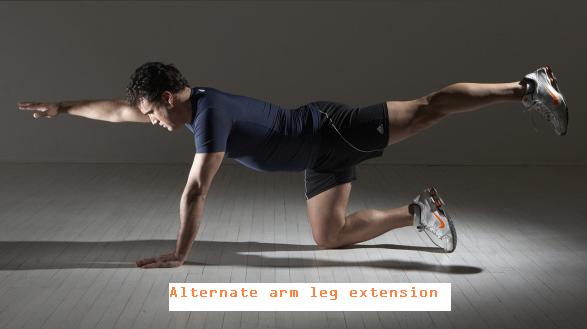 |
- Face floor on hands and knees.
- Raise left arm and right leg. Do not arch neck.
- Hold for 10 seconds and release.
- Raise right arm and left leg. Do not arch neck.
- Hold for 10 seconds and release.
 |
- Lie on your stomach with your arms folded under your chin.
- Slowly lift one leg not too high without bending it, while keeping your pelvis flat on the floor.
- Slowly lower your leg and repeat with the other leg.
Prone Lumbar Extension
 |
- Begin lying on your front with your hands in a push-up position
- Slowly push your upper body off the floor by straightening your arms, but keep your hips on the floor.
- Hold for 10 seconds, then relax your arms, moving back to the floor
Pelvic Tilt Exercise

- Lie on back with knees bent, feel flat on floor, and arms at sides
- Flatten small of back against floor. (Hips will tilt upward)
- Hold for 10 to 15 seconds and release. Gradually increase your holding time to 60 seconds

- Lie on the floor on back.
- Keeping arms folded across chest, tilt pelvis to flatten back. Tuck chin into chest.
- Tighten abdominal muscles while raising head and shoulders from floor
- Hold for 10 seconds and release
- Repeat 10 to 15 times. Gradually increase your repititions
Double knee-to-chest stretch

- Lie down on back.
- Pull both knees in to chest until you feel a comfortable stretch in lower back.
- Keep the back relaxed Hold for 45 to 60 seconds.
- Release. Repeat 2 times.
- Do once per day.
You can follow these methods caully and apply them slow and steady. Always try to relax and feel comfortable before you start any kind of exercise because your mind plays a vital role in any exercise to show effect on you.
Let us know the result in comment section when you try any of these methods.
Let us know the result in comment section when you try any of these methods.
Subscribe to:
Posts (Atom)