Showing posts with label based. Show all posts
Showing posts with label based. Show all posts
Retail based Clinics
Wednesday, April 9, 2014
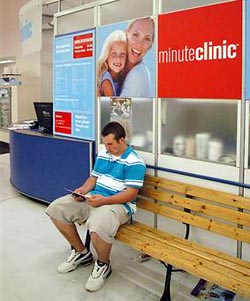 They dont offer services for diabetes care yet, but keep your eye on them. These retail-based health care centers may one day be able to augment basic chronic-care services typically provided by primary care physicians.
In the mean time, if youre in the market for an easily accessible, no-appointment-needed, walk-in clinic - many of which offer wait times of less than 15 minutes - a MinuteClinic, RediClinic, or Take Care Health Center may be for you.
The clinics have cropped up in retail outlets and drugstores across the country, including Wal-Mart, Walgreens, Rite-Aid, and most notably CVS Pharmacies which purchased the large network of MinuteClinics in July of this year.
Theyre staffed by certified family nurse practitioners and physician assistants who use a standard protocol to diagnose and treat basic ailments such as ear and sinus infections, poison ivy rashes, and other minor skin infections and burns. They can dispense vaccines for the flu, pneumonia, or hepatitis. Many offer blood sugar and blood pressure screenings.
Since theres usually a pharmacy on the premises, prescriptions written by qualified clinic staff can be filled immediately.
The clinics accept most major health plans including Medicare. They strive to be affordable even if you dont have health insurance.
The trend of retail-based clinics is in its infancy. Time will tell whether it grows to fill a gap for basic services in health care that are less time-consuming and more affordable to the consumer while staying profitable for operators.
To find a retail clinic in your area, a list of treatments offered and insurance accepted, visit:
MinuteClinic
RediClinic
Take Care Health Centers


Mindfulness based stress reduction helps lower blood pressure
Wednesday, March 12, 2014
Blood pressure is effectively lowered by mindfulness-based stress reduction (MBSR) for patients with borderline high blood pressure or "prehypertension." This finding is reported in the October issue of Psychosomatic Medicine: Journal of Biobehavioral Medicine, the official journal of the American Psychosomatic Society. The journal is published by Lippincott Williams & Wilkins, a part of Wolters Kluwer Health.
"Our results provide evidence that MBSR, when added to lifestyle modification advice, may be an appropriate complementary treatment for BP in the prehypertensive range," writes Joel W. Hughes, PhD, of Kent State (Ohio) University and colleagues.
Mindfulness Practice Leads to Drop in Blood Pressure
The study included 56 women and men diagnosed with prehypertension -- blood pressure that was higher than desirable, but not yet so high that antihypertensive drugs would be prescribed. Prehypertension receives increasing attention from doctors because it is associated with a wide range of heart disease and other cardiovascular problems. About 30% of Americans have prehypertension and may be prescribed medications for this condition.
One group of patients was assigned to a program of MBSR: eight group sessions of 2½ hours per week. Led by an experienced instructor, the sessions included three main types of mindfulness skills: body scan exercises, sitting meditation, and yoga exercises. Patients were also encouraged to perform mindfulness exercises at home.
The other "comparison" group received lifestyle advice plus a muscle-relaxation activity. This "active control" treatment group was not expected to have lasting effects on blood pressure. Blood pressure measurements were compared between groups to determine whether the mindfulness-based intervention reduced blood pressure in this group of people at risk of cardiovascular problems.
Patients in the mindfulness-based intervention group had significant reductions in clinic-based blood pressure measurements. Systolic blood pressure (the first, higher number) decreased by an average of nearly 5 millimeters of mercury (mm Hg), compared to less than 1 mm Hg with in the control group who did not receive the mindfulness intervention.
Diastolic blood pressure (the second, lower number) was also lower in the mindfulness-based intervention group: a reduction of nearly 2 mm Hg, compared to an increase of 1 mm Hg in the control group.
Mindfulness-based interventions Could Prevent or Delay Need for Antihypertensive Drugs Ambulatory monitoring is an increasingly used alternative to clinic-based blood pressure measurements. However, 24-hour ambulatory blood pressure monitoring showed no significant difference in blood pressure with the mindfulness-based intervention.
"Mindfulness-based stress reduction is an increasingly popular practice that has been purported to alleviate stress, treat depression and anxiety, and treat certain health conditions," according to Dr Hughes and coauthors. It has been suggested that MBSR and other types of meditation may be useful in lowering blood pressure. Previous studies have reported small but significant reductions in blood pressure with Transcendental Meditation; the new study is the first to specifically evaluate the blood pressure effects of mindfulness-based intervention in patients with prehypertension.
Although the blood pressure reductions associated with mindfulness-based interventions are modest, they are similar to many drug interventions and potentially large enough to lead to reductions in the risk of heart attack or stroke. Further studies are needed to see if the blood pressure-lowering effects are sustained over time.
The researchers argue that mindfulness-based interventions may provide a useful alternative to help "prevent or delay" the need for antihypertensive medications in patients with borderline high blood pressure.
A Population Based Care Management Lesson What Telephonic Disease Management Lacks In Individual Effectiveness Is Made Up By Its Greater Reach
Sunday, February 16, 2014
 |
| What did that study show? |
A New England Journal of Medicine editorial accompanying the POWER article points out that there may have been an additional factor that explained the results: patient attendance at the in-person counseling sessions dropped off precipitously as the trial progressed (an average of only 2 out of 24 scheduled visits after the seventh month), while the telephonic approach achieved 16 out of 18 scheduled contacts.
The DMCB agrees and suggests this is an additional virtue of remote telephonic disease management. While in-person counseling may have more of an individual impact, it does little good if patients no-show. In contrast, "high volume" telephonic counseling may have more of a population-based effect, because a lower intensity intervention has greater absolute impact if its delivered to more persons.
NIH scientist Susan Yanovskis editorial falls short on capitalizing on that insight. While it grudgingly points out that POWER shows "PCPs can deliver safe and effective weight-loss interventions in primary care settings," it neglects to mention the two important implications of POWER:
1) non-physician team members acting collaboration with PCPs are an important resource in the national battle against obesity and
2) offering a variety of communication channels increases reach and gives more patients new and effective options to access anti-obesity programs.
Lessons From The Practice based Opportunities for Weight Reduction POWER Study More Evidence of the Effectiveness of Remote Care Management for Obesity
Wednesday, February 5, 2014
 |
| "I need to call someone..." |
Talk to some of the Ayatollahs dominating the academic medical-industrial complex about telephonic disease management and theyll give you the same look that they give to something unsightly that they just discovered on the end of their finger after rubbing their nose. The idea that some remote (ugh!), telephone-based (bleh!) for-profit (yuck!) company could contribute anything to their vision of the health delivery is health policy apostasy.
But what how does this ideology stack up against the evidence?
Until recently, we haven’t really known because there were few head-to-head comparisons of traditional “disease management” vs. traditional patient counseling. But now we have the just-published POWER (“Practice-based Opportunities for Weight Reduction” study that was funded by the NHLBI and (whoa!) Healthways. The authors were from Johns Hopkins University, which has a long-term consulting agreement with Healthways. They had final say on the research methodology and the papers contents.
POWER was a prospective clinical trial that randomly assigned patients to one of three weight loss intervention strategies. One consisted of “remote” telephonic treatment counseling, the second provided in-person counseling and the third was a control group. The in-person sessions were provided by Johns Hopkins employees while the remote telephone counseling was provided by Healthways.
Study patients with obesity and at least one risk factor (hypertension, hyperlipidemia or diabetes) were recruited from six Baltimore primary care practices from 2008 through 2009.
All the interventions used basic nutritional and exercise guidelines that were delivered with state-of-the art “social cognitive theory,” "behavioral self-management,” “positive reinforcement” and “motivational interviewing.” Both of the intervention groups had access to a web site with learning modules plus feedback. If there was no log-on to the web site every 7 days, patients were sent a reminder email.
Persons in the disease management-style remote support arm of the study got 12 weekly calls lasting 20 minutes for three months, which was followed by 3 monthly calls. Persons assigned to the traditional in-person coaching arm got nine group sessions and three individual sessions over the 3 months followed by one group and two individual monthly sessions over three months.
Participants’ weight loss was assessed at 6 and 24 months.
The patients primary care physicians received summary reports and encouraged their patients’ participation.
Readers should note that this was an “effectiveness” trial. Unlike “efficacy” trials, the protocol dispensed with the usual run-in period or making sure patients were adherent to the protocol before or during the study.
1370 persons were screened and 415 were randomized. 64% were women, the mean age was 54 years, 41% were black, 97% had commercial insurance and the mean BMI was a hefty 36.6.
After randomization, there was some drop out: 366 were weighed at 6 months, 355 at 12 months and 392 at 24 months.
At 6 months: the control group lost 1.4 kilograms (kg) while there was 6.1 kg lost in the remote support, and 5.8 kg. lost in the in-person group. Thats 3.1 lbs vs. 13.4 lbs vs. 12.8 lbs.
At 24 months, the weight loss .8 kg in the control, 4.6 Kg in remote support and 5.1 Kg for in-person. Thats 1.8 lbs, 10.1 lbs and 11.2 lbs. That translates to body weight changes of 1.1%, 5.0% and 5.2%. The percent of persons hitting at least 5% weight loss was 18.8% in the control group, 41.4% in the in-person support group and 38.2% in the group getting remote support. 7.8% of controls, 27.5% and 18.8% of controls, remote and in-person support patients, respectively, reached a BMI less than 30
There was no statistically significant difference in weight loss outcomes between the two intervention groups. In other words, the small changes between the disease management and in-person counseling could have been the result of chance.
What can readers conclude?
1. This was a solidly performed study with important implications for a still-evolving national strategy in the battle against obesity. If an intervention can lead approximately 40% of persons to lose 5% of their weight over two years, maybe the science of non-invasive weight reduction has gotten to the point where insurers should cover it. While the DMCB remains suspicious about “mandates” and “the minimum benefit,” there are other policy levers that could be pushed to make this happen. This is doubly true when you think about the costly alternatives of drugs and weight loss surgery.
2. Seen through the lens of a disease management vs. in-person counseling competition, the industry’s “best” (Healthways) went toe to toe with the health system’s best (Johns Hopkins) and it was a tie. When it comes to weight loss, it now comes down to who can do it cheaper and who can scale it.
3. While this was a solid study, readers should be aware of its imperfections. Since there were so few patients on Medicare or Medicaid, we dont know how this would work in patients with public insurance. This was not double blinded, so it’s possible that the outcomes were skewed because patients and their doctors were aware of their assigned treatment arm. The drops-outs weights went unmeasured and their data could have changed the results. There was a high reliance on group sessions in the "in-person" arm of the study, which may not be as effective as one-on-one counseling. The in-person sessions were also “remote” from the PCPs’ offices and may have been a poor substitute for the one-on-one counseling envisioned for a robust PCMH. Successful weight loss is usually defined at 10% of body weight at one year instead of 5% at 2 years. It’s also difficult to discern the relative contribution of the web site vs. the physician support vs. the nurse counseling. We don’t know what happened to the patients’ blood pressure, cholesterol levels or their blood glucose control. Finally, Hopkins had a doubtful but potential conflict of interest in a study that showed non-superiority vs. one of their customers.
4 While the DMCB doesn’t want to quibble, close scrutiny of the p-values in a table comparing the percent of persons reaching a BMI less than 30 for the in-person vs. remote support cohorts shows that it came quite close to being statistically significant at p = .07. In other words, Healthways (27.5%) almost beat Johns Hopkins (18.8%). Using the same criteria in this study widely hailed as proving that Group Health’s medical home saves money, Healthways did beat Johns Hopkins.
5 Healthways deserves kudos for submitting to and committing resources to a clinical trial. To the DMCB, the search for scientific truth is a price of doing business. Their shareholders may think that cash is better spent on pursuing customers or driving efficiencies, but this research is an investment that will yield returns over the long run. Other for-profits "get it" and so does Healthways. The only question is why isnt this spashed on the companys web site?
6 If both interventions are equivalent, the DMCB suggests that they are not necessarily exclusive. A truly enlighted approach to this would be to let patients choose which form of counseling they per. Whats more, if patients were allowed to choose, the amount of weight loss for both groups would probably be even greater.
7. Last but not least, this is further evidence that "disease management" has grown up. This "DM Ver 2.0" is based on far more sophisticated principles of behavior change than those used in the Medicare Health Support debacle. Whats more, this Johns Hopkins paper reminds us that physicians, in the course of routine patient encounters, are simply not an option when it comes to weight loss counseling. Theyre too busy and their job is to provide a supporting role.
"POWER" - one more acronym and one more piece of evidence to use in defense of disease and population-based care management.
Cinnamon and cinnamon based products may be dangerous
Tuesday, January 28, 2014
Many kinds of cinnamon, cinnamon-flavored foods, beverages and food supplements in the United States use a form of the spice that contains high levels of a natural substance that may cause liver damage in some sensitive people, scientists are reporting. Their study, published in ACS Journal of Agricultural and Food Chemistry, found similar results as those published in the European Union.
Ikhlas Khan and colleagues explain that cinnamon, which comes from the bark of certain trees, is one of the most important flavoring agents used in foods and beverages. "True," or Ceylon, cinnamon is expensive, so most breads, sticky buns and other products in the United States use dried cassia bark, or cassia cinnamon. Ceylon cinnamon contains very little coumarin, a naturally occurring substance that has been linked to liver damage in people sensitive to the substance. However, cassia cinnamon can contain larger amounts. Khans team decided to check on the coumarin content of a wide variety of food products.
"As found in this study, coumarin was present, sometimes in substantial amounts, in cinnamon-based food supplements and cinnamon-flavored foods," they say.
Subscribe to:
Posts (Atom)


