Showing posts with label based. Show all posts
Showing posts with label based. Show all posts
Retail based Clinics
Wednesday, April 9, 2014
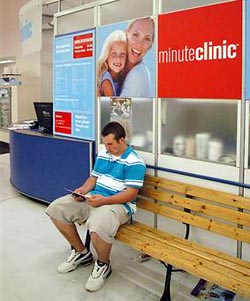 They dont offer services for diabetes care yet, but keep your eye on them. These retail-based health care centers may one day be able to augment basic chronic-care services typically provided by primary care physicians.
In the mean time, if youre in the market for an easily accessible, no-appointment-needed, walk-in clinic - many of which offer wait times of less than 15 minutes - a MinuteClinic, RediClinic, or Take Care Health Center may be for you.
The clinics have cropped up in retail outlets and drugstores across the country, including Wal-Mart, Walgreens, Rite-Aid, and most notably CVS Pharmacies which purchased the large network of MinuteClinics in July of this year.
Theyre staffed by certified family nurse practitioners and physician assistants who use a standard protocol to diagnose and treat basic ailments such as ear and sinus infections, poison ivy rashes, and other minor skin infections and burns. They can dispense vaccines for the flu, pneumonia, or hepatitis. Many offer blood sugar and blood pressure screenings.
Since theres usually a pharmacy on the premises, prescriptions written by qualified clinic staff can be filled immediately.
The clinics accept most major health plans including Medicare. They strive to be affordable even if you dont have health insurance.
The trend of retail-based clinics is in its infancy. Time will tell whether it grows to fill a gap for basic services in health care that are less time-consuming and more affordable to the consumer while staying profitable for operators.
To find a retail clinic in your area, a list of treatments offered and insurance accepted, visit:
MinuteClinic
RediClinic
Take Care Health Centers


Mindfulness based stress reduction helps lower blood pressure
Wednesday, March 12, 2014
Blood pressure is effectively lowered by mindfulness-based stress reduction (MBSR) for patients with borderline high blood pressure or "prehypertension." This finding is reported in the October issue of Psychosomatic Medicine: Journal of Biobehavioral Medicine, the official journal of the American Psychosomatic Society. The journal is published by Lippincott Williams & Wilkins, a part of Wolters Kluwer Health.
"Our results provide evidence that MBSR, when added to lifestyle modification advice, may be an appropriate complementary treatment for BP in the prehypertensive range," writes Joel W. Hughes, PhD, of Kent State (Ohio) University and colleagues.
Mindfulness Practice Leads to Drop in Blood Pressure
The study included 56 women and men diagnosed with prehypertension -- blood pressure that was higher than desirable, but not yet so high that antihypertensive drugs would be prescribed. Prehypertension receives increasing attention from doctors because it is associated with a wide range of heart disease and other cardiovascular problems. About 30% of Americans have prehypertension and may be prescribed medications for this condition.
One group of patients was assigned to a program of MBSR: eight group sessions of 2½ hours per week. Led by an experienced instructor, the sessions included three main types of mindfulness skills: body scan exercises, sitting meditation, and yoga exercises. Patients were also encouraged to perform mindfulness exercises at home.
The other "comparison" group received lifestyle advice plus a muscle-relaxation activity. This "active control" treatment group was not expected to have lasting effects on blood pressure. Blood pressure measurements were compared between groups to determine whether the mindfulness-based intervention reduced blood pressure in this group of people at risk of cardiovascular problems.
Patients in the mindfulness-based intervention group had significant reductions in clinic-based blood pressure measurements. Systolic blood pressure (the first, higher number) decreased by an average of nearly 5 millimeters of mercury (mm Hg), compared to less than 1 mm Hg with in the control group who did not receive the mindfulness intervention.
Diastolic blood pressure (the second, lower number) was also lower in the mindfulness-based intervention group: a reduction of nearly 2 mm Hg, compared to an increase of 1 mm Hg in the control group.
Mindfulness-based interventions Could Prevent or Delay Need for Antihypertensive Drugs Ambulatory monitoring is an increasingly used alternative to clinic-based blood pressure measurements. However, 24-hour ambulatory blood pressure monitoring showed no significant difference in blood pressure with the mindfulness-based intervention.
"Mindfulness-based stress reduction is an increasingly popular practice that has been purported to alleviate stress, treat depression and anxiety, and treat certain health conditions," according to Dr Hughes and coauthors. It has been suggested that MBSR and other types of meditation may be useful in lowering blood pressure. Previous studies have reported small but significant reductions in blood pressure with Transcendental Meditation; the new study is the first to specifically evaluate the blood pressure effects of mindfulness-based intervention in patients with prehypertension.
Although the blood pressure reductions associated with mindfulness-based interventions are modest, they are similar to many drug interventions and potentially large enough to lead to reductions in the risk of heart attack or stroke. Further studies are needed to see if the blood pressure-lowering effects are sustained over time.
The researchers argue that mindfulness-based interventions may provide a useful alternative to help "prevent or delay" the need for antihypertensive medications in patients with borderline high blood pressure.
A Population Based Care Management Lesson What Telephonic Disease Management Lacks In Individual Effectiveness Is Made Up By Its Greater Reach
Sunday, February 16, 2014
 |
| What did that study show? |
A New England Journal of Medicine editorial accompanying the POWER article points out that there may have been an additional factor that explained the results: patient attendance at the in-person counseling sessions dropped off precipitously as the trial progressed (an average of only 2 out of 24 scheduled visits after the seventh month), while the telephonic approach achieved 16 out of 18 scheduled contacts.
The DMCB agrees and suggests this is an additional virtue of remote telephonic disease management. While in-person counseling may have more of an individual impact, it does little good if patients no-show. In contrast, "high volume" telephonic counseling may have more of a population-based effect, because a lower intensity intervention has greater absolute impact if its delivered to more persons.
NIH scientist Susan Yanovskis editorial falls short on capitalizing on that insight. While it grudgingly points out that POWER shows "PCPs can deliver safe and effective weight-loss interventions in primary care settings," it neglects to mention the two important implications of POWER:
1) non-physician team members acting collaboration with PCPs are an important resource in the national battle against obesity and
2) offering a variety of communication channels increases reach and gives more patients new and effective options to access anti-obesity programs.
Subscribe to:
Posts (Atom)


