Showing posts with label insulin. Show all posts
Showing posts with label insulin. Show all posts
Is Insulin Resistance A Natural Defense Against Overnutrition
Tuesday, May 20, 2014
When we eat, we make glucose available to our cells for energy and other processes. Insulin helps that glucose enter our cells. But when cells reach a certain satiety point, insulins signaling ability lessens, possibly protecting the cell from an influx of too much glucose. This process may be at the root of insulin resistance.

A study that appeared in the February 21 issue of Nature described a link between the presence of glucose, fats, and other nutrients in the bloodstream ... and the action of an enzyme called O-linked beta-N-acetylglucosamine transferase (OGT). When nutrient levels are high, OGT travels out of the cell nucleus to the cell membrane. There it works to dampen insulin signaling by attaching glucose-containing molecules to key proteins of the intercellular insulin signaling pathway.
Not surprisingly, the particular sugar molecule it attaches is called O-linked beta-N-acetylglucosamine (O-GlcNAc). And the amount of O-GlcNAc is related to how much glucose is in the bloodstream.
Knowing the specific enzymes and sugars involved in insulin resistance can lead to the development of specific drugs that target these molecules. This type of research can also help us to understand how overnutrition can bring about insulin resistance, a condition which often leads to diabetes.
Although drug therapy that targets these molecules may not be available for a while, diet therapy is available today. Learning how to feed our bodies just what they need, but not more than they need, can improve the action of insulin ... reducing the occurrence of insulin resistance and lowering the risk for type 2 diabetes.
________
For the study:
Phosphoinositide Signalling Links O-Glcnac Transferase To Insulin Resistance
News article (ScienceDaily):
Novel Link Between Excessive Nutrient Levels And Insulin Resistance Uncovered
A study that appeared in the February 21 issue of Nature described a link between the presence of glucose, fats, and other nutrients in the bloodstream ... and the action of an enzyme called O-linked beta-N-acetylglucosamine transferase (OGT). When nutrient levels are high, OGT travels out of the cell nucleus to the cell membrane. There it works to dampen insulin signaling by attaching glucose-containing molecules to key proteins of the intercellular insulin signaling pathway.
Not surprisingly, the particular sugar molecule it attaches is called O-linked beta-N-acetylglucosamine (O-GlcNAc). And the amount of O-GlcNAc is related to how much glucose is in the bloodstream.
Knowing the specific enzymes and sugars involved in insulin resistance can lead to the development of specific drugs that target these molecules. This type of research can also help us to understand how overnutrition can bring about insulin resistance, a condition which often leads to diabetes.
Although drug therapy that targets these molecules may not be available for a while, diet therapy is available today. Learning how to feed our bodies just what they need, but not more than they need, can improve the action of insulin ... reducing the occurrence of insulin resistance and lowering the risk for type 2 diabetes.
For the study:
Phosphoinositide Signalling Links O-Glcnac Transferase To Insulin Resistance
News article (ScienceDaily):
Novel Link Between Excessive Nutrient Levels And Insulin Resistance Uncovered


Resistant Starch May Improve Insulin Sensitivity
Wednesday, May 14, 2014
 ... and aid the breakdown of fat!
Researchers reporting in last months issue of the American Journal of Clinical Nutrition found that supplementing 30 grams/day of resistant starch to their volunteers diets resulted in a 33% increase in insulin sensitivity. As a result, subjects could clear glucose from their bloodstreams faster than those who did not receive the resistant starch.
A study last year in Nutrition and Metabolism found that replacing 5.4% of the carbohydrate in a meal* increased fat-oxidation (the breakdown of fat) and could decrease fat accumulation over time. The implications for resistant starchs use in weight management are encouraging.
* For example, if your meal contained 100 grams of carbohydrate, 5.4 grams would be replaced with resistant starch.
What is resistant starch (RS)?
Simply, its starch we eat that is not digested in the small intestine. It passes to the large intestine where it undergoes fermentation by bacteria. The HealthyEatingClub.com lists these foods as containing resistant starch:
- Intact wholegrain cereals/seeds/nuts, e.g. oats, rye, wheat, barley, semolina, corn, linseed, sesame
- Processed starchy foods, e.g. some breakfast cereals (cornflakes), white bread, rice, pasta
- Processed starchy foods with added RS called Hi-Maize (derived from corn)
- Legumes, e.g. lentils, beans (Legumes have the highest content of RS.)
- Unripe fruit, especially banana
- Cooked cold rice, cold pasta salad, cold boiled potato salad (Cooking and cooling food can increase RS content.)
For some background on resistant starch:
Resistant Starch
For the American Journal of Clinical Nutrition study:
Insulin-sensitizing effects of dietary resistant starch and effects on skeletal muscle and adipose tissue metabolism
For the Nutrition and Metabolism study:
Resistant starch consumption promotes lipid oxidation
High Insulin Levels May Accelerate Death From Breast Cancer
Thursday, May 1, 2014
 Below is another presentation from the American Association for Cancer Researchs annual conference last week. (I posted another one from their conference about diabetes link to colon cancer here.)
Dr. Irwin and her colleagues found that high levels of fasting C-peptide (a marker for insulin*) was associated with a higher incidence of death from breast cancer in women in their 40s whose cancer was at an early stage. That association decreased as women entered their 50s and 60s. The women did not have diabetes.
They analyzed data from 689 women with breast cancer who were enrolled in the Health, Eating, Activity, and Lifestyle (HEAL) Study. The women were followed for up to 9 years, until 2004.
Insulin has been shown in clinical studies to stimulate the growth of breast cancer cells. This epidemiological study supported that association.
When Do Insulin Levels Rise?
Often, before a diagnosis of diabetes, the bodys cells become increasingly resistant to insulin. That sends a signal to the pancreas to secrete more. It isnt until the beta cells of the pancreas lose their ability to respond that insulin levels drop off. By that time, blood sugar levels are high and type 2 diabetes is well established.
The authors of this study recommended that younger women with breast cancer adopt lifestyle changes, such as exercise, that can moderate insulin levels.
* C-peptide is a protein fragment that splits from proinsulin after proinsulin is released from the pancreas. C-peptide levels lect insulin levels.
Poor Sleep Quality Leads To Insulin Resistance
Monday, April 28, 2014
 Researchers in Chicago found it is possible to induce a state of insulin resistance - with subsequent rises in blood glucose - in young, healthy, non-overweight subjects by simply disturbing their sleep.
When volunteers entered a stage of sleep called deep non-rapid eye movement (NREM), also known as slow-wave sleep (SWS), researchers made noise, but not enough to wake them. After three days, the participants ability to regulate blood glucose declined by 25%.
This impaired glucose tolerance occurred even though the participants slept for 8.5 consecutive hours. It was the quality of their sleep, not the length, that determined their ability to manage blood glucose.
The research appeared in an online edition of the Proceedings of the National Academy of Sciences (PNAS) this month:
Slow-Wave Sleep And The Risk Of Type 2 Diabetes In Humans
Some news summaries:
Lack Of Deep Sleep May Increase Risk Of Type 2 Diabetes (Science Daily)
Sleep Disruptions May Up Diabetes Risk (Yahoo)
Handling Insulin During an Emergency
Friday, April 11, 2014
The Food and Drug Administration (FDA) has posted a fact sheet on insulin storage and substitution during an emergency such as the Katrina hurricane.
Some highlights:
In an emergency, only when a physician cannot be consulted, you may switch your insulin for another brand as long as you maintain its type. For example, regular of one brand may be substituted for regular of another, intermediate for intermediate, etc. The FDAs fact sheet describes more precise substitutions across brands.
Insulin manufacturers may be reached at the following toll-free numbers:
Eli Lilly: 1-800-545-5979
Aventis: 1-800-633-1610
Novo Nordisk: 1-800-727-6500
________
For the FDAs fact sheet:
Information Regarding Insulin Storage and Switching Between Products by Victims of Hurricane Katrina
Some highlights:
- Try to keep your insulin rigerated, between 35ºF to 46ºF.
- If your insulin cannot be kept cool, it will still retain its potency for about 28 days if its temperature doesnt rise above 86ºF.
- Keep your insulin out of direct heat and direct sunlight.
- When possible, replace insulin that was exposed to heat or sunlight.
In an emergency, only when a physician cannot be consulted, you may switch your insulin for another brand as long as you maintain its type. For example, regular of one brand may be substituted for regular of another, intermediate for intermediate, etc. The FDAs fact sheet describes more precise substitutions across brands.
Insulin manufacturers may be reached at the following toll-free numbers:
Eli Lilly: 1-800-545-5979
Aventis: 1-800-633-1610
Novo Nordisk: 1-800-727-6500
For the FDAs fact sheet:
Information Regarding Insulin Storage and Switching Between Products by Victims of Hurricane Katrina
Exercise Restores Insulin Sensitivity
Thursday, April 3, 2014
 In the following study:
Reversal Of Diet-Induced Insulin Resistance With A Single Bout Of Exercise In The Rat: The Role Of PTP1B And IRS-1 Serine Phosphorylation, The Journal of Physiology, 2006
Researchers fed mice either a control diet or a high-fat diet for three months. The high-fat diet produced obese mice with greater insulin resistance.
Researchers then submitted some of the high-fat-fed, insulin-resistant, obese mice to a bout of exercise. The exercise increased insulin sensitivity in the obese mice, such that:
"The decrease in the glucose disappearance rate induced by the high-fat diet, returned to the basal levels 16 hours after acute exercise."It did not return to basal levels in mice that did not exercise.
The authors hypothesized that the mechanism for this improved glucose uptake may be linked to the action of certain proteins known to regulate glucose metabolism in muscle cells.
Another group of researchers hypothesized that the mechanism for improved glucose uptake after exercise may be related instead to activity of mitochondria in muscle.
In their study:
Setting The Stage: Possible Mechanisms By Which Acute Contraction Restores Insulin Sensitivity In Muscle, American Journal of Physiology - Regulatory, Integrative, and Comparative Physiology, 2008
When obese rats were exposed to bouts of exercise:
"Our group found that acute muscle contraction synergistically improved insulin-stimulated glucose transport in skeletal muscle. ... The improved insulin sensitivity was associated with a robust increase in mitochondrial energy flux."How exercise works to improve insulin sensitivity may be under consideration, but that it works has been shown consistently.
Insulin Action Times
Monday, February 24, 2014
Joslin Diabetes Center posted a great, easy-to-read table on the different insulins (rapid-, short-, intermediate-, long-acting), and the time periods in which they work (onset, peak, duration):

Click table to enlarge.________
Click table to enlarge.
Link Between Lantus Insulin And Cancer
Friday, February 14, 2014
 The European Association for the Study of Diabetes (EASD)s journal, Diabetologia, has four papers and an Editorial in press, addressing a possible link between insulin glargine (Lantus insulin) and cancer.
You can access their studies and press release here.
From their press release:
"The concerns about a possible link between use of Lantus insulin and increased cancer risk were raised by a German study of around 127,000 insulin-treated patients in an insurance database. The research identified a statistically significant link between patients who had used Lantus insulin and those who had been diagnosed with cancer. Compared with people using similar doses of human insulin, out of every 100 people who used Lantus insulin over an average of about one-and-a-half years, one additional person was diagnosed with cancer. Of particular note in this study was the finding that the increased risk of cancer was dose-dependent. Thus for patients given a dose of 10U, Lantus insulin alone increased the risk of cancer by 9% compared with human insulin; but for a dose of 50U, the increased risk was 31%."Additional studies were carried in Sweden, Scotland, and the UK:
- The Swedish study found that compared with patients on insulins other than Lantus insulin, patients on lantus insulin alone had double the risk of breast cancer.
- The Scottish study found a non-significant increased risk for breast cancer specifically.
- The UK study found no link between insulin glargine and cancer.
Fat Cells Help Pancreas To Secrete Insulin
Monday, February 10, 2014
 According to researchers from Washington University in St. Louis, fat cells - at least those in mice - release a protein, called Nampt, that helps the beta cells of the pancreas secrete insulin.
"In the face of increasing insulin resistance," says lead author Shin-ichiro Imai, "this process could be critical for compensating pancreatic beta cell function."So why do people who are overweight have difficulty metabolizing glucose? Dr. Imai says,
"It may be that in some obese individuals a threshold has been reached so that this mechanism no longer provides adequate compensation. But there may be ways to overcome this threshold."Those ways involve a compound produced by Nampt, called NMN. NMN circulates in the bloodstream. When it reaches the pancreas in high enough amounts, it stimulates insulin secretion. Mice that were short on Nampt had impaired glucose metabolism, a condition that improved when they were given NMN.
This discovery could lead to new ways of treating insulin resistance and diabetes.
The study was reported in the November 7 issue of Cell Metabolism:
Nampt/PBEF/Visfatin Regulates Insulin Secretion in β Cells as a Systemic NAD Biosynthetic Enzyme
Washington University news brief:
Fat Cells Send Message That Aids Insulin Secretion
Photo of four fat cells, from immaturity to full maturity, via University of Medicine and Dentistry of New Jersey: UMDNJ Magazine
Medtronics Insulin Pump with Glucose Monitor Gets FDA Approval
Saturday, February 1, 2014
In a healthy person, the body senses insulin need and dispenses the hormone without the persons conscious thought or action. Future technologies may one day be able to mimic this unconscious sensing and dispensing of insulin for people with diabetes.
Last week, medical science moved a step closer to such a "closed loop" system with the FDAs approval of Medtronics insulin pump and glucose monitoring system.
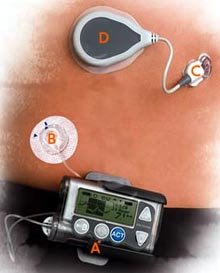
The MiniMed Paradigm® REAL-Time Insulin Pump and Continuous Glucose Monitoring System sends glucose readings every 5 minutes from a sensor to the pump. These continuous readings allow a user to monitor their glucose throughout the day. The system includes an alarm that vibrates or sounds when blood glucose is too high or too low, especially useful when sleeping. Action can be taken to improve glucose levels after a fingerstick confirmation.
 "Integrating an insulin pump with REAL-Time CGM is a major step toward the development of a “closed-loop” insulin delivery system that may one day mimic some functions of the human pancreas."
- Medtronics press release
MiniMeds REAL-Time System is shown at right:
A - Insulin pump
B - Insulin delivery
C - Glucose sensor
D - Transmitter
If youre interested in just continuous glucose monitoring (CGM) without a pump, MiniMed currently sells the Guardian® RT CGM System.
Or you can buy the MiniMed Paradigm 522/722 insulin pump and use it without the glucose monitoring system. Later, if you decide to try continuous monitoring, you can purchase the REAL-Time Continuous Glucose Monitoring Kit, designed to be used with those pumps. The monitoring kit should be available this summer.
For Medtronics press release:
Medtronic Receives FDA Approval for Worlds First Insulin Pump with Real-Time Continuous Glucose Monitoring
FDA Approves Inhaled Insulin In Stores By Summer
Sunday, January 26, 2014
The FDA yesterday approved Exubera®, the powered inhalable insulin developed by Pfizer and Sanofi-Aventis, for the treatment of diabetes. (Pfizer since acquired sole worldwide rights.)
 Inhaled insulin is a breakthrough for the drugs administration which until now required injection - by needle, pen, or pump. Insulin cannot be taken orally since the protein is broken down by digestive enzymes. Exubera is designed to enter the lungs though the mouth via an inhaler, originally designed by Nektar Therapeutics (shown).
Inhaled insulin has the potential to ease the burden of injection, but there are a few caveats:
Exubera should be available by prescription this summer. Pfizer has posted the following hotline for consumers or health care providers whod like more information: 1-800-EXUBERA.
________
FDA Press release:
FDA Approves First Ever Inhaled Insulin Combination Product for Treatment of Diabetes
Pfizer press release:
Pfizer Receives FDA Approval for Exubera, the First Inhalable Form of Insulin for Controlling Type 1 and Type 2 Diabetes in Adults
Some news summaries:
US Regulators Approve Insulin in Inhaled Form
FDA Approves Inhaled Insulin for Diabetics
 Inhaled insulin is a breakthrough for the drugs administration which until now required injection - by needle, pen, or pump. Insulin cannot be taken orally since the protein is broken down by digestive enzymes. Exubera is designed to enter the lungs though the mouth via an inhaler, originally designed by Nektar Therapeutics (shown).
Inhaled insulin has the potential to ease the burden of injection, but there are a few caveats:
- Its not recommended for smokers, those with asthma, bronchitis, emphysema, or other unstable lung conditions.
- Currently, it can only replace the short-acting, bolus dose of insulin. If a longer-acting basal dose is needed, that would need to be injected.
"Exubera would cost between $120 and $150 a month, roughly comparable to the price of pills taken by some people with Type 2 diabetes but about three times the price of injectable insulin."
Exubera should be available by prescription this summer. Pfizer has posted the following hotline for consumers or health care providers whod like more information: 1-800-EXUBERA.
FDA Press release:
FDA Approves First Ever Inhaled Insulin Combination Product for Treatment of Diabetes
Pfizer press release:
Pfizer Receives FDA Approval for Exubera, the First Inhalable Form of Insulin for Controlling Type 1 and Type 2 Diabetes in Adults
Some news summaries:
US Regulators Approve Insulin in Inhaled Form
FDA Approves Inhaled Insulin for Diabetics
Understand Diabetes Diet Chart Glucose Blood Meters and Insulin Pumps
Sunday, January 12, 2014
According to a research, it has been proved that about 4.5 million people in India are victims of diabetes. The major reason behind this is irregular meal, stress, and a sedentary lifestyle. The disease is basically associated to metabolic wherein carbohydrates oxidation and glucose is not completely detected.
How important is a Diabetes Diet Chart for patients to lead healthy and happy life?
Meal plan of diabetic patient plays crucial role in maintaining blood glucose levels in the body. The doctor plans a diabetes diet chart based on the gender, age, weight, height, working, and lifestyle of the patient.
Most foods taken by the patient are converted into a type of sugar known as glucose during digestion. The bloodstream carries glucose through the body. Insulin, the hormone converts glucose into quick energy. It may even store it further use. In case, of a diabetic, the body is either incapable of making enough insulin or use it correctly. This is also the reason too much glucose is accumulated in the bloodstream.
When preparing a diabetes diet chart, the doctor usually guides patient on certain foods to avoid and those to include daily. Some of the most common foods a diabetic (both Type I and Type II) must avoid include excess amounts of salt, sugar, fats, red meat, conventional tea and coffee (not more than twice a day), high fat cheese, white flour and products made from white flour, whole milk, foods with a high glycemic index, white rice, potatoes, carrots, breads and banana.
The best foods to invite in your daily diet regime include lean fish, low fat milk, low fat yogurt, low fat cottage cheese, herbal teas, whole grains, whole wheat, soya breads, unpolished rice, bitter gourd juice, fenugreek seeds, Indian blackberry (jamun), garlic, onion, flaxseed, fibre, and antioxidants (green tea).
Apart from following a healthy diet, it is important for diabetics to check blood sugar levels regularly. This is possible via using certain devices such as insulin pumps, glucometers, and strips.
Understanding Insulin Pumps
The insulin pump is a special device for continuous insulin delivery. It comprises of a pump reservoir similar to that of an insulin cartridge, a computer chip, and AAA battery-operated pump. It facilitates user to control the precise amount of insulin being delivered.
Glucose Blood Meters
A glucometer is a technologically advanced medical device for determining the estimated concentration of glucose in the blood. It is a key ingredient of home blood glucose monitoring (HBGM) by diabetics mellitus or hypoglycemia.
For more knowing about Diabetes Diet click here
Subscribe to:
Posts (Atom)


