Showing posts with label pain. Show all posts
Showing posts with label pain. Show all posts
10 Ways to Manage Low Back Pain at Home
Wednesday, April 23, 2014
Perhaps you bent the wrong way while lifting something heavy. Or youre dealing with a degenerative condition like arthritis. Whatever the cause, once you have low back pain, it can be hard to shake. About one in four Americans say theyve had a recent bout of low back pain. And almost everyone can expect to experience back pain at some point in their lives.
Chill it. Ice is best in the first 24 to 48 hours after an injury because it reduces inflammation, says E. Anne Reicherter, PT, DPT, PhD, associate professor of Physical Therapy at the University of Maryland School of Medicine. "Even though the warmth feels good because it helps cover up the pain and it does help relax the muscles, the heat actually inflames the inflammatory processes," she says. After 48 hours, you can switch to heat if you per. Whether you use heat or ice -- take it off after about 20 minutes to give your skin a rest.
Keep moving. "Our spines are like the rest of our body -- theyre meant to move," says Reicherter. Keep doing your daily activities. Make the beds, go to work, walk the dog. Once youre feeling better, regular aerobic exercises like swimming, bicycling, and walking can keep you -- and your back -- more mobile. Just dont overdo it. Theres no need to run a marathon when your back is sore.
Stay strong. Once your low back pain has receded, you can help avert future episodes of back pain by working the muscles that support your lower back, including the back extensor muscles. "They help you maintain the proper posture and alignment of your spine," Reicherter says. Having strong hip, pelvic, and abdominal muscles also gives you more back support. Avoid abdominal crunches, because they can actually put more strain on your back.
Stretch. Dont sit slumped in your desk chair all day. Get up every 20 minutes or so and stretch the other way. "Because most of us spend a lot of time bending forward in our jobs, its important to stand up and stretch backward throughout the day," Reicherter says. Dont forget to also stretch your legs. Some people find relief from their back pain by doing a regular stretching routine, like yoga.
Think ergonomically. Design your workspace so you dont have to hunch forward to see your computer monitor or reach way out for your mouse. Use a desk chair that supports your lower back and allows you to keep your feet planted firmly on the floor.
Watch your posture. Slumping makes it harder for your back to support your weight. Be especially caul of your posture when lifting heavy objects. Never bend over from the waist. Instead, bend and straighten from the knees.
Watch your weight. Use diet and exercise to keep your weight within a healthy range for your height. Being overweight puts excess stress on your spine.
Try an over-the-counter pain reliever. Anti-inflammatory drugs such as ibuprofen (Advil, Motrin), naproxen (Aleve, Naproxyn), and aspirin can help reduce back pain and swelling. Acetaminophen (Tylenol) is another over-the-counter option for pain management. Be sure to check with your doctor or pharmacist about any interactions over-the-counter pain relievers may have with other medications you are taking. People with a history of certain medical conditions (such as ulcers, kidney disease, and liver disease) should avoid some medicines
Sometimes it’s clearly serious: You were injured, or you feel numbness, weakness, or tingling in the legs. Call the doctor, of course. But for routine and mild low back pain, here are a few simple tips to try at home.
Chill it. Ice is best in the first 24 to 48 hours after an injury because it reduces inflammation, says E. Anne Reicherter, PT, DPT, PhD, associate professor of Physical Therapy at the University of Maryland School of Medicine. "Even though the warmth feels good because it helps cover up the pain and it does help relax the muscles, the heat actually inflames the inflammatory processes," she says. After 48 hours, you can switch to heat if you per. Whether you use heat or ice -- take it off after about 20 minutes to give your skin a rest.
Keep moving. "Our spines are like the rest of our body -- theyre meant to move," says Reicherter. Keep doing your daily activities. Make the beds, go to work, walk the dog. Once youre feeling better, regular aerobic exercises like swimming, bicycling, and walking can keep you -- and your back -- more mobile. Just dont overdo it. Theres no need to run a marathon when your back is sore.
Stay strong. Once your low back pain has receded, you can help avert future episodes of back pain by working the muscles that support your lower back, including the back extensor muscles. "They help you maintain the proper posture and alignment of your spine," Reicherter says. Having strong hip, pelvic, and abdominal muscles also gives you more back support. Avoid abdominal crunches, because they can actually put more strain on your back.
Stretch. Dont sit slumped in your desk chair all day. Get up every 20 minutes or so and stretch the other way. "Because most of us spend a lot of time bending forward in our jobs, its important to stand up and stretch backward throughout the day," Reicherter says. Dont forget to also stretch your legs. Some people find relief from their back pain by doing a regular stretching routine, like yoga.
Think ergonomically. Design your workspace so you dont have to hunch forward to see your computer monitor or reach way out for your mouse. Use a desk chair that supports your lower back and allows you to keep your feet planted firmly on the floor.
Watch your posture. Slumping makes it harder for your back to support your weight. Be especially caul of your posture when lifting heavy objects. Never bend over from the waist. Instead, bend and straighten from the knees.
Wear low heels. Exchange your four-inch pumps for flats or low heels (less than 1 inch). High heels create a more unstable posture, and increase pressure on your lower spine. According to research, nearly 60% of women who consistently wear high-heeled shoes complain of low back pain.
Kick the habit. Smoking can increase your risk for osteoporosis of the spine and other bone problems. Osteoporosis can lead to compression fractures of the spine. One study found that smokers are about a third more likely to have low back pain compared with nonsmokers.Watch your weight. Use diet and exercise to keep your weight within a healthy range for your height. Being overweight puts excess stress on your spine.
Try an over-the-counter pain reliever. Anti-inflammatory drugs such as ibuprofen (Advil, Motrin), naproxen (Aleve, Naproxyn), and aspirin can help reduce back pain and swelling. Acetaminophen (Tylenol) is another over-the-counter option for pain management. Be sure to check with your doctor or pharmacist about any interactions over-the-counter pain relievers may have with other medications you are taking. People with a history of certain medical conditions (such as ulcers, kidney disease, and liver disease) should avoid some medicines


Important Muscle Pain Treatment
Friday, April 11, 2014
Important, Muscle Pain Treatment | Pain by the common people regarded as trivial and treated potluck. In fact, chronic pain can worsen health.
It is delivered by Aida Tantri of the Department of Anesthesia and Intensive Care, Faculty of Medicine RSCM Jakarta, Saturday (10/3), the International Forum on Pain Management held Joint Commission International (JCI), institutional providers of health care accreditation and certification, as well as pharmaceutical companies Pfizer Indonesia.
Chronic pain has become a major health problem especially in the Asia Pacific region. This disorder affects one in five adults worldwide. Chronic pain is predicted to be one of the critical health issues in the Asia Pacific region with increases in the elderly population.
Unfortunately, the disease is often overlooked because of a lack of understanding of the community. In fact, chronic pain can limit the quality of life and well-being of patients and can drastically heavy burden on the health care system, Aida explained.
Acute pain is usually considered a symptom of disease or injury. Chronic pain in the long term or after an injury or disease difficult to cure. In this case, the pain becomes chronic health problems that are specific, physiological and psychosocial related problems.
Chronic pain can worsen the quality of life for patients because it would reduce the ability to work, cause sleep disturbances, anxiety, frustration, and depression, lack of appetite, increased susceptibility to disease, have a negative impact on the attitudes and lifestyles, as well as dependence on drugs and medical care.
Postoperative survey data at the RSCM, according to Aida, showing persistent pain experienced by 16.6 percent of patients. Degree of pain perceived weight 16.67 per cent of patients, pain was 41.7 percent, and the remainder mild pain.
Chronic pain often associated with diabetes, cancer, HIV / AIDS, and depression. In addition, also associated with diseases of old age, such as shingles, arthritis, back pain, and muscle aches. "Its time to educate patients, health professionals and the public about the need to reduce chronic pain and prolonged pain," says Aida.
Reduce and cope with pain is an important goal for medical personnel. Controlling pain can help patients to recover more quickly. "In addition, reducing the risk of complications after surgery, such as pneumonia and blood clots," said Paul Chand, Managing Director of JCI Asia Pacific. In JCI, pain management becomes an integral part of the accreditation process for safety and quality of patient care.
To improve the quality of pain management and hospital management, the Government of Indonesia in cooperation with Dow and Pfizer Indonesia to improve the quality of management in the hospital.
Health providers and local hospitals or the prevention protocol introduced effective pain management. During this time, monitoring of medical conditions is performed by measuring height and weight as well as a variety of vital indications of health conditions, such as blood pressure, pulse, respiratory rate, and body temperature.
JCI international forum aimed advise physicians to evaluate and improve disease management procedures and implementation of international standards of health care in Indonesia.
In Indonesia, in cooperation with JCI Ministry of Health and public health agencies to evaluate and improve patient care, said Chairul Radjab Nasution, Director of the Ministry of Health Reference Health Efforts. [kompas]
It is delivered by Aida Tantri of the Department of Anesthesia and Intensive Care, Faculty of Medicine RSCM Jakarta, Saturday (10/3), the International Forum on Pain Management held Joint Commission International (JCI), institutional providers of health care accreditation and certification, as well as pharmaceutical companies Pfizer Indonesia.
Chronic pain has become a major health problem especially in the Asia Pacific region. This disorder affects one in five adults worldwide. Chronic pain is predicted to be one of the critical health issues in the Asia Pacific region with increases in the elderly population.
Unfortunately, the disease is often overlooked because of a lack of understanding of the community. In fact, chronic pain can limit the quality of life and well-being of patients and can drastically heavy burden on the health care system, Aida explained.
Acute pain is usually considered a symptom of disease or injury. Chronic pain in the long term or after an injury or disease difficult to cure. In this case, the pain becomes chronic health problems that are specific, physiological and psychosocial related problems.
Chronic pain can worsen the quality of life for patients because it would reduce the ability to work, cause sleep disturbances, anxiety, frustration, and depression, lack of appetite, increased susceptibility to disease, have a negative impact on the attitudes and lifestyles, as well as dependence on drugs and medical care.
Postoperative survey data at the RSCM, according to Aida, showing persistent pain experienced by 16.6 percent of patients. Degree of pain perceived weight 16.67 per cent of patients, pain was 41.7 percent, and the remainder mild pain.
Chronic pain often associated with diabetes, cancer, HIV / AIDS, and depression. In addition, also associated with diseases of old age, such as shingles, arthritis, back pain, and muscle aches. "Its time to educate patients, health professionals and the public about the need to reduce chronic pain and prolonged pain," says Aida.
Reduce and cope with pain is an important goal for medical personnel. Controlling pain can help patients to recover more quickly. "In addition, reducing the risk of complications after surgery, such as pneumonia and blood clots," said Paul Chand, Managing Director of JCI Asia Pacific. In JCI, pain management becomes an integral part of the accreditation process for safety and quality of patient care.
To improve the quality of pain management and hospital management, the Government of Indonesia in cooperation with Dow and Pfizer Indonesia to improve the quality of management in the hospital.
Health providers and local hospitals or the prevention protocol introduced effective pain management. During this time, monitoring of medical conditions is performed by measuring height and weight as well as a variety of vital indications of health conditions, such as blood pressure, pulse, respiratory rate, and body temperature.
JCI international forum aimed advise physicians to evaluate and improve disease management procedures and implementation of international standards of health care in Indonesia.
In Indonesia, in cooperation with JCI Ministry of Health and public health agencies to evaluate and improve patient care, said Chairul Radjab Nasution, Director of the Ministry of Health Reference Health Efforts. [kompas]
Walking Away from Back Pain
Thursday, April 10, 2014
Home aerobic program as effective as clinical therapy in treating lower back pain, finds TAU researcher
Lower back pain is a common complaint, and treatment often requires many hours of physical therapy over multiple weekly clinic visits — a costly commitment. Now Dr. Michal Katz-Leurer of Tel Aviv Universitys Stanley Steyer School of Health Professions at the Sackler Faculty of Medicine says that a simple aerobic walking program is as effective in alleviating lower back pain as muscle strengthening programs that require specialized equipment in rehabilitation clinics. The program includes walking two to three times a week for a period of 20 to 40 minutes.
Dr. Katz-Leurer and her colleague Ilana Shnayderman, a graduate student at the Department of Physical Therapy and a practicing physiotherapist at Maccabi Health Care, say that their treatment option fits easily into a daily routine and allows those with back pain to be more responsible for their own health.
Their study was published in the journal Clinical Rehabilitation.
According to Dr. Katz-Leurer, research has shown that when people walk actively, abdominal and back muscles work in much the same way as when they complete exercises that target these areas. And unlike muscle strengthening programs, which often call for specific equipment and can involve exercises that require expert supervision, walking is a simple activity that can be done alone.
For the study, the researchers recruited 52 patients with lower back pain to participate in a randomized control trial. Through questionnaires, they were initially assessed for pain levels, feelings of disability, and avoidance of daily activities, as well as muscle and walking endurance.
Then, half of the participants completed a typical clinic-based muscle strengthening program, with two to three exercise sessions a week for six weeks. The other half completed a six-week aerobic walking program, walking two to three times weekly. Participants started with 20 minutes of walking, then progressed to 40 minutes as their endurance improved.
Results showed that both groups improved significantly in all areas of assessment, demonstrating that the walking program was "as effective as treatment that could have been received in the clinic," says Dr. Katz-Leurer.
The path to a healthier lifestyle
Dr. Katz-Leurer says that the walking program has the additional advantage of encouraging patients to follow a healthier lifestyle overall. In terms of physical fitness, those in the walking group were able to walk an average of 0.05 miles farther during a six-minute walking test at the end of the program compared to the pre-program assessments.
She also notes that that regularly active people are less likely to suffer typical aches and pains over their lifetime. Walking, a low-impact activity, also lowers blood pressure, boosts brain and immune system functioning, and reduces stress, she says.
6 Types of stomach pain and how to cope
Tuesday, March 25, 2014
6 Types of stomach pain and how to cope - Abdominal pain is not always caused by food consumption, because many unexpected that causes abdominal pain. To treat abdominal pain, not random drug in a drink can. You have to know the cause of abdominal pain first, then you can do the proper treatment.
As quoted from Good Housekeeping, you should know the types of stomach pain and how to find out as below.
1. Bloating
Abdominal bloating, stomach means you are full of air. Flatulence so quickly subsides, you have to walk a lot to overcome the pain caused by the bloated stomach. With eating and chew food slowly, flatulence will not come your way.
2. Heartburn
Heartburn occurs when stomach (and usually to the chest) burning feeling. This occurs because the stomach acids back up into the esophagus. To fix this you can take heartburn medications that are sold in the market so that the condition is not getting worse. How to prevent heartburn is not attacking the stomach, the recommended 2-3 hours after eating is allowed to lie. That way, the food has been entered into the intestine and no longer accumulate in the abdomen.
3. Constipation
Constipation suffered by most humans. Constipation is caused by the food we eat less fiber, as well as lack of drinking water. To overcome constipation, many-many consumption of foods containing fiber, such as fruits and multiply also drinking water.
4. Diarrhea
Diarrhea is caused by the foods we eat contain germs. When you have diarrhea, we would often go to the bathroom, and make the body become dehydrated. To prevent diarrhea, wash hands and food that will be consumed.
5. Often fart
Fart that happens because the body is not much wind but due to lactose intolerance or dairy allergies. The fix is to drink coffee. If you already know has an allergy to milk, you should limit consumption of these beverages.
6. Menstrual pain
For women, some of them feel pain in the abdomen when menstruating. If this is the case, you can compress the stomach with warm water, increase the consumption of milk, and foods that contain magnesium and iron to replace lost nutrients from the blood.
If the above is you do, and the problem is not resolved, contact your doctor immediately. Thus the types of stomach pain and how to cope and hopefully useful.
As quoted from Good Housekeeping, you should know the types of stomach pain and how to find out as below.
1. Bloating
Abdominal bloating, stomach means you are full of air. Flatulence so quickly subsides, you have to walk a lot to overcome the pain caused by the bloated stomach. With eating and chew food slowly, flatulence will not come your way.
2. Heartburn
Heartburn occurs when stomach (and usually to the chest) burning feeling. This occurs because the stomach acids back up into the esophagus. To fix this you can take heartburn medications that are sold in the market so that the condition is not getting worse. How to prevent heartburn is not attacking the stomach, the recommended 2-3 hours after eating is allowed to lie. That way, the food has been entered into the intestine and no longer accumulate in the abdomen.
3. Constipation
Constipation suffered by most humans. Constipation is caused by the food we eat less fiber, as well as lack of drinking water. To overcome constipation, many-many consumption of foods containing fiber, such as fruits and multiply also drinking water.
4. Diarrhea
Diarrhea is caused by the foods we eat contain germs. When you have diarrhea, we would often go to the bathroom, and make the body become dehydrated. To prevent diarrhea, wash hands and food that will be consumed.
5. Often fart
Fart that happens because the body is not much wind but due to lactose intolerance or dairy allergies. The fix is to drink coffee. If you already know has an allergy to milk, you should limit consumption of these beverages.
6. Menstrual pain
For women, some of them feel pain in the abdomen when menstruating. If this is the case, you can compress the stomach with warm water, increase the consumption of milk, and foods that contain magnesium and iron to replace lost nutrients from the blood.
If the above is you do, and the problem is not resolved, contact your doctor immediately. Thus the types of stomach pain and how to cope and hopefully useful.
Prevent Foot Pain youll sail through life with comfortable pain free feet
Tuesday, March 4, 2014
Foot pain isnt normal. Here are six ways to prevent it.
1. Pay Attention to Hygiene and Pedicures
Feet are easy to ignore, especially in cooler months when theyre often in closed-toe shoes or boots. But a little attention can go a long way toward comfort, Frisch says.Make sure you cut toenails straight across" to avoid ingrown nails, Frisch says.
Moisturize dry skin on the foot when its cracked to keep feet comfortable, Frisch says, and to help ward off infections when bacteria enter through cracked skin.
"If you go to a pedicurist, be sure the shop is clean and take your own tools," Frisch says. Pedicure tools are widely sold at beauty supply stores and at some nail salons.

2. Be Alert to Age-Related Changes
Expect your foot to change as the years go by, Frisch says. Although the timing varies from person to person, changes in the 40s and 50s are typical, he says."With age, we lose some of our fat pads [on the bottom of the foot] and cushioning," Frisch says. That might mean wearing sturdier shoes, he says.
Arthritic changes can set in, Frisch says. The toes may bend or contract more, and the nails may be thicker, making you more prone to ingrown toenails.
Be alert for problems such as hammertoes, in which the middle joint bends down and the toes begin to look deformed; or for bunions, bony bumps at the base of the big toe that can be painful. These conditions may appear or worsen with age.
"Foot size can change as you get older," Frisch says. Generally feet get longer and wider as the tendons loosen, he says. Dont be surprised if your shoe size changes, and be sure to get feet measured when you buy shoes.
3. Wear Shoes That Fit -- and Match Your Activity

Sizing for shoes has become less standardized, Frisch says. That means you may be a size 7 in one shoe and a smaller or larger size in another.
"Measure your feet every time you get shoes," Frisch says. Buy shoes at the end of the day, because your feet tend to swell as the day progresses.If you are buying athletic shoes for walking, running, or other workouts, buy the appropriate shoe for the activity, Ross says. Walking shoes, for instance, have different features than do running shoes.
Next, pick the shoe thats best for any foot problem you have. For instance, if you are an overpronator -- your feet roll inward too much -- you should consider motion control shoes, Ross says.
If you read the marketing information that accompanies athletic shoes, Ross says, you can educate yourself about features the shoe has that you may need.
4. Give Your Arches the Support They Deserve
Foot specialists talk about the importance of proper arch support, but how can you tell, besides eyeballing your foot and guessing whether your arch is flat, high, or normal?You can ask your foot doctor to take a look, or you can evaluate your arches at home, Frisch says.
Take a brown paper bag, wet your foot, and put your foot [down] on it," Frisch says. "If you see just [mostly] the heel and the toes and a big gap, you have a high arch."
If you see a wide footprint, all filled in, your foot is probably flat, and needs more support than other types of arches.
"A flat foot needs the most [support]," Frisch says. If yours is flat, you might consider over-the-counter orthotic arch supports, he says. If those dont keep your feet comfortable, ask a foot doctor about custom orthotics, Frisch says. Theyre made to fit just your foot, and sometimes give better results.
5. Reconsider the Stilettos and Flip-Flops continued...
Ross, too, concedes that very occasional high heel wear is probably OK, but only up to a two-inch heel.Why not a higher heel? "It may look great and sexy, but its very hard on the feet," Frisch says. The higher the heel, the more pressure it put on the balls of the feet. Wearing high heels also becomes more uncomfortable with age, he says, because of foot changes such as loss of the fatty pads on the bottom of the feet.
If you notice friction points, areas that become irritated when you wear high-heeled shoes, put a bandage on ahead of time to cut down on the friction, Frisch suggests. Often, the friction point is the pinkie toe, especially in closed-toe shoes, or the heel, he says.Flip-flops are another point of contention with foot specialists. Skip the flip-flops," Ross says. Thats especially true, he says, if you overpronate. "Your feet will roll in even more," if you have a flip-flop habit. "There is no protection, there is no support, there is no stability."
When pressed, Ross says occasional flip-flop wear may be OK for dedicated lovers of the shoe style -- but only if you are not doing a lot of walking."
For those who cant give up their flip-flops, Frisch suggests considering the flip-flop styles with built-in arch support. Manufacturers note the arch support feature prominently.
6. Pick Your Baoot Moments

But its easier to have an accident when baoot," Frisch says. You can easily step on something, especially outdoors, or stub your toe on furniture indoors.
People with healthier, pain-free feet are safer going baoot than people with foot problems, Ross says. If your foot still has an adequate fat pad and no calluses, its OK sometimes, he says. But if you have foot problems to begin with, he advises against going baoot.
Consider the environment when deciding whether to go baoot, Ross says. In a health club, for instance, you may be risking a fungal infection if you shed shoes and socks.
Natural Medicines Joint Pain
Wednesday, February 12, 2014

Joint pain is a disease that usually appears at the age of 45 years and older, especially in women. Joint pain caused by inflammation of the joint cartilage. There are different kinds of arthritis, however, the most common is osteoarthritis. Osteoarthritis is a chronic disease that attacks the cartilage in the joints and surrounding tissues with symptoms of pain, stiffness, and loss of function of the joints.
Natural Joint Pain Medication List
Heres a list of natural remedies used to cure joint pain.
1. Cod liver oil, omega-3 acids contained in cod liver oil has benefits to reduce the pain and inflammation of arthritis.
2. Warm water immersion and salt, this will help to increase blood flow and help relieve joint pain.
3. Bananas good for joint pain as it will help in lubricating joints and rich in potassium and vitamin B6, which can reduce pain
4. Garlic, garlics active ingredients are sulfur compounds that not only inhibits joint inflammation but also stimulates the synthesis of a protein called collagen.
5. Honey is known strongly to fight inflammation in the body, can handle the pain and inflammation associated with arthritis
6. Cinnamon is known for its ability to inhibit inflammation in the body to eliminate free radicals and toxins that accumulate in and around the joints and relieve pain, swelling and stiffness in the joints.
7. Make a habit of eating nutritious foods that contain omega-3 and vitamin and drink enough water
If excess weight is good to lose weight so that the joints do not accept the load is too heavy.
Check and konsulatasi medicine to get certainty about the disease you have. maintain health with a healthy lifestyle can be a good option to avoid the disease.
Lower back pain exercise
Wednesday, January 29, 2014
Low back pain can occur to frequent computer users who spend long hours at a same position. Frequent bikers can also be a victim of back pain if they are riding a bike with poor shock absorbers. Also there are a lot of peoples doing routine type of work daily so muscles get stressed out and can easily catch strain. Muscular strains are among the most common physical problems we face, mostly 4 out of 5 Americans can suffer from lower back pain because of muscular strain.
However, you should not perform these exercises while you are experiencing severe lower back pain. Check with your doctor before beginning any of these exercises.Trunk Flexing Stretch
Regular stretching exercises can help prevent all types of muscular strains and can prevent back pain. Computers surfers can follow workplace workouts to avoid lower back pain and stress. The following exercises can help you prevent muscle strains in the future, or help you recover from existing ones.
However, you should not perform these exercises while you are experiencing severe lower back pain. Check with your doctor before beginning any of these exercises.
 |
- On hands and knees, tuck in chin and arch back.
- Slowly sit back on heels, letting shoulders drop toward the floor
- Keep the back relaxed.
- Hold for 45 to 60 seconds.
- Release. Repeat 2 times.
- Do once per day.
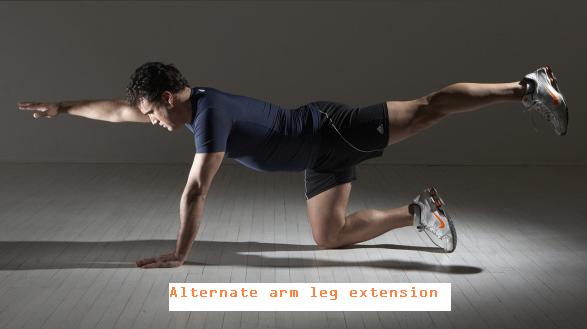 |
- Face floor on hands and knees.
- Raise left arm and right leg. Do not arch neck.
- Hold for 10 seconds and release.
- Raise right arm and left leg. Do not arch neck.
- Hold for 10 seconds and release.
 |
- Lie on your stomach with your arms folded under your chin.
- Slowly lift one leg not too high without bending it, while keeping your pelvis flat on the floor.
- Slowly lower your leg and repeat with the other leg.
Prone Lumbar Extension
 |
- Begin lying on your front with your hands in a push-up position
- Slowly push your upper body off the floor by straightening your arms, but keep your hips on the floor.
- Hold for 10 seconds, then relax your arms, moving back to the floor
Pelvic Tilt Exercise

- Lie on back with knees bent, feel flat on floor, and arms at sides
- Flatten small of back against floor. (Hips will tilt upward)
- Hold for 10 to 15 seconds and release. Gradually increase your holding time to 60 seconds

- Lie on the floor on back.
- Keeping arms folded across chest, tilt pelvis to flatten back. Tuck chin into chest.
- Tighten abdominal muscles while raising head and shoulders from floor
- Hold for 10 seconds and release
- Repeat 10 to 15 times. Gradually increase your repititions
Double knee-to-chest stretch

- Lie down on back.
- Pull both knees in to chest until you feel a comfortable stretch in lower back.
- Keep the back relaxed Hold for 45 to 60 seconds.
- Release. Repeat 2 times.
- Do once per day.
You can follow these methods caully and apply them slow and steady. Always try to relax and feel comfortable before you start any kind of exercise because your mind plays a vital role in any exercise to show effect on you.
Let us know the result in comment section when you try any of these methods.
Let us know the result in comment section when you try any of these methods.
Indian scientists find syringes without pain
Saturday, January 18, 2014
Indian scientists managed to find a way without using needles to vaccinate at all.
Scientists at Kings College London for the first time demonstrated their ability to provide life-dried vaccine into the skin without the traditional needle and found this technique is strong enough to activate specific immune cells in the skin.
The technical advancements offer a potential solution to the challenge of providing a live vaccine to some resource-limited countries globally, including India, without the need for refrigeration. A cheaper alternative to syringes, will also eliminate the risk of contamination of needles and pain-free.
"We have found that it is possible to maintain the effectiveness of live vaccines by means of drying the sugar and apply it on the skin by using a micro needle. We also discovered the role of certain cells in the skin that acts as a monitoring system," said Dr. Linda Klavinskis of King College told the Times of India.
This latest discovery involves a silicone mold to make micro needles made of sugar that can be dissolved when inserted into the skin.
Scientists at Kings College London for the first time demonstrated their ability to provide life-dried vaccine into the skin without the traditional needle and found this technique is strong enough to activate specific immune cells in the skin.
The technical advancements offer a potential solution to the challenge of providing a live vaccine to some resource-limited countries globally, including India, without the need for refrigeration. A cheaper alternative to syringes, will also eliminate the risk of contamination of needles and pain-free.
"We have found that it is possible to maintain the effectiveness of live vaccines by means of drying the sugar and apply it on the skin by using a micro needle. We also discovered the role of certain cells in the skin that acts as a monitoring system," said Dr. Linda Klavinskis of King College told the Times of India.
This latest discovery involves a silicone mold to make micro needles made of sugar that can be dissolved when inserted into the skin.
5 Nutrients against muscle pain
Friday, January 10, 2014
5 Nutrients against muscle pain - You often feel muscle cramps, stiffness and pain? Of course this would be tortured and made sleeping uncomfortable. Muscle cramps can be caused by fatigue and lack of stretching, poor circulation, dehydration and certain nutritional deficiencies. Heres a great nutrients that fight cramps muscle, reported Mind Body Green.
1. Water
When you are dehydrated water disturbed electrolyte balance, and affects the nerves. The average person loses three to four cups of water per day just through sweat and urine. So make sure your body is not short of water.
2. Sodium
This substance helps to balance the body, nerve impulse generation and contraction otot.Ketika disturbed electrolyte balance, the body will begin to draw nutrients from other sources. Therefore fulfilled sodium in the body by eating certain foods like celery.
3. Calcium
This mineral nerve signals controlling muscles contracted elephantiasis. When there is little calcium, no neural signal control, and you can seizures. Calcium-rich foods include green vegetables, canned fish (with bones and in oil), and milk.
4. Magnesium
Magnesium set of adenosine triphosphate (ATP), which is a great source of energy for muscle contraction, making the muscles relax. Foods rich in magnesium include spinach, nuts and seeds, avocados, beans, soy beans, whole grains, yogurt, bananas, dried fruit and dark chocolate.
5. Potassium
This mineral plays an important role in the formation of muscle and nerve cells, and also regulate the balance of electrolytes in your body. Potassium-rich foods such as green leafy vegetables, avocados, dried apricots, bananas, yogurt, salmon, white mushrooms and a baked potato (with skin).
Consumption of five nutrients above and feel his usefulness on your muscles.
1. Water
When you are dehydrated water disturbed electrolyte balance, and affects the nerves. The average person loses three to four cups of water per day just through sweat and urine. So make sure your body is not short of water.
2. Sodium
This substance helps to balance the body, nerve impulse generation and contraction otot.Ketika disturbed electrolyte balance, the body will begin to draw nutrients from other sources. Therefore fulfilled sodium in the body by eating certain foods like celery.
3. Calcium
This mineral nerve signals controlling muscles contracted elephantiasis. When there is little calcium, no neural signal control, and you can seizures. Calcium-rich foods include green vegetables, canned fish (with bones and in oil), and milk.
4. Magnesium
Magnesium set of adenosine triphosphate (ATP), which is a great source of energy for muscle contraction, making the muscles relax. Foods rich in magnesium include spinach, nuts and seeds, avocados, beans, soy beans, whole grains, yogurt, bananas, dried fruit and dark chocolate.
5. Potassium
This mineral plays an important role in the formation of muscle and nerve cells, and also regulate the balance of electrolytes in your body. Potassium-rich foods such as green leafy vegetables, avocados, dried apricots, bananas, yogurt, salmon, white mushrooms and a baked potato (with skin).
Consumption of five nutrients above and feel his usefulness on your muscles.
Subscribe to:
Posts (Atom)


