Showing posts with label lung. Show all posts
Showing posts with label lung. Show all posts
Should Health Insurers Cover Lung Cancer Screening with Low Dose CAT Scans
Saturday, May 17, 2014
 |
| Testing for hidden early lung cancer |
More than 54,000 former and current tobacco users who looked like they were free of cancer were randomly assigned to a yearly cheapo chest x-ray vs. a yearly pricey low-radiation-dose CAT scan. Over 5 to 7 years of follow-up, the CAT scan was better at picking up early lung cancer (119 cases) which translated into a small but statistically significant survival advantage of 62 lives saved per 100,000 patient years.
Does this mean that Medicare, Medicaid and all commercial insurers should "cover" a baseline and yearly follow-up screening CAT scan for tobacco smokers at risk for lung cancer? According to actuary Bruce Pyenson and colleagues writing in the latest issue of Health Affairs, the answer may be yes.
The Disease Management Care Blog thinks the answer may still be no.
Is it being a heartless curmudgeon? Read on and decide for yourself.......
In the Health Affairs article, the authors assumed current and former tobacco smokers comprise about 30% of persons aged 50-64 years. They further assumed that about 50% of persons at risk would agree to the CAT screening exam. Based on prior studies, they estimated that 21% of the baseline scans and 7% of the follow-up yearly scans would require additional testing and figured lung cancers would be present in 0.6% and 0.2% of the baseline and follow-up scans. They used a fee rate of $247 per screening for both the scan and included the cost of a counseling session on smoking cessation.
Spread over a population, the cost of the screening would amount to 76 cents per member per month (PMPM). On a nationwide basis, there would be 130,000 additional lung cancer survivors. The cost per life-year saved in 2012 dollars would range between $11,708 and $26,016. To put things in perspective, it costs more per life-year saved to use current screening approaches to cervical cancer with pap smears (more than $50,000), colon cancer with colonoscopies ($18,000 to $29,000) and mammography ($31,000 to $51,000).
Much of the high costs of these other cancer screening procedures are the result of more persons being eligible for the testing. In the Health Affairs study, the only persons getting the scan are smokers who are at high risk.
What did the DMCB learn?
One important lesson in this study is that cancer screening is not free. Its too easy to assume that the early detection provided by mammography, colonoscopies and pap smears pays for itself. Thats simply not true. What is true is that cancer screening is good value, but itll still cost you for each life saved.
The second lesson is that good value still represents incremental cost. As a result, the 76 cents PMPM is in addition to the money already being spent by health insurers. While the extra pennies doesnt seem like a lot of money, the health insurance dollar is comprised of coverage of similarly priced goods and services, and all those pennies are continuing to add up. The DMCB thinks were getting to the point where the U.S. would need to ask what coverage of which service should be cut to pay for lung cancer screening.
Both of these issues make it unlikely that insurers will willingly include coverage of screening CAT scans in their health insurer benefit. They can also argue that it would be highly unusual to decide to cover a new screening procedure based on a single study that hasnt even been reviewed yet by the U.S. Preventive Health Services Task Force.
Last but not least, the DMCB is willing to bet that there wont be much consumer demand for coverage by insurers because of bias against the victims of tobacco-associated illnesses as well as the argument that smokers should self-pay based on the comparative cost of a years worth of cigarettes.
It remains to be seen if, under their ability to define a minimum insurance benefit as part of the Affordable Care Act, the Feds will require lung cancer screening.
Stay tuned!
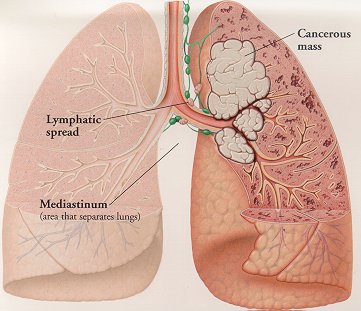
Image from Wikipedia


Milk Thistle Compound Can Stop Lung Cancer by Inhibiting Gene Expression
Monday, April 21, 2014

Lung cancer is a devastating disease with a traditionally poor survival rate less than ten percent after five years from diagnosis. There are a number of well documented triggers that cause tissue damage that eventually results in DNA damage, allowing lung cancer cells to develop and spread.
Researchers from the University of Colorado publishing in the journalMolecular Carcinogenesis found that treatment with silibinin, a major component of milk thistle effectively treated wound development in lung cancer cells that halted the disease and prevented metastasis. Long known for its rejuvenating effects on the liver, milk thistle is now emerging as a viable therapy to help prevent and reverse the damage caused by years of cellular breakdown in lung tissue and halt the spread of this deadly disease.
Milk Thistle Halts the Inflammatory Chain Known to Promote Lung Cancer Progression

Although milk thistle use has been documented for nearly 2,000 years, very little solid science exists to validate the beneficial effects on human health. Cells communicate with one another through a complex series of signals to achieve an end result, normally the creation of a protein or completion of an enzymatic reaction. When this chain is broken as a result of poor dietor lifestyle choices that affect metabolic homeostasis, diseases such as cancer are allowed to develop and manifest in tissues throughout the body.
Big Pharma frequently looks to break these chain reactions in an unnatural way to halt metabolic processes in the body, commonly with undesired or potentially deadly consequences. COX2 and iNOS are two enzymesthat are involved in a chain of actions that elicit an inflammatory response to wounds and infectious processes. If you were to cut yourself, inflammation at the local site is a desired response that will aid healing. Unfortunately, systemic inflammation caused by excess body weight and poor dietary choices is a serious problem underlying many chronic diseases including lung cancer.
Milk Thistle Compound Inhibits Genetic Expression to Help Prevent Lung Cancer

Both COX2 and iNOS aid tumor growth when they remain in circulation as a response to chronic inflammation. Two transcription factors known as STAT1 and STAT3 allow the blueprint of DNA to bind with proteins that continue the signal cascade, eventually leading to the production of harmful COX2 and iNOS. Researchers found that when chain is broken, tumor growth is halted and metastatic growth stops. They found that a derivative of milk thistle called silibinin was able to inhibit the upstream signals that lead to the expression of COX2 and iNOS to help prevent lung cancer.
Lead study authors concluded“What we showed is that STAT1 and STAT3 may be promising therapeutic targets in the treatment of lung cancer… and that naturally-derived products like silibinin may be as effective as todays best treatments.” Milk thistle represents another natural compound that provides a powerful effect to prevent and treat chronic diseases. Alternative health experts recommend supplementing with 250 mg of a standardized milk thistle extract each day to fight the threat of lung cancer.
Modest unit lung disease focused on help
Monday, March 24, 2014
Modest unit lung disease focused on help - In the previous 30 years, medication of propelled non- modest unit lung growth, critical advancement , 98% of the noteworthy stage SCLC (ED-SCLC) still expire of the sickness. Lately, organic focused on help has the possibility to enhance minor cell lung tumor to give a broader space . At present, various clinical trials devoted to research those that meddle with little unit lung malignancy natural sign transduction pathway of minor particles so as to modify the infection handle. Counting protease inhibitors (BI) bortezomib , against angiogenic pill thalidomide , bevacizumab, and an assortment of tyrosine kinase inhibitors (Tkis).
( A ) CCI-779 (temsirolimus)
2005 report , CCI-779 is m-TOR ( focus of rapamycin mammalian protein ) kinase inhibitor , m-TOR motioning on tumor units , and a mixed bag of unit capacities downstream of tyrosine kinase receptors a center part in sign transduction regulation . It is likewise a supplement sensor, control of protein union and cell burgeoning, and conform the different angiogenic cytokines antecedents . The point when CCI-779 blend with the cytoplasmic protein FKBP , can hinder the m-TOR, square intracellular indicator transduction pathways that control cell development restraint of a mixture of key protein amalgamation cycle , the unit cycle in the G1 stage were nullified , in this manner restraining tumor unit burgeoning. ED-SCLC accepted standard medicine, the average survival was 9 months. 87 instances of patients finished prompting chemotherapy (CCI-779 + CBP + Vp16) were randomized into the CCI-779 25mg and 250mg two measurement aggregations were intravenously 30 minutes once a week, until infection movement , with an average survival of 19.8 months distinctive dosage gatherings were 16.5 months and 19.8 months , PFS average 4.7 months and 6.3 months to 8.9 months. Above shows the CCI-779对treatment of SCLC have some impact , it is worth further study.
( Two ) bevacizumab
ECOG has reported 2004.6 ~ 2006.8 conveyed E3501 Phase ⅱ clinical trial of 39 evaluable selected patients getting first-line medicine were dissected broad stage SCLC , medication choices cisplatin + Vp16 + bevacizumab , which arrived at CR 4 cases , Pr23 cases, effectiveness 69% , quiet survival at 6 months was 33% . In the test aggregation did not happen > 2 degrees hemoptysis occasions.
Calgb30306 ⅱ clinical trial in 2005,3 ~ 2006,4,72 patients with untreated noteworthy stage SCLC patients as per consideration criteria included in the clinical trial system for the cisplatin + Cpt11 + bevacizumab . The outcomes did not happen > 2 degrees hemoptysis unfavorable responses. In evaluable patients , 2 instances of CR (3%), 42例pr (59%) RR was 80% , with an average survival of 10.6 months , PFS 7 months.
Genentech reports ⅱ clinical trials , patients were untreated into the aggregation s restricted SCLC, programs for the simultaneous chemoradiotherapy , chemotherapy is Cpt11 + carboplatin + bevacizumab . After the finish of chemotherapy , upkeep help with bevacizumab to six months. Passage into the study bunch , 29 patients, 2 instances of genuine antagonistic occasions happened , that tracheoesophageal fistula , one case perished subsequently . The third instance of gas aggregation and upper gastrointestinal draining, after expiration, yet for obscure explanations. The three instances of unfavorable occasions happened in the bevacizumab upkeep medicine period, and all patients with diligent esophagitis .
( Three ) VEGFR inhibitor
VEGFR tyrosine kinase channel majority of modest particle inhibitors likewise SCLC clinical trials directed in patients . Counting sorafenib , Azd2171, Sunitinib and Zd6474 et cetera.
Zd6474 in Canada, the National Cancer Research Centre (CAN-NICIL-Br20) Phase ⅱ clinical study directed in 107 patients with beforehand untreated SCLC patients after chemotherapy or radiation into the assembly , incorporating 46 instances of constrained stage , 61 cases for an extensive variety of study systems isolated into two aggregations , in particular the upkeep help, a gathering taking Zd6474, an alternate gathering of placebo , the average PFS comes about of the two gatherings and no noteworthy distinction in generally survival .
Azd2171 (Cediranib) restrain VEGFR-1, -2 and -3 tyrosine kinase phosphorylation .
2008 Ramalingam have been accounted for Azd2171 Phase ⅱ clinical trial who were selected after platinum-based chemotherapy after illness movement in SCLC, 13 patients result of Azd2171, 30mgqd, 4 weeks for a period , the average medication time of 2, the principle toxicities were weakness , loose bowels, skin rash and hypertension , viability assessment without PR, 8例sd, average Pfs8 weeks. Ailment movement after medicine , coursing endothelial cells (CEC) check expanded plasma VEGF levels expanded. Along these lines, further suggestions ought to be consolidated with chemotherapy medication.
Thalidomide has been demonstrated in probes SCLC with hostile to angiogenesis and apoptosis. 2007 Report thalidomide ⅱ clinical trials CWRU-1502, into the aggregation by broad organize SCLC, after standard chemotherapy, realized CR or PR after , and afterward enter the thalidomide upkeep help. Average survival of 13 months (95% C1 10 ~ 16 months ) , 1 -year survival 52% (95% C1 32.5 ~ 67.9 months ) .
LLCG look into report in 2007 , the Phase ⅲ clinical trial patients are noteworthy stage SCLC, randomization , research projects partitioned into two aggregations , one gathering of Vp16 + carboplatin + thalidomide , an alternate aggregation of Vp16 + carboplatin + placebo. From 2003 to 2006, 724 cases selected 365 patients randomized into the holding thalidomide , 359 cases into with the placebo bunch , the outcomes were comparable in general survival time , 2-year survival rates were 13%. The average survival was 10.2 months and 10.5 months (P0.24), PFS no distinction. In the thalidomide assembly of major antagonistic occasions pneumonic embolism and profound vein thrombosis .
Subscribe to:
Posts (Atom)


