Showing posts with label part. Show all posts
Showing posts with label part. Show all posts
Why Are Food Allergies on the Rise Part 1 GMOs
Tuesday, May 6, 2014
 If youve worked with kids lately, or if youre a new parent yourself, then Im sure you know all about this epidemic of food allergies. According to a 2011 study, 8% of American children under 18 have at least one food allergy, and that is up from 4% in 2009 (1). Peanut allergies in particular have been on the rise. In one Midwestern county, the prevalence of peanut allergies in children tripled between 1999 and 2007 (2). But you dont need numbers to realize its a problem. Just spend a day in a school cafeteria. Or a summer camp. Just enter an elementary school classroom at all and youll hear about it; the concern is clearly growing. Dairy may be the most common allergy, and it seems kids can have a reaction just looking at a peanut, but there are others to worry about as well, including wheat, eggs, soy, tree nuts, fish, and shellfish.
But it wasnt always this way. When I was a youngster, I dont recall ever hearing about another kid having a food allergy. Maybe the most I ever heard was that a classmate was lactose intolerant. But there was no mention of peanuts. Nobody had a wheat allergy. Nobody went into anaphylactic shock at the mercy of a pistachio. So what gives?? Why are food allergies exploding?
Well, sadly I dont think we know the answer to that question. Much has changed in the food and health world over the past few decades, so we have many likely culprits. Over these next few posts, Ill be exploring the options, in a sort of thinking-out-loud fashion. Excuse me if what follows turns into an incoherent mess.
Genetically Modified Organisms
This seems to be a hot topic right now. Genetically modified organisms (GMOs) are plants or animals that are created through gene splicing techniques. This merges the DNA from different species, creating a new variation of a species that wouldnt be possible through traditional crossbreeding. Example. Say biotech giant Monsanto finds a bacteria that naturally resists an herbicide like Round Up. (They did.) Then they isolate the gene that allows that bacteria to resist the pesticide, and they splice it into corn. (Again, they did.) Now they have a genetically modified strain of corn that resists Round Up. Lets call it Round-Up Ready corn. Now we can grow mass quantities of corn and spray mass quantities of Round-Up on it to kill those pesky things like weeds and bugs, while leaving the corn unaffected. Yes, believe it or not, true story.
The following foods have been approved to be genetically modified: alfalfa, canola, corn, cottonseed, papaya, soy, sugar beets, and green/yellow summer squash (3). You may say, well, thats only 8 foods, thats not that bad. But canola, corn, cottonseed, soy, and sugar beets are nearly ALWAYS genetically modified, and theyre found in nearly ALL processed food. Youd be hard-pressed to find anything in a box or a bag that doesnt contain at least one of these, just look next time youre shopping.

So how do you know if what youre eating contains GMO ingredients? Its not easy. Companies arent required by the FDA to label a product as GMO, contrary to the wishes of the American people. So if you want to know, youve gotta be a detective and read the ingredient list. Or, if you want to make it easier on yourself, you can buy organic. Any food certified organic is free of GMOs. In addition, apparently, GMO fruits and veggies must be labeled with a 5-digit code beginning with an 8, rather than the conventional 4-digit code. Ive yet to see one of these for sale, but no doubt its coming.
But the worst part... we dont even know if eating this stuff is safe. There are some people claiming that the studies have been done and theyve been swept under the rug to hide the incriminating evidence (4). Who knows if theres any truth to that. Then there was this recent study from France, showing that rats eating GMO corn developed breast cancer at a far greater rate than control rats fed non-GMO corn (5). And of course, biotech companies like Monsanto swear by their safety. Its no different than regular corn, they say.
But the fact remains... GMO foods are a science experiment. Nobody in the history of the earth has consumed anything like this, and wed be giving ourselves too much credit as scientists to say "its just the same as corn". Were not even close to understanding all the intricacies of how the human body works, let alone how a brand new franken-food is going to interact with said body. I dont think we know how much we dont know, which is why its always a good idea to default to evolutionary biology... Were designed to eat plants and animals; were not designed to eat herbicide and pesticide resistant corn. We are the subject of a science experiment, and nobody knows how its going to turn out.
But are GMOs causing food allergies?
Is it possible that the recent spike in food allergies has a link to these genetically modified foods? It sure is. The timing works perfectly... GMO foods as we know them today burst onto the scene in the late 1990s (6). Thats just enough time for families to start eating them and start popping out kids with food allergies. Theres no way to know, as of yet, just what GMOs are doing to our health. But given all that Ive said so far, it does seem a bit fishy doesnt it? Yes, fishy indeed. One thing is for sure... if I were to have kids today, GMOs would be one of the first things Id watch out for.
What are your thoughts, reader(s)? Id love to hear your opinion on GMOs.
And stay tuned for the rest of the series. Ill be discussing all kinds of fun stuff, like antibiotics, medications, and dwarf wheat. Come on back!


Historical Context Part 3 Ancel Keys
Wednesday, April 30, 2014
Ancel Keys, a University of Minnesota physiologist, deserves much of the credit for convincing the public that dietary fat and cholesterol are killers. He initially became famous through his development of the "K-ration" for feeding combat troops in World War II; the "K" stood for Keys. He then performed a series of human starvation studies and wrote the book "The Biology of Human Starvation", which made him a well-known, reputable nutrition researcher. Originally, Keys did not believe dietary fat and cholesterol had anything to do with the rising heart disease rates, but his opinion changed when he attended a conference in Rome in 1951, where he spoke with a physiologist from Naples, Italy who boasted about the lack of heart disease in his city. The diet in southern Italy was low in animal products, and the people there, especially the poor, tended to have lower cholesterol than those in the United States. The rich in Naples, however, ate more meat, and had higher cholesterol levels and heart disease rates. This convinced Keys for the first time that dietary fat from meat was driving the heart disease epidemic in the United States.
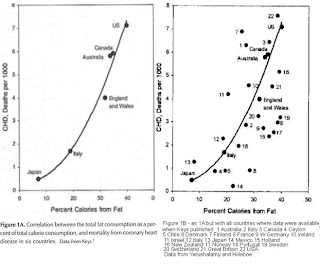
There were two key observational studies performed by Ancel Keys that ended up having an impact on the publics view of dietary fat. The first, which many researchers did not taken seriously, was the 1953 study he performed involving six countries, comparing their fat intake to their heart disease rates. The six countries he reported on (United States, Canada, Australia, UK, Italy, and Japan), showed a very strong association between fat intake and heart disease. Now, of course, this is only an observational study and no cause and effect can be determined. But the biggest problem with his study is that he left out the data from the 16 other countries for which data was available. When all 22 countries are considered, his perfect correlation turns into a much weaker one.
Initially, in 1957, the American Heart Association (AHA) opposed Ancel Keys on the diet-heart hypothesis. They wrote a 15-page report that year denouncing Keys and similar researchers for jumping to conclusions about the diet-heart hypothesis when there was no good evidence that it was true. Less than four years later, in December of 1960, the AHA flipped their stance and adopted the diet-heart hypothesis as their new philosophy on heart health, proclaiming that "the best scientific evidence of the time" strongly suggested a low-fat diet, or at least replacing saturated fats with polyunsaturated fats, is preventative of heart disease. What had changed in that four-year period? Not the evidence. There was no new evidence to either confirm or reject the diet-heart hypothesis. What had changed is that Ancel Keys and Jeremiah Stamler, another supporter of Keys, had now made up two of the six members on the AHA committee. Soon after, Ancel Keys was enshrined as the face of dietary wisdom in America in an article in Time magazine. The article discussed Keys idea of a heart-healthy diet as one in which nearly 70% of calories came from carbohydrates and just 15% from fat. Despite the fact that there was ZERO evidence from clinical trials to back up this claim, the article only contained one short paragraph explaining that Keys hypothesis was "still questioned by some researchers with conflicting ideas of what causes coronary heart disease."

The second important study done by Ancel Keys was considered to be his masterpiece, The Seven Countries Study. This study is still, today, considered to be a landmark study because of the pivotal role it played in the acceptance of the diet-heart hypothesis. Launched in 1956, Keys followed 16,000 middle-aged men for over a decade and tracked their diets and their heart-disease risk. The populations he chose came from seven countries: Italy, Yugoslavia, Greece, Finland, the Netherlands, Japan, and the United States. The results showed, again, a remarkably clear association, but this time the association was between saturated fat and heart disease. Keys drew three conclusions from this study: 1. Cholesterol levels predicted heart disease. 2. The amount of saturated fat predicted cholesterol levels and heart disease. 3. Monounsaturated fats protected against heart disease.
Seems pretty clear huh? Not quite... there are a number of problems with the study. First and foremost, this is an observational study, and like Ive said a million times, you cannot determine any causality from it. Secondly, Keys chose countries that he knew would fit his hypothesis. Had he chosen at random, he may have included countries like France or Switzerland that consume high amounts of saturated fat and have very little heart disease. Third, we know now that middle-aged men are the only population for which total cholesterol numbers can predict heart disease, and the Seven Countries Study only looked at middle-aged men. Lastly, and perhaps most importantly, Keys didnt look at total mortality, even though what we really want to know is whether or not well live longer. Coronary heart disease accounted for less than a third of deaths. He said himself in a 1984 follow-up paper, "little attention was given to longevity or total mortality." Interestingly, if all-cause death had been taken into account, Keys would have found that the American population he studied lived longer than any other population with the exception of the Crete islanders, despite their high cholesterol.
Even with all of the problems with Ancel Keys research, his findings on saturated fat and cholesterol would have a profound impact on the public due to a sort-of perfect storm of events that would eventually lead up to the first government dietary recommendations, Senator George McGoverns 1977 Dietary Guidelines for America. More on that in part 4!
There were two key observational studies performed by Ancel Keys that ended up having an impact on the publics view of dietary fat. The first, which many researchers did not taken seriously, was the 1953 study he performed involving six countries, comparing their fat intake to their heart disease rates. The six countries he reported on (United States, Canada, Australia, UK, Italy, and Japan), showed a very strong association between fat intake and heart disease. Now, of course, this is only an observational study and no cause and effect can be determined. But the biggest problem with his study is that he left out the data from the 16 other countries for which data was available. When all 22 countries are considered, his perfect correlation turns into a much weaker one.
Initially, in 1957, the American Heart Association (AHA) opposed Ancel Keys on the diet-heart hypothesis. They wrote a 15-page report that year denouncing Keys and similar researchers for jumping to conclusions about the diet-heart hypothesis when there was no good evidence that it was true. Less than four years later, in December of 1960, the AHA flipped their stance and adopted the diet-heart hypothesis as their new philosophy on heart health, proclaiming that "the best scientific evidence of the time" strongly suggested a low-fat diet, or at least replacing saturated fats with polyunsaturated fats, is preventative of heart disease. What had changed in that four-year period? Not the evidence. There was no new evidence to either confirm or reject the diet-heart hypothesis. What had changed is that Ancel Keys and Jeremiah Stamler, another supporter of Keys, had now made up two of the six members on the AHA committee. Soon after, Ancel Keys was enshrined as the face of dietary wisdom in America in an article in Time magazine. The article discussed Keys idea of a heart-healthy diet as one in which nearly 70% of calories came from carbohydrates and just 15% from fat. Despite the fact that there was ZERO evidence from clinical trials to back up this claim, the article only contained one short paragraph explaining that Keys hypothesis was "still questioned by some researchers with conflicting ideas of what causes coronary heart disease."
The second important study done by Ancel Keys was considered to be his masterpiece, The Seven Countries Study. This study is still, today, considered to be a landmark study because of the pivotal role it played in the acceptance of the diet-heart hypothesis. Launched in 1956, Keys followed 16,000 middle-aged men for over a decade and tracked their diets and their heart-disease risk. The populations he chose came from seven countries: Italy, Yugoslavia, Greece, Finland, the Netherlands, Japan, and the United States. The results showed, again, a remarkably clear association, but this time the association was between saturated fat and heart disease. Keys drew three conclusions from this study: 1. Cholesterol levels predicted heart disease. 2. The amount of saturated fat predicted cholesterol levels and heart disease. 3. Monounsaturated fats protected against heart disease.
Seems pretty clear huh? Not quite... there are a number of problems with the study. First and foremost, this is an observational study, and like Ive said a million times, you cannot determine any causality from it. Secondly, Keys chose countries that he knew would fit his hypothesis. Had he chosen at random, he may have included countries like France or Switzerland that consume high amounts of saturated fat and have very little heart disease. Third, we know now that middle-aged men are the only population for which total cholesterol numbers can predict heart disease, and the Seven Countries Study only looked at middle-aged men. Lastly, and perhaps most importantly, Keys didnt look at total mortality, even though what we really want to know is whether or not well live longer. Coronary heart disease accounted for less than a third of deaths. He said himself in a 1984 follow-up paper, "little attention was given to longevity or total mortality." Interestingly, if all-cause death had been taken into account, Keys would have found that the American population he studied lived longer than any other population with the exception of the Crete islanders, despite their high cholesterol.
Even with all of the problems with Ancel Keys research, his findings on saturated fat and cholesterol would have a profound impact on the public due to a sort-of perfect storm of events that would eventually lead up to the first government dietary recommendations, Senator George McGoverns 1977 Dietary Guidelines for America. More on that in part 4!
Food Network Liveblog Marathon Part 1 9 30am to 2 00pm
Sunday, April 13, 2014
Hi, everybody, and welcome to the Food Network Liveblog Marathon! We had such a ball doing the Biggest Loser finale last week, I figured a 19-hour running diary of Food Networks entire broadcast day would be nice way to extend the good times.
Most of this is just for fun, and to see how many ¾-sleeve sweaters I can spot, but I’ll also be keeping a close eye on how Food Network addresses the issues of health and frugality throughout the course of its normal schedule. This will involve a few holiday-oriented shows and possible multiple viewings of Paula’s Cookie Party, so don’t forget to cut ‘em some slack.
Feel free to chime in, too! I’ll be checking comments constantly, and highlighting my favorites as we go along. Criticism is good as long as its not personal or too mean. Funny is encouraged.
P.S. As with the BL Liveblog, this will go backwards, with the most recent commentary appearing up top.
1:59
On to Part II - 2:01pm to 7:00pm!
1:58
End of show.
3/4-SLEEVE SWEATERS: zero
FRUGALITY QUOTIENT: er ... pretty low
HEALTH QUOTIENT: um ... also low
VERDICT: 10/10. Its Ina, and dissent will not be tolerated.
1:57
Jeffrey is playing a trick on Ina, to make her think he ate all the food. This is cruel and unnecessary. Also, I dont know how to spell "unnecessary."
1:51
The lobster pies were just dubbed "rustic." In cooking, is "rustic" a synonym for "messy"? If so, my apartment is very rustic.
1:49
Ina wants us to place pastry dough in the fridge for 30 minutes "to chill and relax." Unmentioned: "to light up some doobage and listen to Steve Miller albums on shuffle."
1:42
She is now making lobster pot pies. I was taught to appreciate fresh-from-the-animal lobster meat from a very young age, and always hesitate to use it in any recipe. I mean, what if I mess it up? And why would I want to dilute lobster flavor? But Im going with this, Ina. I trust you. Be caul with my heart.
1:40
Ina is visiting her fishmonger. I like to picture her being personal friends with her various mongers, and at the end of every year, they all have a giant monger party. Where they mong out, presumably.
1:36
Ina is wearing a black button-down instead of her usual denim one. If youre not a regular viewer, this means nothing to you, but if you are, its a plot twist on par with The Sixth Sense.
1:34
Husband-Elect, are you reading this? If so, can we go to Inas kitchen for our honeymoon? I will let you have the Gandalf ice carving if you say yes.
1:32
Shes making chocolate gelato. For Jeffrey, of course. CURSE YOU, JEFFREY!
1:31
THE SHOW: Baoot Contessa! WOOOO!
THE HOST: the lovely Ina Garten
THE CONCEPT: incredible food served by a woman you want to hang out with ALL THE TIME
1:28
End of show.
3/4-SLEEVE SWEATERS: 0, though the sleeves of her regular sweater were rolled up
FRUGALITY QUOTIENT: high
HEALTH QUOTIENT: negative numbers
VERDICT: 7/10, for too many "yummos
1:26
On a related note, do you ever wonder if RR narrates her everyday movements when shes at home? "Well, Im goin to pick up my toothpaste like this. Awesome! Then Im going to grab my toothbrush like this. Yummo! Now Im gonna bring it up to my mouth, and run it back and forth across my teeth. All right! And we end by spitting the froth into the sink. Big finish!"
1:21
Toffee Hot Cocoa was just described as "SUPER delicious." Just once, I want a TV chef to say, "You know what? Its a broccoli recipe. It tastes slightly better than burlap, but if we dont get some veggies in our diets, well die."
1:19
Rachael is excellent at remaining upbeat. When youre makin TV, its really, really tough to turn on the cheer when youre not feeling it. But she manages. I dig that.
1:14
A haiku for Rachael:
You carry so much
but is that nutmeg ever
a burden too heavy?
1:11
Were having "ahh-some wanh-ffles" here everybody, but not before we eyeball the molasses.
1:06
Whenever RR asks us to "eyeball" something, I picture pouring the item (fennel, cloves, oil, etc.) on our actual eyeballs. This is not the intended meaning, I understand, but ... need more coffee.
1:03
Rachael is making sausage, and her accent ("sah-sidge") is making me miss my friends in Rochester and Buffalo. (*sniff*) You guys, lean ground chicken breast reminds me of you.
1:00
THE SHOW: 30-Minute Meals
THE HOST: Rachael Ray
THE CONCEPT: A nice woman from Western New York makes a meal in an unmentioned allotment of time.
12:59
End of show.
3/4-SLEEVE SWEATERS: 1 (You can always count on Giada.)
FRUGALITY QUOTIENT: medium; risotto is cheaper than you think
HEALTH QUOTIENT: pretty low
VERDICT: 10/10, for much-appreciated gratuitous use of champagne
12:57
For dessert, its Raspberry Limoncello Champagne and an Espresso Panna Cotta. Forget plain ol pregnancy. These will get you a Duggar-style reality show on TLC.
12:51
I love that PR folks think well enough of CHG to send us offers, but ... uh ... my name is Kristen. Not Christine. And I dont have kids. And I hate mayonnaise. Just sayin.
12:48
Champagne Risotto with Asparagus is Gs next date night recipe. (P.S. The theme of this show is "Date Night." Now you know.) Served with Chiarellos Peppermint Chocolate Tiramisu and Nigellas Espresso Martini, there is a 100% chance you will be pregnant by the end of the night.
12:46
This is the 37 millionth time the Le Cordon Bleu commercial is airing, and its only 12:46. If I hear, "Get your career cooking ... LITERALLY!" one more time, I will literally jump through the TV and broil that guy.
12:42
Giadas "this is so good" claw: check.
Giadas tasting O-face: check.
Still waiting for first pronunciation of "pan-CHET-tha."
12:37
Giada is frying some oysters. When shes done, they will be "sweet and tender, which is how your date will act after he eats them." I assume this means my date will also be breaded and covered in marinara sauce.
12:34
My Ma is as Irishiest of Irish ladies, but insists on pronouncing Latin and Italian foods as they would be in the native language. This means "mozzarella" is "mooz-a-dell" and "parmesan" is "parrrr-mi-jhan." Giada also does this. Giada is my Ma.
12:32
Giada starts out with panna cotta, or translated, "theres a cot in my pan."
12:31
THE SHOW: Everyday Italian
THE HOST: Giada DeLaurentiis
THE CONCEPT: Hot, talented chef makes authentic Italian dishes and funny tasting faces.
12:29
End of show.
3/4-SLEEVE SWEATERS: 0, though her blouse has shorter sleeves, yall
FRUGALITY QUOTIENT: high, yall
HEALTH QUOTIENT: super, super low, yall
VERDICT: 9/10, for gentility, yall
12:23
Gingerbread Michael (Paulas husband) has white chest hair, a mohawk, and appears to be wearing a diaper. How does Real Michael feel about this?
12:19
Edit - Paula is making gingerbread men AND women. Later, they will create gingerbread babies together, unless they use gingerbread prophylactics.
12:12
Paulas making Gingerbread Men, and "when we come back, Im gonna show you how we bring these little [guys] to life." This is going to involve lightning and tiny brain transplants, isnt it?
12:06
Analogy time!
Paula Deen is to Fantasy Grandma as George Clooney is to _______.
A) Fantasy Boyfriend
B) Fantasy Shortstop
C) Fantasy Island
12:04
How you can tell this is an early episode: wrinkles, natural lighting, no cackling, zero appearances by Bobby and Jamie. I miss the cackling, yall.
12:02
Butter count: 1 stick so far.
12:00
THE SHOW: Paulas Home Cooking
THE HOST: Paula Deen, yall!
THE CONCEPT: Today, its cookies. But most days, its butter. Just butter.
11:59
End of show.
3/4-SLEEVE SWEATERS: 0 (it was full-length)
FRUGALITY QUOTIENT: high - nothing was outrageous
HEALTH QUOTIENT: very low - I question serving some of these to kids as dinner
VERDICT: 6/10, for questionable usage of vessels
11:58
Robin blended strawberries and yogurt, and I thought for sure it was going to be a smoothie. But she poured it in a bowl, so now its a soup. If she poured it in a votive glass, would it be a candle?
11:52
Chopping montage! In general, wouldnt cooking would be much more awesome if all our chopping was set to Michael Jackson? Here, try it.
11:50
Good tip from Robin: make vinaigrettes and dressings in the bottom of the salad bowl, then toss everything afterward.
11:45
Once and for all: is cumin pronounced "keeyou-min" or "coo-min"?
11:43
Weve moved on to Mexican fondue, meaning cheese, spinach, artichokes, and salsa melted together. Im still deciding how I feel about this. Also: "take it to a whole new level" should be retired permanently, as should "outside the box."
11:36
Robin is having a tough time lifting her skillet. I can relate, having the upper body strength of a fetal chihuahua.
11:32
Robin is searing some scallops, and she just poured a dang gallon of olive oil into a large skillet. Look, I know olive oil is one of the healthier cooking fats, but 1/4 cup per serving doesnt do anyone any good. (Now getting off my high horse before I hurt myself.)
11:31
THE SHOW: Quick Fix Meals
THE HOST: Robin Miller
THE CONCEPT: Week-long dinners for busy families, with Oprah-esque theme song.
11:30
End of show. How you know: the wine comes out, and Mike changes into a red t-shirt under a charcoal grey blazer. Very Napa.
3/4-SLEEVE SWEATERS: 1/2
FRUGALITY QUOTIENT: low
HEALTH QUOTIENT: low
VERDICT: 8/10, for Peppermint Chocolate Tiramisu and general attractiveness
11:27
Why dont the Food Network hosts ever wash their own pots and pans? They should have a show made up entirely of Ina Garten and Bobby Flay doing dishes. I guarantee it would be a ratings winner.
11:23
He just poured about a cup of red wine into risotto, making it look like brains. Delicious, delicious brains. Again, the ugly/tasty paradox has been proven.
11:19
While I like Michael Chiarello, he suffers a bit from John Kerry Syndrome: you know hes totally great at what he does, but you dont necessarily want to have a beer with him.
11:15
Food Network Drinking Game, Rule #5739: Drink whenever a host claims he/she is "going somewhere," "checking the market out," or "has some errands to run" during the commercial break. We know you need more than four minutes to hit up the orchard, Chiarello.
11:13
Up next: a Peppermint Chocolate Tiramisu. I have never heard a finer collection of words. (P.S. Did you know "tiramisu" means "pick me up"? Me neither. Thanks, Mike!)
11:12
Currently, hes adding a TON of ground fennel to already fennel-heavy roast. Moderate amounts of fennel are always appreciated, but this looks like its going to taste like a bag of black licorice exploded in your mouth.
11:10
Chiarello isnt wearing a 3/4-sleeve sweater, but his pullover sleeves are rolled up to just under the elbow. Does that count?
11:09
Coffee procured! Urge to kill ... fading.
11:04
So far, this is an onion- and beet-heavy show. Not kid food, apparently. In first grade, either of those words would have thrown me into total gag lex failure.
11:01
THE SHOW: Easy Entertaining
THE HOST: Michael Chiarello
THE CONCEPT: "Formal fare in your formalwear." Clever boy.
10:59
End of show.
3/4-SLEEVE SWEATERS: a shocking 0
FRUGALITY QUOTIENT: good - salad and tamales are pretty cheap
HEALTH QUOTIENT: nada, though points for trying with the salad
VERDICT: 7/10, for gratuitous shots of blending.
10:55
Emerils jacket has remained perfectly clean through the entire show, despite making salad, mac and cheese, tamales con queso, and cheesecake. No mess at all. I would look like Pizza the Hut after a day like that.
10:52
Have you seen the ice cream sandwich bench? Its $950, though if Trading Spaces has taught me anything, you can make it at home with $15.62 and a bedsheet.
10:49
Can I tell you how much I love it when Emeril adds alcohol to recipes? Everyone in the audience cheers like crazy, as if to say, "WOO! This flan is gonna get us totally sploshed!"
10:46
Holly from Ohio is the next winner of Emerils Say Cheese contest, and she has a very, very red kitchen. Like, all her appliances and countertops are a fiery crimson. Wouldnt that make you angry when youre cooking? Like youre in Hells Kitchen? "Dont TALK TO ME when Im making CHEESECAKE, DAMMIT!"
10:43
Time for a multiple choice question! What kind of degree does Doc Gibbs have?
A) Funkiness MD
B) A PhD in smoothosity
C) A doctorate in jazz hands
D) Gastroenterology
10:40
As Emeril rolls his second tamale, I find my mind wandering to faraway places. Like Morocco. Were fez hats just decorative, or did they have a purpose? They dont shade the eyes or protect the head very well, so Im figuring they were invented for aesthetic purposes. In a related story, I think its time for some coffee.
10:37
Another ugly-but-delicious food: ried beans. We can all agree it looks like baby puke, right?
10:33
Emeril is making tamales con queso, and keeps asking for "lahwd." I wondered why he would be using the lord in his cooking, until it occurred to me that hes saying "lard."
10:32
Food Network Drinking Game, Rule #437: take a shot every time you wonder how a food show can pay for a full band. Youll be sploshed inside an hour.
10:30
Re: Emerils accent. Hes from Boston, right? Because it sounds so Brooklyn sometimes, I imagine him selling me knockoff sunglasses on the corner by the Halal Chinese Food place.
10:27
Emeril is stirring white-gray crabmeat into a yellow-gray macaroni and cheese mixture. You know that scene in Empire Strikes Back, when Han makes Luke a bed out of TonTon intestines? It looks like that. Which is okay, because sometimes ugly food is the best food. (See: eggplant.)
10:23
Bathroom dilemma, solved. Thank god for commercials. Did you guys need to know that? Also of note: my computer is resting on a hummus tub so the bottom wont overheat. In Brooklyn, we work with what we have, folks.
10:20
Augh! The vertical rotisserie ad is back so "Dad" can school us some more. I think Ive found my nemesis for the day.
10:18
Emeril is both a "spoon guy" and a "whisk fan." Can you be both? Is that like rooting for the Yankees and the Mets?
10:16
Emeril is running a "Say Cheese" recipe contest. Pam from Maryland is a winner, and she reminds me of every nurse or teachers assistant Ive ever met. Pam is using crab in her macaroni and cheese, which "kicks [it] up to notches unknown." NOTCHES UNKNOWN.
10:11
Speaking of golf, what happens now that Tiger is in the permanent doghouse? I imagine curling will finally have its day as THE sport for people who dont like sudden movements.
10:08
Were watching a split screen of the blonde mom and Emeril blending a dressing. Its still more interesting than golf.
10:06
First tip, from an at-home video segment with a blonde mom: "Never walk away from your pine nuts." Truer words, never spoken. How many times have I set them to toast and sniffed the air three minutes later all like, "Whats burning?"
10:05
The theme of the show is cheese. I can get behind this.
10:00
THE SHOW: Emeril Live!
THE HOST: Emeril Lagasse
THE CONCEPT: The godfather of TV cheffery hosts a cooking show in front of a live audience, says "BAM" a lot. Theres a band, too.
9:58
Nigella ends the show scarfing potatoes on a crimson couch by a roaring fire, while angels play smooth jazz in the background. This is a Luther Vandross video.
3/4-SLEEVE SWEATERS: 1
FRUGALITY QUOTIENT: nothing too expensive here
HEALTH QUOTIENT: Well let it slide. Its a Christmas show.
VERDICT: 10/10, for sexiness
9:54
Were up to fully loaded baked potatoes. Cooked by candlelight, naturally. Ive never been attracted to a potato before today, but somehow, Nigella is making them look sexy. Maybe because she just "splodged" them with sour cream, and now - I swear to god - is "forking them together."
9:52
Its not even time for Price is Right, and Nigellas guests are eating Christmas tree cakes and getting sploshed on espresso martinis. I want to go to there.
9:50
Her strata is (direct quote): "Like a toasted cheese sandwich, but a celestial one, as if eaten by angels." If heaven is filled with grilled cheese sandwiches, I will feel a lot better about death.
9:47
Unconsidered when planning 19-hour blogging marathon: when do I go to the bathroom?
9:45
Nigellas cake batter is "perfectly plain, but anything but austere." Husband-Elect just kissed me goodbye and went to work. Are these related somehow?
9:43
A Nigella haiku:
Oh, metric system
You make baking funny with
your grams and liters
9:40
"Let Dad school you with a vertical rotisserie." is a sentence I never hoped to hear, in a commercial or otherwise.
9:37
This entire show is candlelit and set to saxophone jazz. I think Food Network is trying to seduce me.
9:35
Nigellas casual vocabulary is my favorite. Shes making jam, and has described it as "fiery crimson" and "volcanically boiling." This is the stuff that goes with peanut butter, right?
9:32
Nigella is sploshing cider vinegar into sugar. I enjoy sploshing. Someday, I hope to splosh my way into college.
9:30
THE SHOW: Nigellas Christmas Kitchen
THE HOST: British cook/woman Id date if I went that way, Nigella Lawson
THE CONCEPT: homemade Christmas gifts
T-minus 24 minutes…
AHS 2012 Part 2 Mark and Robb Gut Health and Obesity and Lustig Talks Sugar Again
Tuesday, April 1, 2014
And Im back for part 2 of my AHS 2012 review. Read part 1 if you missed it. And no, this blog is not about AHS, the leader among home warranty providers. Its the Ancestral Health Symposium. Only the biggest event in the paleo nutrition world, everyone knows that. Now read......
Mark Sisson and Robb Wolf Q&A
This was another highlight of the weekend, in which Mark and Robb took questions from the audience. It was only a 40 minute session, but I could have listened to this for hours. I honestly dont remember what any of the questions were, so I guess I dont have much to talk about here, but they were very engaging and hilarious. Great stuff. I would love to spend a night socializing with these guys over NorCal margaritas.
Gut Health and Obesity
Stephan Guyenets talk on gut health and obesity was just fascinating. Hes been one of my favorite people in the paleo community for a while now, Ive learned so much valuable information from his blog. The gist of his talk, from what I can remember, was on how your intestinal health affects your propensity to gain weight. And he made a major distinction between visceral fat and subcutaneous fat (visceral being the fat gained within the abdominal cavity, and subcutaneous fat being fat located under the skin). Theres a big difference. A person with more visceral fat will be at much higher risk for metabolic abnormalities and chronic disease, while someone with mostly subcutaneous fat is likely to be metabolically healthy, regardless of the fact that theyre obese.
Ill certainly need to go back and watch Stephans presentation again to really take in the information (once they get the lectures online, that is). But as I recall, the most interesting part to me was about gut bacteria and obesity. He talked about a few studies in rats, in which they performed fecal transplants to transfer gut bacteria from one rat to another. Yes, that means taking the poop from one rat and sticking it up the butt of another rat. We do it in humans too. But the basic idea was that the gut flora differed between lean and obese mice. But when the gut bacteria from the obese rat was transferred to a lean rat, that lean rat then became obese. There was much more to it than this, but as I said, I need to go back and watch it again and take notes. But its very intriguing to me that simply changing the gut flora of an animal could make them become obese. It sounds like this area has a lot of potential for future study, and its definitely something Ill be following.
On another note, on the last night of the conference I was able to meet Stephan and chat a little bit. He was super nice and down-to-earth. We talked about beer and other manly things, apparently he brews beer. But I also talked with him about probiotics. Probiotics can be found in either food or in supplement form, but they are essentially healthy bacteria for your gut. The idea is that they make it to your large intestine, set up shop there, and do good things for your digestion and your body. But according to Stephan, and I suspected this to be true, probiotics dont significantly change your gut bacteria, and they dont really have any effect at all. Most of the bacteria get killed on the way to the large intestine, and the few that are left just dont make a dent in the billions of bacteria that are already there. Ill be sure to look into this more in the future as well.
Maybe the best part of Stephans talk though... the opening. "Hi, Im Stephan Guyenet, and Im not going to talk about carbs." Loved it.
Lustig and His New Research
 Dr. Robert Lustig gave one of the better talks at AHS as well, about sugar (as if he ever talks about anything else). It was really great though. Even though Ive seen his lecture Sugar: The Bitter Truth, and Ive seen his 60 Minutes special on sugar, I still learned something. He discussed the danger of fructose overconsumption, per the usual, but one thing he stressed this time was that fructose is only toxic if it is consumed in the context of a hypercaloric diet. Translation: if youre in caloric balance, or caloric deficit, fructose doesnt exhibit the same dangerous effects on insulin sensitivity, weight gain, etc. Only if you are overconsuming calories will it exhibit these toxic effects. I had read this on Stephans blog as a criticism of Lustigs work, so I was happy to see Lustig evolve his information. In a real life situation though, it seems as though many people who consume a lot of sugar would be in caloric excess, especially those who consume a lot of sugar-sweetened beverages. High-sugar foods typically arent satiating and can lead to overconsumption.
Dr. Lustig also revealed some data on a new sugar/fructose/metabolic syndrome study that hes working on getting published. He asked the audience not to take any pictures of his slides since this study isnt published yet, and as a result, I have no way of remembering any of the details. However, he was very pleased with the results, and as you can guess, it made sugar look pretty shitty. Cant wait for that one to be published.
Okay, thats it for this edition of my AHS review. Ive still got much more to talk about, so come on back for part 3 tomorrow!
 |
| Can you believe Mark Sisson is 60? I guess this paleo thing works. |
This was another highlight of the weekend, in which Mark and Robb took questions from the audience. It was only a 40 minute session, but I could have listened to this for hours. I honestly dont remember what any of the questions were, so I guess I dont have much to talk about here, but they were very engaging and hilarious. Great stuff. I would love to spend a night socializing with these guys over NorCal margaritas.
Gut Health and Obesity
Stephan Guyenets talk on gut health and obesity was just fascinating. Hes been one of my favorite people in the paleo community for a while now, Ive learned so much valuable information from his blog. The gist of his talk, from what I can remember, was on how your intestinal health affects your propensity to gain weight. And he made a major distinction between visceral fat and subcutaneous fat (visceral being the fat gained within the abdominal cavity, and subcutaneous fat being fat located under the skin). Theres a big difference. A person with more visceral fat will be at much higher risk for metabolic abnormalities and chronic disease, while someone with mostly subcutaneous fat is likely to be metabolically healthy, regardless of the fact that theyre obese.
Ill certainly need to go back and watch Stephans presentation again to really take in the information (once they get the lectures online, that is). But as I recall, the most interesting part to me was about gut bacteria and obesity. He talked about a few studies in rats, in which they performed fecal transplants to transfer gut bacteria from one rat to another. Yes, that means taking the poop from one rat and sticking it up the butt of another rat. We do it in humans too. But the basic idea was that the gut flora differed between lean and obese mice. But when the gut bacteria from the obese rat was transferred to a lean rat, that lean rat then became obese. There was much more to it than this, but as I said, I need to go back and watch it again and take notes. But its very intriguing to me that simply changing the gut flora of an animal could make them become obese. It sounds like this area has a lot of potential for future study, and its definitely something Ill be following.
On another note, on the last night of the conference I was able to meet Stephan and chat a little bit. He was super nice and down-to-earth. We talked about beer and other manly things, apparently he brews beer. But I also talked with him about probiotics. Probiotics can be found in either food or in supplement form, but they are essentially healthy bacteria for your gut. The idea is that they make it to your large intestine, set up shop there, and do good things for your digestion and your body. But according to Stephan, and I suspected this to be true, probiotics dont significantly change your gut bacteria, and they dont really have any effect at all. Most of the bacteria get killed on the way to the large intestine, and the few that are left just dont make a dent in the billions of bacteria that are already there. Ill be sure to look into this more in the future as well.
Maybe the best part of Stephans talk though... the opening. "Hi, Im Stephan Guyenet, and Im not going to talk about carbs." Loved it.
Lustig and His New Research
Dr. Robert Lustig gave one of the better talks at AHS as well, about sugar (as if he ever talks about anything else). It was really great though. Even though Ive seen his lecture Sugar: The Bitter Truth, and Ive seen his 60 Minutes special on sugar, I still learned something. He discussed the danger of fructose overconsumption, per the usual, but one thing he stressed this time was that fructose is only toxic if it is consumed in the context of a hypercaloric diet. Translation: if youre in caloric balance, or caloric deficit, fructose doesnt exhibit the same dangerous effects on insulin sensitivity, weight gain, etc. Only if you are overconsuming calories will it exhibit these toxic effects. I had read this on Stephans blog as a criticism of Lustigs work, so I was happy to see Lustig evolve his information. In a real life situation though, it seems as though many people who consume a lot of sugar would be in caloric excess, especially those who consume a lot of sugar-sweetened beverages. High-sugar foods typically arent satiating and can lead to overconsumption.Dr. Lustig also revealed some data on a new sugar/fructose/metabolic syndrome study that hes working on getting published. He asked the audience not to take any pictures of his slides since this study isnt published yet, and as a result, I have no way of remembering any of the details. However, he was very pleased with the results, and as you can guess, it made sugar look pretty shitty. Cant wait for that one to be published.
Okay, thats it for this edition of my AHS review. Ive still got much more to talk about, so come on back for part 3 tomorrow!
Food Network Liveblog Marathon Part 3 – 7 01pm to 12am
Welcome to the Food Network Liveblog/Running Diary, Part 3. (Part 1 over here, Part 2 here.) There are 9-1/2 hours down, with 9-1/2 to go. Just a fun reminder: I’m checking comments constantly, and will highlight favorites as we go along. So chime in! Can’t wait to read.
RSS subscribers, a quick note: these posts are being updated every few minutes, and subsequently, wont appear on the feed in full. They are on the homesite, though, if youd like to peruse.
P.S. As with the BL Liveblog, this will go backwards, with the most recent commentary appearing up top.
12:00am
End of Part 3! On to the 4th and final part!
11:59
End of show.
3/4-SLEEVE SWEATERS: nope
FRUGALITY QUOTIENT: nope
HEALTH QUOTIENT: nope
VERDICT: 2/10, for infuriating me with ... factory line footage.
11:58
Now profiling snackmakers Pirates Booty. Its the same damn conveyor belt with different food on it. You wont fool me, Summers!
11:52
Unwrapped is profiling organic grocery store Whole Foods, a.k.a. Whole Paycheck, a.k.a. That Place Where I Cant Afford Apples. Theyre trying to "dispel the myth that organic has to cost more." Unmentioned: "sell $40 chicken legs."
11:45
Its a quarter to midnight and Im drinking iced coffee. The hallucinations should start soon. My Christmas tree is already starting to look like a Tim Burton movie.
11:40
Alternate names for Unwrapped: The Conveyor Belt Show, People in Hairnets, White Owners/ Non-White Employees, and Drippy Chocolate.
11:33
The Husband-Elect and I have a private joke about this show in that sometimes, we have entire conversations using Marc Summers vocal inflections:
Me: "Hon, can you get me ... a cup of coffee?"
Him: "Would you like ... a little milk?"
Me: "Maybe also ... a paper napkin?"
Him: "Of course, Ill ... be right back."
11:31
THE SHOW: Oh god ... Unwrapped.
THE HOST: Marc Summers
THE CONCEPT: How boring mass produced food is boringly made.
11:29
End of show.
3/4-SLEEVE SWEATERS: zero - Weird Al Yankovic shirts is Altons perred look
FRUGALITY QUOTIENT: sky high
HEALTH QUOTIENT: medium
VERDICT: 12/10, for being my TV boyfriend (with apologies to Tim Riggins).
11:27
Alton now preparing a Dutch Pancake, or, as its more commonly known, a Pancake That Pays for its Half of a Date.
11:25
How much I wanted to see "Its Complicated" at the beginning of the day: 54%
Number of commercials for "Its Complicated" seen today: approximately 30
How much I want to see "Its Complicated" now: -4%
11:21
Holy ... the recipe for Yorkshire pudding is almost exactly the same as the recipe for popovers! This show makes everyone smarter. Is there any doubt its the best on Food Network?
11:20
We have suddenly jumped to Yorkshire pudding, as defined in the 1500s. We have gone Back to the Future, and Doc Alton Brown is our guide, Marty.
11:15
The popovers are being filled with all kinds of disturbing things - fruit, ice cream, broth, etc. Wheres the butter? Wheres the jam? They are afraid and alone. Unfrozen Caveman Popovers.
11:12
Have those popover signs been popping up throughout they whole show? They have, havent they? Im not a genius, then. Im merely brilliant.
11:09
Oh! Hes buying a popover pan. Hes making popovers. Im a genius. All hail me.
11:05
This is brilliant. Altons given us the show recipes ingredients, but hasnt revealed the name of the recipe itself yet. We have to figure it out ourselves. He is the Will Shortz of TV chefs.
11:02
Alton is explaining flour, and hes uncomfortably close to the camera. He has 257 eyebrow hairs.
11:00
THE SHOW: Good Eats! Finally!
THE HOST: Alton Brown!
THE CONCEPT: Cooking nerd schools us, is generally pretty great.
10:59
End of show.
3/4-SLEEVE SWEATERS: 0
FRUGALITY QUOTIENT: pretty high - theyre volunteers
HEALTH QUOTIENT: theyve been working out, so its okay
VERDICT: 6/10, for the lack of yelling.
10:57
Miss Brenda just got a look at her new home, and shes stunned. The dining room almost knocked her over. What a sweet lady.
10:47
Fill in the blank! There is a disturbing amount of food _____:
A) stitting outside without rigeration
B) in close proximity to the ground
C) being prepared by men whose primary talent is sweating
10:42
Irvine is hilariously reluctant to yell at his fellow volunteers. Its like watching a pit bull with a Barbie jump rope tied around its muzzle.
10:40
In regard to Bobby Flays repeated Throwdown drubbings, reader Kat writes: "Challenging anyone and everyone to a Throwdown is getting slightly embarrassing, especially when you lose every dang time. Im only trying to protect you, man."
10:38
The manufactured drama in this show is freakin killing me. Have they ever not finished in time?
10:36
Our brown rug is now a brown rug with red spots. Merry Christmas!
10:31
Sweet and sour sauce spill. Back in a minute.
10:24
Ooo - I lied. This is an hour-long show. Irvine is safe ... FOR NOW.
10:17
This show ends in 13 minutes and no ones started cooking yet. Theyre about to have some very angry Habitat for Humanitarians on their hands. And they have hammers.
10:14
Does everyone in Mississippi play banjo or blues guitar? Is that a prerequisite to live in the state? On Long Island, you have to know the lyrics to every Bill Joel song.
10:12
Robert is squaring off/doing a dance of love with the local soul food restaurant owner. If theyre not making out by the end of this, I will eat my own socks.
10:03
At the end of the show, theyre giving Brenda keys to her renovated home, which was ruined in Katrina in 2005. Yknow, weve been looking at pictures from the hurricane for three years now, and its still infuriating and sad.
10:00
THE SHOW: Dinner Impossible
THE HOST: Robert Irvine
THE CONCEPT: The Chef has to feed 1000 volunteers in Biloxi, Mississippi. He has nine hours.
9:58
End of show. Father Leo won, duh.
3/4-SLEEVE SWEATERS: none
FRUGALITY QUOTIENT: pretty high
HEALTH QUOTIENT: fairly high, I guess. Im flustered
VERDICT: 9/10, for avoiding the obvious holy cow jokes
9:58
The bed music sounds like its excerpted from Rocky 16: Rocky Goes to Crate & Barrel.
9:52
Dear Pope Benedict,
Hi there! How are you? So glad you seem to be doing well. I was just wondering - is there a way to incorporate more fajitas into the average mass? I promise I would go more often.
Hugs,
Kristen
P.S. I understand if you dont want to dignify this with a response.
9:48
Father Leos secret marinade ingredient: "holy water." And he was taught to chop by Mother Theresa. What a cool life, Batman.
9:43
Father Leo is a ham of the highest order. Can I say that? Will I still get into heaven?
9:41
We have entered Hour 12 of the blogathon. There is a butt-shaped jello mold where my actual butt used to be.
9:38
A haiku about Father Leo:
Awesome ninja priest
preaches peace but will nunchuk
you if provoked, dude.
9:33
Leos a breakdancing Catholic priest who loves cooking and has a third-degree black belt. He also has many, many religious cooking puns in his back pocket. Bobby is a dead man. And his soul isnt too safe, either.
9:30
THE SHOW: Throwdown
THE HOST: Bobby Flay
THE CONCEPT: Bobbys challenging a priest for the Best Fajita crown. Expect a lot of holy plays on words.
9:28
End of show.
3/4-SLEEVE SWEATERS: none - will the mustache suffice?
FRUGALITY QUOTIENT: surprisingly relevant - there was a budgetary aspect to the challenge
HEALTH QUOTIENT: uh - okay, I guess
VERDICT: 7/10, for the mustache
9:27
The fire chief/eree has an incredible handlebar mustache not unlike this Emperor Tamarin.
9:22
Bobbys adding honey to his tomato sauce. Ive never seen that before. Italian grandmamas that read this blog: does this happen?
9:20
If my ears doth not deceive me, Keith just called his poultry "chicken bosom." Im using that from now on and claiming it as my own. No one will ever know. MUAHAHAHAHA.
9:19
But seriously, Keith ate him.
9:18
Oh, how I jest. Both men are still alive. Their fight will be fought in an arena of food.
9:15
Bobby walked into the firehouse to propose the challenge and Keith ate him. It was awful.
9:12
Big difference between Bobby and Keiths cacciatore: Flay uses red wine, while the fiighter opts for white, figuring it goes better with chicken. I think I have to go with the Iron Chef here, folks. Red wine + tomatoes = party in my mouth, and everyones invited.
9:10
Chicken cacciatore literally translates into "hunters chicken," or "chicken that you caught with a big gun and then soaked in tomatoes until its bloody-looking."
9:06
Do you have a distinctive accent? Does it get worse when youre around your family? Mine does, and Bobbys is too, the longer he hangs out with these New York fiighters.
9:01
New York City firehouse chef Keith Young is 6-foot-6, and has a Long Island accent thats almost as big. He loves "protectin prah-petty" and "caw-melized onions." I love his bald head.
9:00
THE SHOW: Throwdown
THE HOST: Bobby Flay
THE CONCEPT: The Chef of note challenges a renowned Chicken Cacciatore cook to discover whose version is best.
8:59
End of show.
3/4-SLEEVE SWEATERS: none - but the bird of paradise blouse made up for it
FRUGALITY QUOTIENT: n/a
HEALTH QUOTIENT: below absolute zero
VERDICT: 10/10 - insanely entertaining, yall
8:54
Michaels here! Hes dressed in a Santa suit to enhance his natural Santa-ness, and even in the jacket, its apparent hes lost significant weight. Paula has too, come to think of it. Anyone know what theyre doing?
8:53
Paula is calling her decorator out for bringing store-bought cookies to the swap. The decorator looks mortified, like you just told her she has toilet paper stuck in her teeth.
8:52
Reader Robyn has an excellent question: "What happened to the lady who won the last Food Network Star?"
8:48
Yall, were not done yet! Paulas decking the halls in a tasty way. Or something. Its late, and I just ate two pounds of sesame noodles.
8:44
Crossover alert! Paulas brought in Bobby from HGTV. Hes teaching her how to wrap cookies all pretty-like, with ribbon and such. History Channel wishes it was this riveting.
8:38
If our first child is a boy, were naming him Paul Dean. He will be Southern, super gay, and totally delightful.
8:33
How do the Deens have so many family recipes? It seems like every dish has been in their family since the beginning of time. We have one family recipe, and its for wallpaper paste.
8:32
Jamie and Bobby sighting! Theyre making ... sand tarts? What the hell are they saying?
8:29
Seen today: Ina, Giada, Bobby, Tyler, Rachael, lots of Paula
Unseen today: Mario, Ace, Sara, Anne Burrell, Santa Claus, James Bond
8:22
The further we get into this show, the more apparent its become that Paula might be partaking in some Christmas spirits. I wish I could join her, but there are EIGHT HOURS OF BLOGGING LEFT. Eat your heart out, Jerry Lewis.
8:14
Also, theyre toasting nuts. Hee. Toasted nuts.
8:11
Hee. The lady cooking with Paula now is named Mrs. Susie Butts. In college, I worked making cold calls to hundreds of people with (really real) names like Warren Peace, Homer Simpson, John F. Kennedy, and Mrs. Shitrit.
8:06
Paula 2009 is the kind of grandma youd introduce to all your friends, and then take to a champagne bar/drag club to hang out with ladies with names like Barbara Ghanoush and Honey Crisp. The next day, shed disappear back to Georgia and youd be sad for like, 100 years.
8:04
Time for another multiple choice question! Paula is wearing:
A) a brightly-colored shirt
B) Jimmy Buffet
C) several pomegranates
D) a Polynesian barbecue
8:02
Paula 2009 is SO MUCH MORE GLAM than Paula 2006. Whereas Paula 2006 probably enjoyed bridge and 60 Minutes, Paula 2009 would wear leather pants and tour with the Scissor Sisters.
8:01
THE SHOW: Paulas Cookie Swap
THE HOST: Paula Deen
THE CONCEPT: Friends and family of the Deenster are dropping by with their favorite cookie recipes. Jamie and Bobby are here! Finally, yall!
7:59
End of show.
3/4-SLEEVE SWEATERS: zip
FRUGALITY QUOTIENT: n/a
HEALTH QUOTIENT: n/a, unless youre into eating trees
VERDICT: 5/10, for lack of terrifying Carrie juge and bizarre four-level pineapple tree topper that will never leave my nightmares
7:55
Edible Film Baker is getting reamed by the judges. (A pun! Its a pun!)
7:52
L.A. guy just told his mom to clean up his mess! Its a shocking parent/child role reversal and its making me uncomfortable. The familial hierarchy exists for a reason, people!
7:47
How I know the Husband-Elect is the right guy: he saw me after ten hours of blogging and didnt scream "CRONE!" and run away to Timbuktu.
7:44
Staten Island baker is using an edible film paper, which I had no idea existed. I will be licking a lot more random paper now. Yknow, to test it out.
7:42
Question for readers: would you want to eat ornaments that have been shoved in a sap-filled Christmas tree? Where squirrels and birds might have lived? I suck on tinsel every now and then, so no judgment.
7:40
The Long Island bakers brother is hilariously inept.
Interviewer: What do you like, David?
Brother: Sports and ... uh, sports.
~~~
Brother (holding up ornament): Where should I put these?
Baker: Its a Christmas tree, David.
7:32
Food Network Drinking Game, Rule #2893752: If something can go wrong with a Food Challenge ingredient, it will. And it wont be something youd ever expect. "Oh no, my tortilla is too flaky!" "Oh no, my edible silver beads are too roll-ey!" "Oh no, my cream puffs are becoming too moist, which will disconnect them from the adhesive chocolate!"
7:30
Another baker basically took some lasagna ingredients, spray painted them, and threw them up wherever theyd fit. Im not sayin I could do that, but Im very good at sticking lasagna in trees.
7:22
One baker is making garland out of metal tubing and cream puffs. Another is doing it with amber sugar-covered chestnuts. These may end up tasting like roofing material, but they sure look good.
7:16
In New York, theres a childrens behavioral adjustment program commercial that promises to fix your kids bad habits. One part claims it will even "turn your childs attitude around in one minute or less." Imagine the possibilities there. I imagine it will involve threats to send kids to China.
7:11
Food Network brought in the contestants parents and siblings in as special assistants, and there is immediate friction between the Staten Island mother/daughter pair. I hope this doesnt devolve into Jersey Shore-style shenanigans. Theres not enough spray tan in the world.
7:10
Lisa Simpson is trying to find her way north, and Bart has a faucet stuck to his ... damn, this isnt the right channel.
7:06
There is a shocking lack of Carrie Whats-her-face, the terrifying British judge that usually reduces the contestants to weeping piles of mushy goo. Its going to be up to the guy with the glasses and spiky hair who isnt Guy Fieri (TGWTGASHWIGF), and I dont think he has the cojones.
7:03
Todays competitors are three New Yorkers and a dude from L.A. whose "mother would cry if [the tree] wasnt pretty enough." Has mom trained him well enough? Will the New Yorkers bring their crowbars? Can everyone make nice flowers? FEEL THE EXCITEMENT.
7:01
THE SHOW: Food Network Challenge - Edible Ornaments
THE HOST: The guy with the glasses and spiky hair who isnt Guy Fieri
THE CONCEPT: Cakemakers are taking real trees and covering them with edible ornaments
The Sweet Stuff Part 3 Nectar of the Gods
Monday, March 31, 2014
Part 3 of a 3-part series about sugar and sugar substitutes.
Over the past two weeks, in our quest to unlock the mysteries of sweeteners, we have covered the calorie-free-but-mostly-chemical (though I still heartily vouch for stevia’s naturalosity if you buy organic) and real sugar, both ined and raw(ish). But there remains a pantheon of sweeteners yet unexamined: the gooey, sticky syrups.
Liquid sweeteners are versatile and ubiquitous. But, just as it goes with their crystalline cousins, few liquid sweeteners are untouched by human hands before they reach our supermarket shelves or farmer’s market stalls.
So what’s the buzz about the sticky sweetness?
Honey
Honey is produced by the synergy between bees and flowers. Bees collect nectar from the flowers in their mouths, mixing it with enzymes, and then deposit the resulting sweet stuff in little pockets of wax back at the hive.
Before it’s processed, raw honey is loaded with phytonutrients, trace minerals, and antioxidants depending upon flower diversity. Honey has been shown to relieve cough and treat cuts, but should not be given to children under the age of one.
Molasses
Molasses, as we covered briefly last week, is made from cane or beet sugar. The juice is extracted, the remaining crystals are removed, and a dark, thick syrup remains. Also known as treacle, molasses is most commonly used in baking and cooking. A gingerbread man would not be the same without rich molasses.
Molasses comes in three grades:
Light or Barbados Molasses: From the first pressing of the sugarcane, this is the lightest in color, sweetest, and mildest variety, often used as pancake syrup or to sweeten beverages.
Dark Molasses: From the second pressing of the sugarcane, dark molasses is less sweet and has a stronger flavor than light. It is most commonly used in baking and cooking.
Blackstrap Molasses: From the third processing of the sugarcane and used mostly as an iron supplement, blackstrap molasses is considered too strong and bitter for baking. Trust me, my favorite ginger cookies and I learned this the hard way.
Unsulfered vs. Sulfured: Unsulfured molasses is free of sulfur dioxide, a preservative to improve shelf life. Sulfured molasses is not quite as sweet as unsulfured.
Maple Syrup
Maple syrup, the pride of the Great White North, is produced from the sap of maple trees. The process is fairly simple: sap is collected from a tapped tree, boiled to evaporate the water, and poured through a filter to remove any nasty bits. The longer the sap is boiled, the darker and sweeter the syrup.
Maple syrup, with its myriad uses, is classified into four grades, based on color, not quality:
Grade A Fancy or Light Amber: light golden color, subtle maple flavor, used for the table
Grade A Medium Amber: golden color, more distinct maple flavor, used for the table
Grade A Dark Amber: light russet color, rich maple flavor, used for the table and cooking/baking
Grade B: deep russet color, strongest maple flavor, used for the table, best grade for cooking/baking
Corn Syrup
Oh corn syrup. There is so much confusion about you. First of all, corn syrup and high-fructose corn syrup are different beasts. Corn syrup is derived from cornstarch, and while often called glucose syrup, the latter can be made from the starch of just about any other grain.
Corn syrup, both the dark and light varieties, is a Southern staple for making pecan pie. My grandmother’s pantry was never without it. We used the “maple” version for pancakes too. Light corn syrup is often used in candy making. Bonus Halloween Fake Blood Recipe: Mix 3 parts corn syrup to 1 part clear dishwashing liquid. Add red food coloring until desired color is achieved. Apply wherever fake blood is required. (Since it’s partially soap-based, it will wash out of clothes.)
Corn syrup’s evil twin, high fructose corn syrup, is corn syrup that as been chemically altered to increase the percentage of fructose which heightens its sweetness. HFCS became widespread in mass food production because a little bit goes a long way. So much so that a recent Princeton University study showed that “[a]nimals with access to high-fructose corn syrup gained 48 percent more weight than those eating a normal diet.”
Agave Nectar
Agave nectar is another highly controversial sweetener. Juice (or sap) from the agave cactus is boiled down, and, depending on the processor, treated with enzymes to increase sweetness and viscosity. Whether this process is as highly ined as that of table sugar or more “natural” is still up for debate.
Agave nectar can be found in light and dark varieties and, because of its neutral flavor, is a favorite in cooking and baking. It also dissolves easily in cold fluid, so it works well as drink sweetener.
Agave’s problems arise from being touted as a “low-glycemic” sweetener, perfect for diabetics and people watching their blood sugar. Well, agave nectar is primarily fructose, and the glycemic index only measures glucose. Do you see where I’m going? So while it rates low on the GI scale, it’s still a sugar, with the same calories as sugar, and and should be eaten in moderation, just like sugar. Sorry for the buzzkill; or maybe I just made your day.
Sweeteners, Health, and The Glycemic Index
The Glycemic Index ranks carbohydrates on a scale of 1 to 100 by the amount they raise our blood glucose levels. According to the Glycemic Index Foundation, “Choosing low GI carbs...is the secret to long-term health, reducing your risk of heart disease and diabetes and is the key to sustainable weight loss.”
* Low GI = 55 or less
* Medium GI = 56 – 69
* High GI = 70 or more
Cane sugar scores about 65, while agave comes in around 27 and HFCS around 89. Maple syrup is the most competitive, logging in at 54, while honey ranks between 65 and 83. You can see why, at a glance, agave nectar and maple syrup look healthier.
But not everyone agrees that the Glycemic Index is the best way to judge a food. It doesn’t account for how food is prepared, how much is eaten, or the fiber content of foods. For instance, there is a huge difference between the way your body metabolizes an agave-sweetened iced tea, a maple-syrup-sweetened granola bar, or a sugar-sweetened cookie.
In some ways, natural sweeteners like honey and maple syrup are the healthier choice than ined sugar. Since their production processes are less intense, the trace minerals remain. But they are still sugars, and the moderation song keeps coming on the radio because it has universal appeal. It might not be the most danceable tune, but it’s one we can all sing along to.
The Sweet Stuff in Action
Now that we know what we’re dealing with, how do we apply this knowledge in the kitchen? Well, I found two great guides to sweetener substitutions for cooking and baking: this simple, straightforward chart (thanks JBF!) and this more in-depth table, complete with notes on flavor and how to tweak baking soda quantities. Here’s a quick and dirty summary:
Alternative to Refined White Sugar Ratio
1 cup to 1 cup : turbinado, Sucanat, demerara
3/4 cup to 1 cup: honey, maple syrup, agave nectar; decrease liquid by 3 tbsp to 1/4 cup
1 1/4 cup to 1 cup: molasses; decrease liquid by 5 tbsp
Now go bake something sweet, healthy, and good!
Resources/Further Reading
The World’s Healthiest Foods
Mayo Clinic Expert Answers: Diabetes
A Sweet Problem: Princeton researchers find that high fructose corn syrup prompts significantly higher weight gain
Fooducate: Eight Facts about Agave Nectar
Grist: The Low-down on Agave and Other Natural Sweeteners
~~~
If this article tipped your canoe, float on over to
The Sweet Stuff, Part 1: A New Color in the Packet Rainbow
The Sweet Stuff, Part 2: White, Brown, and Sparkly Crystals
Mmm...Is for Maple Ginger Applesauce
Over the past two weeks, in our quest to unlock the mysteries of sweeteners, we have covered the calorie-free-but-mostly-chemical (though I still heartily vouch for stevia’s naturalosity if you buy organic) and real sugar, both ined and raw(ish). But there remains a pantheon of sweeteners yet unexamined: the gooey, sticky syrups.
Liquid sweeteners are versatile and ubiquitous. But, just as it goes with their crystalline cousins, few liquid sweeteners are untouched by human hands before they reach our supermarket shelves or farmer’s market stalls.
So what’s the buzz about the sticky sweetness?
 |
| Photo: Vicky Brock via flickr |
Honey is produced by the synergy between bees and flowers. Bees collect nectar from the flowers in their mouths, mixing it with enzymes, and then deposit the resulting sweet stuff in little pockets of wax back at the hive.
Before it’s processed, raw honey is loaded with phytonutrients, trace minerals, and antioxidants depending upon flower diversity. Honey has been shown to relieve cough and treat cuts, but should not be given to children under the age of one.
Molasses
Molasses, as we covered briefly last week, is made from cane or beet sugar. The juice is extracted, the remaining crystals are removed, and a dark, thick syrup remains. Also known as treacle, molasses is most commonly used in baking and cooking. A gingerbread man would not be the same without rich molasses.
Molasses comes in three grades:
Light or Barbados Molasses: From the first pressing of the sugarcane, this is the lightest in color, sweetest, and mildest variety, often used as pancake syrup or to sweeten beverages.
Dark Molasses: From the second pressing of the sugarcane, dark molasses is less sweet and has a stronger flavor than light. It is most commonly used in baking and cooking.
Blackstrap Molasses: From the third processing of the sugarcane and used mostly as an iron supplement, blackstrap molasses is considered too strong and bitter for baking. Trust me, my favorite ginger cookies and I learned this the hard way.
Unsulfered vs. Sulfured: Unsulfured molasses is free of sulfur dioxide, a preservative to improve shelf life. Sulfured molasses is not quite as sweet as unsulfured.
 |
| Photo: My Lil Rotten via flickr |
Maple syrup, the pride of the Great White North, is produced from the sap of maple trees. The process is fairly simple: sap is collected from a tapped tree, boiled to evaporate the water, and poured through a filter to remove any nasty bits. The longer the sap is boiled, the darker and sweeter the syrup.
Maple syrup, with its myriad uses, is classified into four grades, based on color, not quality:
Grade A Fancy or Light Amber: light golden color, subtle maple flavor, used for the table
Grade A Medium Amber: golden color, more distinct maple flavor, used for the table
Grade A Dark Amber: light russet color, rich maple flavor, used for the table and cooking/baking
Grade B: deep russet color, strongest maple flavor, used for the table, best grade for cooking/baking
Corn Syrup
Oh corn syrup. There is so much confusion about you. First of all, corn syrup and high-fructose corn syrup are different beasts. Corn syrup is derived from cornstarch, and while often called glucose syrup, the latter can be made from the starch of just about any other grain.
Corn syrup, both the dark and light varieties, is a Southern staple for making pecan pie. My grandmother’s pantry was never without it. We used the “maple” version for pancakes too. Light corn syrup is often used in candy making. Bonus Halloween Fake Blood Recipe: Mix 3 parts corn syrup to 1 part clear dishwashing liquid. Add red food coloring until desired color is achieved. Apply wherever fake blood is required. (Since it’s partially soap-based, it will wash out of clothes.)
Corn syrup’s evil twin, high fructose corn syrup, is corn syrup that as been chemically altered to increase the percentage of fructose which heightens its sweetness. HFCS became widespread in mass food production because a little bit goes a long way. So much so that a recent Princeton University study showed that “[a]nimals with access to high-fructose corn syrup gained 48 percent more weight than those eating a normal diet.”
Agave Nectar
Agave nectar is another highly controversial sweetener. Juice (or sap) from the agave cactus is boiled down, and, depending on the processor, treated with enzymes to increase sweetness and viscosity. Whether this process is as highly ined as that of table sugar or more “natural” is still up for debate.
Agave nectar can be found in light and dark varieties and, because of its neutral flavor, is a favorite in cooking and baking. It also dissolves easily in cold fluid, so it works well as drink sweetener.
Agave’s problems arise from being touted as a “low-glycemic” sweetener, perfect for diabetics and people watching their blood sugar. Well, agave nectar is primarily fructose, and the glycemic index only measures glucose. Do you see where I’m going? So while it rates low on the GI scale, it’s still a sugar, with the same calories as sugar, and and should be eaten in moderation, just like sugar. Sorry for the buzzkill; or maybe I just made your day.
Sweeteners, Health, and The Glycemic Index
The Glycemic Index ranks carbohydrates on a scale of 1 to 100 by the amount they raise our blood glucose levels. According to the Glycemic Index Foundation, “Choosing low GI carbs...is the secret to long-term health, reducing your risk of heart disease and diabetes and is the key to sustainable weight loss.”
* Low GI = 55 or less
* Medium GI = 56 – 69
* High GI = 70 or more
Cane sugar scores about 65, while agave comes in around 27 and HFCS around 89. Maple syrup is the most competitive, logging in at 54, while honey ranks between 65 and 83. You can see why, at a glance, agave nectar and maple syrup look healthier.
But not everyone agrees that the Glycemic Index is the best way to judge a food. It doesn’t account for how food is prepared, how much is eaten, or the fiber content of foods. For instance, there is a huge difference between the way your body metabolizes an agave-sweetened iced tea, a maple-syrup-sweetened granola bar, or a sugar-sweetened cookie.
In some ways, natural sweeteners like honey and maple syrup are the healthier choice than ined sugar. Since their production processes are less intense, the trace minerals remain. But they are still sugars, and the moderation song keeps coming on the radio because it has universal appeal. It might not be the most danceable tune, but it’s one we can all sing along to.
The Sweet Stuff in Action
Now that we know what we’re dealing with, how do we apply this knowledge in the kitchen? Well, I found two great guides to sweetener substitutions for cooking and baking: this simple, straightforward chart (thanks JBF!) and this more in-depth table, complete with notes on flavor and how to tweak baking soda quantities. Here’s a quick and dirty summary:
Alternative to Refined White Sugar Ratio
1 cup to 1 cup : turbinado, Sucanat, demerara
3/4 cup to 1 cup: honey, maple syrup, agave nectar; decrease liquid by 3 tbsp to 1/4 cup
1 1/4 cup to 1 cup: molasses; decrease liquid by 5 tbsp
Now go bake something sweet, healthy, and good!
Resources/Further Reading
The World’s Healthiest Foods
Mayo Clinic Expert Answers: Diabetes
A Sweet Problem: Princeton researchers find that high fructose corn syrup prompts significantly higher weight gain
Fooducate: Eight Facts about Agave Nectar
Grist: The Low-down on Agave and Other Natural Sweeteners
~~~
If this article tipped your canoe, float on over to
The Sweet Stuff, Part 1: A New Color in the Packet Rainbow
The Sweet Stuff, Part 2: White, Brown, and Sparkly Crystals
Mmm...Is for Maple Ginger Applesauce
Avoiding Dementia Part I
Tuesday, March 25, 2014
A dear friend, only 85 years old, healthy and physically and mentally active (golf, tennis, bridge) has developed serious signs of mental decline. This has alarmed me sufficiently to review what recent research says about this:
Regular Physical Activity Reduces Risk of Dementia in Older People
In a new study published in the American Heart Association journal Stroke, older, non-disabled people who regularly engaged in physical activity reduced their risk of vascular-related dementia by 40 percent and cognitive impairment of any etiology by 60 percent.
The protective effect of regular physical activity remained regardless of age, education, changes in the brains white matter and even previous history of stroke or diabetes, researchers said.
The findings are based on a prospective multinational European study that included yearly comprehensive cognitive assessments for three years. The results are part of increasing evidence that regular physical activity promotes brain health, researchers said.
"We strongly suggest physical activity of moderate intensity at least 30 minutes three times a week to prevent cognitive impairment," said Ana Verdelho, M.D., lead author of the study and a neuroscience researcher at the University of Lisbon, Santa Maria Hospital in Portugal. "This is particularly important for people with vascular risk factors such as hypertension, stroke or diabetes."
The analysis included 639 people in their 60s and 70s; 55 percent were women and almost 64 percent said they were active at least 30 minutes a day three times a week. The activity included gym classes, walking and biking.
The American Heart Association recommends at least 150 minutes of moderate exercise every week or 75 minutes of vigorous exercise for optimal health.
Researchers performed magnetic resonance imaging (MRI) tests at the beginning and end of the study to gauge white matter changes in the brain, an indicator of possible cognitive decline.
"Damage of the cerebral white matter is implicated in cognitive problems including depression, walking difficulties and urinary complaints," Verdelho said. "White matter changes are very common in older people and mainly associated with vascular risk factors like hypertension and stroke."
Throughout the study, researchers asked participants in phone interviews and clinical visits about depression, quality of life and performing everyday activities.
At the end of the follow-up, 90 patients had dementia, including 54 with vascular dementia in which impaired blood flow to the brain causes cognitive decline, and 34 patients met criteria for Alzheimers disease. Another 147 patients developed cognitive impairment, but not dementia.
Aspirin may slow the decline in mental capacity among elderly patients
A daily dose of acetylsalicylic acid equivalent to a fourth of an aspirin may slow the decline in intellectual capacity among elderly individuals with high cardiovascular risk. This is shown in a study by Sahlgrenska Academy, University of Gothenburg, Sweden.
Researchers at Sahlgrenska Academy, University of Gothenburg, over a five year period studied how intellectual capacity changes among 681 elderly women (70 to 92 years) with heightened risk of suffering from a heart attack, vascular spasm or stroke.
Of the 681 women, 129 received a low daily dose of acetylsalicylic acid, equivalent to a fourth of an aspirin, to prevent heart disease. The Gothenburg study shows that acetylsalicylic acid also slowed decline in brain capacity among the elderly women.
In the study, published in British Medical Journal Open, the women underwent various tests to measure their physical health and intellectual capacity, such as language and memory tests.
"At the end of the five year examination period mental capacity had declined among all the women and the portion that suffered from dementia was equally large in the entire group. However, the decline in brain capacity was significantly less and occurred at a slower pace among the women who received acetylsalicylic acid," says Silke Kern, researcher at Sahlgrenska Academy.
Vitamin C and beta-carotene might protect against dementia
Cocoa may enhance brain function
Eating cocoa flavanols daily may improve mild cognitive impairment, according to new research in the American Heart Associations journal Hypertension.
Each year, more than six percent of people aged 70 years or older develop mild cognitive impairment, a condition involving memory loss that can progress to dementia and Alzheimers disease.
Flavanols can be found in tea, grapes, red wine, apples and cocoa products and have been associated with a decreased risk of dementia. They may act on the brain structure and function directly by protecting neurons from injury, improving metabolism and their interaction with the molecular structure responsible for memory researchers said. Indirectly, flavanols may help by improving brain blood flow.
Researchers found
: • Scores significantly improved in the ability to relate visual stimuli to motor responses, working memory, task-switching and verbal memory for those drinking the high and intermediate flavanol drinks.
• Participants drinking daily higher levels of flavanol drinks had significantly higher overall cognitive scores than those participants drinking lower-levels.
High blood caffeine levels linked to avoidance of Alzheimers disease
Those cups of coffee that you drink every day to keep alert appear to have an extra perk – especially if youre an older adult. A recent study monitoring the memory and thinking processes of people older than 65 found that all those with higher blood caffeine levels avoided the onset of Alzheimers disease in the two-to-four years of study follow-up. Moreover, coffee appeared to be the major or only source of caffeine for these individuals.
Researchers from the University of South Florida (www.usf.edu) and the University of Miami (www.miami.edu)say the case control study provides the first direct evidence that caffeine/coffee intake is associated with a reduced risk of dementia or delayed onset. Their findings will appear in the online version of an article to be published June 5 in the Journal of Alzheimers Disease, published by IOS Press (http://health.usf.edu/nocms/publicaffairs/now/pdfs/JAD111781.pdf). The collaborative study involved 124 people, ages 65 to 88, in Tampa and Miami.
"These intriguing results suggest that older adults with mild memory impairment who drink moderate levels of coffee -- about 3 cups a day -- will not convert to Alzheimers disease -- or at least will experience a substantial delay before converting to Alzheimers," said study lead author Dr. Chuanhai Cao, a neuroscientist at the USF College of Pharmacy (http://health.usf.edu/nocms/pharmacy/) and the USF Health Byrd Alzheimers Institute (http://health.usf.edu/nocms/byrd/). "The results from this study, along with our earlier studies in Alzheimers mice, are very consistent in indicating that moderate daily caffeine/coffee intake throughout adulthood should appreciably protect against Alzheimers disease later in life."
The study shows this protection probably occurs even in older people with early signs of the disease, called mild cognitive impairment, or MCI. Patients with MCI already experience some short-term memory loss and initial Alzheimers pathology in their brains. Each year, about 15 percent of MCI patients progress to full-blown Alzheimers disease. The researchers focused on study participants with MCI, because many were destined to develop Alzheimers within a few years.
Blood caffeine levels at the studys onset were substantially lower (51 percent less) in participants diagnosed with MCI who progressed to dementia during the two-to-four year follow-up than in those whose mild cognitive impairment remained stable over the same period.
No one with MCI who later developed Alzheimers had initial blood caffeine levels above a critical level of 1200 ng/ml – equivalent to drinking several cups of coffee a few hours before the blood sample was drawn. In contrast, many with stable MCI had blood caffeine levels higher than this critical level.
"We found that 100 percent of the MCI patients with plasma caffeine levels above the critical level experienced no conversion to Alzheimers disease during the two-to-four year follow-up period," said study co-author Dr. Gary Arendash.
The researchers believe higher blood caffeine levels indicate habitually higher caffeine intake, most probably through coffee. Caffeinated coffee appeared to be the main, if not exclusive, source of caffeine in the memory-protected MCI patients, because they had the same profile of blood immune markers as Alzheimers mice given caffeinated coffee. Alzheimers mice given caffeine alone or decaffeinated coffee had a very different immune marker profile.
Since 2006, USFs Dr. Cao and Dr. Arendash have published several studies investigating the effects of caffeine/coffee administered to Alzheimers mice. Most recently, they reported that caffeine interacts with a yet unidentified component of coffee to boost blood levels of a critical growth factor that seems to fight off the Alzheimers disease process.
"We are not saying that moderate coffee consumption will completely protect people from Alzheimers disease," Dr. Cao cautioned. "However, we firmly believe that moderate coffee consumption can appreciably reduce your risk of Alzheimers or delay its onset."
Alzheimers pathology is a process in which plaques and tangles accumulate in the brain, killing nerve cells, destroying neural connections, and ultimately leading to progressive and irreversible memory loss. Since the neurodegenerative disease starts one or two decades before cognitive decline becomes apparent, the study authors point out, any intervention to cut the risk of Alzheimers should ideally begin that far in advance of symptoms.
"Moderate daily consumption of caffeinated coffee appears to be the best dietary option for long-term protection against Alzheimers memory loss," Dr. Arendash said. "Coffee is inexpensive, readily available, easily gets into the brain, and has few side-effects for most of us. Moreover, our studies show that caffeine and coffee appear to directly attack the Alzheimers disease process."
In addition to Alzheimers disease, moderate caffeine/coffee intake appears to reduce the risk of several other diseases of aging, including Parkinsons disease, stroke, Type II diabetes, and breast cancer. However, supporting studies for these benefits have all been observational (uncontrolled), and controlled clinical trials are needed to definitively demonstrate therapeutic value.
A study tracking the health and coffee consumption of more than 400,000 older adults for 13 years, and published earlier this year in the New England Journal of Medicine, found that coffee drinkers reduced their risk of dying from heart disease, lung disease, pneumonia, stroke, diabetes, infections, and even injuries and accidents.
With new Alzheimers diagnostic guidelines encompassing the full continuum of the disease, approximately 10 million Americans now fall within one of three developmental stages of Alzheimers disease -- Alzheimers disease brain pathology only, MCI, or diagnosed Alzheimers disease. That number is expected to climb even higher as the baby-boomer generation continues to enter older age, unless an effective and proven preventive measure is identified.
"If we could conduct a large cohort study to look into the mechanisms of how and why coffee and caffeine can delay or prevent Alzheimers disease, it might result in billions of dollars in savings each year in addition to improved quality of life," Dr. Cao said.
Light-to-moderate alcohol consumption, in comparison with abstinence, was associated with approximately 35-45% lower risk of cognitive decline or dementia
Alzheimers disease (AD) and other types of dementia are most common in the very elderly, and are associated with huge health costs. With a rapidly ageing population throughout the world, factors that affect the risk of cognitive decline and dementia are of great importance. A review paper by Kim JW et al published in Psychiatry Investig 2012;9:8-16 on the association between alcohol consumption and cognition in the elderly provides an excellent summary of the potential ways in which alcohol may affect cognitive function and the risk of dementia, both adversely and favourably as alcohol may have both a neuro toxic and neuro protective effect, depending on the dose and drinking pattern. Longitudinal and brain imaging studies in the elderly show that excessive alcohol consumption may increase the risk of cognitive dysfunction and dementia, but regular low to moderate alcohol intake may protect against cognitive decline and dementia and provide cardiovascular benefits.
Studies published from 1971 to 2011 related to alcohol and cognition in the elderly were reviewed using a PubMed search. At present, there are no proven agents to prevent cognitive decline or dementia, although a number of prospective epidemiologic studies have shown a lower risk of such conditions among light to moderate drinkers in comparison with non-drinkers. Other studies have found that beneficial effects are seen only among certain sub-groups of subjects. A recent meta-analysis by Peters et al of subjects over the age of 65 in longitudinal studies concluded that light-to-moderate alcohol consumption, in comparison with abstinence, was associated with approximately 35-45% lower risk of cognitive decline or dementia.
This paper provides a summary of what is known about the mechanisms by which alcohol consumption, especially heavy drinking, can be neurotoxic, and how light-to-moderate drinking may help protect against cognitive decline and dementia. The authors state that their intent is to determine if there is an "optimal pattern of drinking" that may protect the elderly against such conditions.
At present, the mechanisms by which the moderate intake of wine and other alcoholic beverages reduces the risk of cardiovascular diseases are much better defined than they are for cognition. Forum members agree with the authors that further research is needed to evaluate a potential role that alcohol may play in reducing the risk of dementia.
Forum members also agree that, at present, the specific mechanisms of such putative protection are not well defined, and it would be premature to recommend light-to-moderate drinking for reducing the risk of dementia. On the other hand, current biomedical data supports the concept that regular, moderate intake of ethanol is not simply less dangerous for cognitive function, but is positively protective. This is the same conclusion reached by epidemiologic studies."
With fat: Whats good or bad for the heart, may be the same for the brain
It has been known for years that eating too many foods containing "bad" fats, such as saturated fats or trans fats, isnt healthy for your heart. However, according to new research from Brigham and Womens Hospital (BWH), one "bad" fat—saturated fat—was found to be associated with worse overall cognitive function and memory in women over time. By contrast, a "good" fat—mono-unsaturated fat was associated with better overall cognitive function and memory.
This study is published online by Annals of Neurology, a journal of the American Neurological Association and Child Neurology Society, on May 18, 2012.
The research team analyzed data from the Womens Health Study—originally a cohort of nearly 40,000 women, 45 years and older. The researchers focused on data from a subset of 6,000 women, all over the age of 65. The women participated in three cognitive function tests, which were spaced out every two years for an average testing span of four years. These women filled out very detailed food frequency surveys at the start of the Womens Health Study, prior to the cognitive testing.
"When looking at changes in cognitive function, what we found is that the total amount of fat intake did not really matter, but the type of fat did," explained Olivia Okereke, MD, MS, BWH Department of Psychiatry.
Women who consumed the highest amounts of saturated fat, which can come from animal fats such as red meat and butter, compared to those who consumed the lowest amounts, had worse overall cognition and memory over the four years of testing. Women who ate the most of the monounsaturated fats, which can be found in olive oil, had better patterns of cognitive scores over time.
"Our findings have significant public health implications," said Okereke. "Substituting in the good fat in place of the bad fat is a fairly simple dietary modification that could help prevent decline in memory."
Okereke notes that strategies to prevent cognitive decline in older people are particularly important. Even subtle declines in cognitive functioning can lead to higher risk of developing more serious problems, like dementia and Alzheimer disease.
Eating Fish, Chicken, Nuts May Lower Risk of Alzheimers Disease
A new study suggests that eating foods that contain omega-3 fatty acids, such as fish, chicken, salad dressing and nuts, may be associated with lower blood levels of a protein related to Alzheimers disease and memory problems.
Resistance-training, can alter the trajectory of cognitive decline
Cognitive decline is a pressing global health care issue. Worldwide, one case of dementia is detected every seven seconds. Mild cognitive impairment is a well recognized risk factor for dementia, and represents a critical window of opportunity for intervening and altering the trajectory of cognitive decline in seniors.
A new study by researchers at the Centre for Hip Health and Mobility at Vancouver Coastal Health and the University of British Columbia shows that implementing a seniors exercise program, specifically one using resistance-training, can alter the trajectory of decline. Perhaps most importantly, the program improved the executive cognitive process of selective attention and conflict resolution as well as associative memory, which are robust predictors of conversion from mild cognitive impairment to dementia.
The research led by Teresa Liu-Ambrose, principal investigator with the Centre for Hip Health and Mobility and the Brain Research Centre at VCH and UBC, and co-investigators from the Department of Psychology and Division of Geriatric Medicine at UBC, and Department of Psychology, University of Iowa, was published today in the Archives of Internal Medicine.
Over the course of six months, the study team followed 86 senior women with probable mild cognitive impairment. The randomized controlled trial is the first to compare the efficacy of both resistance and aerobic training to improve executive cognitive functions - such as attention, memory, problem solving and decision making - necessary for independent living. The trial also assessed the effect of both types of exercise on associative memory performance and corresponding functional brain plasticity.
Both types of exercise were performed twice weekly for six months. Participants were measured with a series of cognitive tests and brain plasticity was assessed using functional MRI. The results showed resistance-training significantly improved executive cognitive functions, associative memory performance, and functional brain plasticity. In contrast to previous studies in healthy older adults, aerobic training did not demonstrate any significant effect for cognitive and brain plasticity.
"There is much debate as to whether cognitive function can be improved once there is noticeable impairment," says Liu-Ambrose, "What our results show is that resistance training can indeed improve both your cognitive performance and your brain function. What is key is that it will improve two processes that are highly sensitive to the effects of aging and neurodegeneration: executive function and associative memory -- often impaired in early stages of Alzheimers disease."
This work builds on the same researcher teams Brain Power Study, published in the January 2010 issue of Archives of Internal Medicine and July 2011 issue of Neurobiology of Aging, which demonstrated that 12 months of once-weekly or twice-weekly progressive strength training improved executive cognitive function and functional brain plasticity in healthy women aged 65- to 75- years- old and provided lasting benefits.
Coinciding with the study, the team has developed and launched an informative YouTube video http://www.youtube.com/watch?v=vG6sJm2d4oc of the resistance training exercises used in the study.
"Exercise is attractive as an prevention strategy for dementia as it is universally accessible and cost-effective," says Liu-Ambrose, who is who is also an assistant professor, in the Department of Physical Therapy at UBC and a Michael Smith Foundation for Health Research and CIHR New Investigator scholar. "By developing this YouTube video we can help translate our findings directly to the senior population and fitness instructors who are working with them."
Dietary Restrictions 101 Part I Allergies Diabetes and Beyond
Saturday, March 15, 2014
This was originally published in November 2009. Part II to come later today.
Maybe you’ve prepared a lovely pot roast dinner, only to discover one of your guests is a lifelong vegan. Perhaps you accidentally ordered chicken parmesan for a lactose-intolerant friend with poultry allergies. Or mayhaps your 13-year-old just announced she’s now a Slow Food-oriented locavore with dreams of going completely raw by sophomore year.
 At one point or another, we’ve all been confronted by dietary restrictions. Some, like vegetarianism, are commonplace enough that they don’t pose much of an obstacle anymore. But what do you feed someone on an elimination diet? Or a diabetic Mormon? Or a Muslim with Celiac Disease? What do these words even mean?
Whether they’re ethical, cultural, or medical, dietary restrictions pose certain hurdles. When confronted by one, you have three options: 1) order takeout, 2) get informed, or 3) ignore them and face the terrible consequences.
Today’s post is all about Option #2 (because #3 could get messy). It’s a quick rundown of the rules surrounding 25 common diets, coupled with resources for further investigation. Some you’ve probably heard of. Some will be totally new. Some are like, “Duh, of course a baby shouldn’t drink Bud Light.” But all should give you a basic understanding of eating Kosher, Ayurvedic, and more.
Obligatory yet exciting disclaimer: as always, I’m not a doctor, and nothing here should be interpreted as expert advice and/or the authority on the subject. If you’re concerned about feeding someone with a dietary restriction, the easiest way to gather information is to ask direct questions.
THE DIETS
 If a woman is ALLERGIC to a particular food, it means her immune system goes haywire when she ingests said edible. Reactions can be relatively minor, like a scratchy throat, or comparatively major, like anaphlyaxis and death. About 12 million Americans are allergic to some type of food, most commonly nuts, fish, eggs, soy, dairy, and wheat. Never, ever give an off-limits food to someone with an allergy.
For more on food allergies, try: The Food Allergy & Anaphylaxis Network
Fun fact: I am allergic to Entenmann’s donut holes, yet not the donuts themselves. I call it the Crumb Topped Paradox.
Originating in India, the AYURVEDIC diet revolves around an individual’s dosha, or constitution, which is comprised of three components: Vata (wind), Pitta (fire), and Kapha (water and earth). (It’s kind of spiritual, if you didn’t get that gist.) Menus tend to be produce-oriented, extremely focused on balance and moderation, and tailored to the individual. If you know someone practicing Ayurveda, they’re probably mind-bendingly healthy.
For more on Ayurvedic diets, try: The World’s Healthiest Foods
Are you a BABY? No? Well, you were once, and there were a gazillion schools of thought about how to feed you. The same holds true today, though there are some generally accepted no-nos like honey, nuts, fish, cow’s milk, egg whites, soft cheeses, soda pop, strawberries, and foods small enough to choke on, like grapes. Beyond that, it’s largely up to parents and doctors.
For more on baby diets, try: Parents
Fun fact: Once, I ate a screw and told my parents it was a nail. Apparently, toddlers should not eat either.
 People with CELIAC DISEASE are sensitive to gluten, which very negatively affects their ability to digest. They must follow a gluten-free diet, meaning they shouldn’t eat barley, rye, triticale, and wheat (“including durum, semolina, spelt, kamut, einkorn and faro”). An autoimmune disease, anyone can develop CD at any time, and the symptoms vary in severity and discomfort. Always check ingredient lists if you’re buying food for someone with Celiac.
For more on Celiac Disease diets, try: Celiac Disease Foundation
CROHNS DISEASE is a chronic and incurable inflammation of the digestive tract resulting in diarrhea, cramping, and occasionally, malnutrition. Nobody quite knows what causes it, but it can be treated with drugs, surgery, and lifestyle changes, including a diet overhaul. Folks with Crohn’s might avoid dairy, alcohol, raw fruits, raw veggies, or gassy foods.
For more on Crohn’s Disease diets, try: the Mayo Clinic
Fun fact: I tried to write a fun fact here. It didn’t work that well.
Vegans, the lactose intolerant, and those with dairy allergies follow DAIRY-FREE diets. That means eggs are usually okay (except for vegans), but cheese, butter, yogurt, milk, milk solids, milk proteins, and milk sugars aren’t. Fortunately, the number of decent dairy substitutes (soy, rice, etc.) is growing everyday, so going sans milk isn’t quite the struggle it once was.
For more on dairy-free diets, try: Go Dairy Free
DIABETES is nothing to joke about, especially as U.S. obesity rates soar. Caused by an inability to regulate blood sugars, the most common forms of diabetes are Type 1 (juvenile diabetes), Type 2 (often related to obesity), and Gestational (found in pregnant women). Though serious consequences can arise when the disease is ignored, it can be mostly controlled with meds, constant vigilance, and the caul regulation of one’s culinary intake. Individual diabetic diets vary, so if you’re cooking for one, ask about her restrictions in advance.
For more on diabetes, try: the American Diabetes Association for information, the Mayo Clinic for recipes.
Doctors stick people on ELIMINATION DIETS to isolate foods that cause allergic reactions. Different edibles are phased out and reintroduced in hopes of finding the culprit, observing symptoms, and devising a plan of attack.
For more on elimination diets, try: WebMD
 You have to go GLUTEN-FREE if you have Celiac Disease, but you don’t have to have Celiac Disease to go gluten-free. You could have Lyme Disease, dermatitis herpetiformis (a vicious skin rash), or a plain ol’ allergy to wheat, among other things. To re-iterate from a few blurbs ago, being gluten-free means eschewing wheat, rye, barley, triticale, and host of other grains on this list.
For more on gluten-free diets, try: Karina’s Kitchen or the Mayo Clinic
Spirituality plays a big role in HINDU diets. Hindus consider cows sacred and as such, don’t eat hamburgers, hot dogs, steak, or any other beef product. Many are practicing vegetarians, having been taught both nonviolence and respect for other forms of life.
For more on Hindu diets, try: Indian Foods Company
Fun fact: Annapurna is the Hindu goddess of cooking. If Indian cuisine is any indication, she totally knows what she’s doing.
There’s one gigantic difference between food allergies and food INTOLERANCE: the first affects the immune system, while the latter goes to town on your GI tract. For example, folks with lactose intolerance have a tough time breaking down and digesting milk products. Drinking a glass won’t cause anaphylaxis (a serious allergic reaction), but will be damn uncomfortable (nausea, cramps, diarrhea, etc.).
For more on food intolerance, try: WebMD. (See? It’s good for something besides diagnosing yourself with Ebola.)
Whether or not you’re Jewish, odds are you’ve eaten KOSHER food at some point, maybe in the form of a hot dog or matzoh ball. And while Kosher groceries are fairly straightforward (Go to supermarket. Look for indicative symbol. Buy mustard.), the dietary laws (or “Kashrut”) are pretty complicated. However, the big rules can be summed up as such: only consume meat that’s been properly slaughtered, always separate dairy and meat (meaning: bacon cheeseburgers are out), avoid pork and shellfish, and never cook a baby goat in its mother’s milk (perhaps not a problem for most of us). L’chaim!
For more on Kosher diets, try: Judaism 101
Fun fact: Kosher food isn’t blessed by rabbis. They are known to watch its production, however.
Funner fact: “There is no such thing as ‘kosher-style’ food. Kosher is not a style of cooking.”
Funnest fact: My grandmother never drank alcohol, except for Manischewitz. She thought it was tasty.
Part II, coming soon!
Maybe you’ve prepared a lovely pot roast dinner, only to discover one of your guests is a lifelong vegan. Perhaps you accidentally ordered chicken parmesan for a lactose-intolerant friend with poultry allergies. Or mayhaps your 13-year-old just announced she’s now a Slow Food-oriented locavore with dreams of going completely raw by sophomore year.
At one point or another, we’ve all been confronted by dietary restrictions. Some, like vegetarianism, are commonplace enough that they don’t pose much of an obstacle anymore. But what do you feed someone on an elimination diet? Or a diabetic Mormon? Or a Muslim with Celiac Disease? What do these words even mean?Whether they’re ethical, cultural, or medical, dietary restrictions pose certain hurdles. When confronted by one, you have three options: 1) order takeout, 2) get informed, or 3) ignore them and face the terrible consequences.
Today’s post is all about Option #2 (because #3 could get messy). It’s a quick rundown of the rules surrounding 25 common diets, coupled with resources for further investigation. Some you’ve probably heard of. Some will be totally new. Some are like, “Duh, of course a baby shouldn’t drink Bud Light.” But all should give you a basic understanding of eating Kosher, Ayurvedic, and more.
Obligatory yet exciting disclaimer: as always, I’m not a doctor, and nothing here should be interpreted as expert advice and/or the authority on the subject. If you’re concerned about feeding someone with a dietary restriction, the easiest way to gather information is to ask direct questions.
THE DIETS
If a woman is ALLERGIC to a particular food, it means her immune system goes haywire when she ingests said edible. Reactions can be relatively minor, like a scratchy throat, or comparatively major, like anaphlyaxis and death. About 12 million Americans are allergic to some type of food, most commonly nuts, fish, eggs, soy, dairy, and wheat. Never, ever give an off-limits food to someone with an allergy.For more on food allergies, try: The Food Allergy & Anaphylaxis Network
Fun fact: I am allergic to Entenmann’s donut holes, yet not the donuts themselves. I call it the Crumb Topped Paradox.
Originating in India, the AYURVEDIC diet revolves around an individual’s dosha, or constitution, which is comprised of three components: Vata (wind), Pitta (fire), and Kapha (water and earth). (It’s kind of spiritual, if you didn’t get that gist.) Menus tend to be produce-oriented, extremely focused on balance and moderation, and tailored to the individual. If you know someone practicing Ayurveda, they’re probably mind-bendingly healthy.
For more on Ayurvedic diets, try: The World’s Healthiest Foods
Are you a BABY? No? Well, you were once, and there were a gazillion schools of thought about how to feed you. The same holds true today, though there are some generally accepted no-nos like honey, nuts, fish, cow’s milk, egg whites, soft cheeses, soda pop, strawberries, and foods small enough to choke on, like grapes. Beyond that, it’s largely up to parents and doctors.
For more on baby diets, try: Parents
Fun fact: Once, I ate a screw and told my parents it was a nail. Apparently, toddlers should not eat either.
People with CELIAC DISEASE are sensitive to gluten, which very negatively affects their ability to digest. They must follow a gluten-free diet, meaning they shouldn’t eat barley, rye, triticale, and wheat (“including durum, semolina, spelt, kamut, einkorn and faro”). An autoimmune disease, anyone can develop CD at any time, and the symptoms vary in severity and discomfort. Always check ingredient lists if you’re buying food for someone with Celiac.For more on Celiac Disease diets, try: Celiac Disease Foundation
CROHNS DISEASE is a chronic and incurable inflammation of the digestive tract resulting in diarrhea, cramping, and occasionally, malnutrition. Nobody quite knows what causes it, but it can be treated with drugs, surgery, and lifestyle changes, including a diet overhaul. Folks with Crohn’s might avoid dairy, alcohol, raw fruits, raw veggies, or gassy foods.
For more on Crohn’s Disease diets, try: the Mayo Clinic
Fun fact: I tried to write a fun fact here. It didn’t work that well.
Vegans, the lactose intolerant, and those with dairy allergies follow DAIRY-FREE diets. That means eggs are usually okay (except for vegans), but cheese, butter, yogurt, milk, milk solids, milk proteins, and milk sugars aren’t. Fortunately, the number of decent dairy substitutes (soy, rice, etc.) is growing everyday, so going sans milk isn’t quite the struggle it once was.
For more on dairy-free diets, try: Go Dairy Free
DIABETES is nothing to joke about, especially as U.S. obesity rates soar. Caused by an inability to regulate blood sugars, the most common forms of diabetes are Type 1 (juvenile diabetes), Type 2 (often related to obesity), and Gestational (found in pregnant women). Though serious consequences can arise when the disease is ignored, it can be mostly controlled with meds, constant vigilance, and the caul regulation of one’s culinary intake. Individual diabetic diets vary, so if you’re cooking for one, ask about her restrictions in advance.
For more on diabetes, try: the American Diabetes Association for information, the Mayo Clinic for recipes.
Doctors stick people on ELIMINATION DIETS to isolate foods that cause allergic reactions. Different edibles are phased out and reintroduced in hopes of finding the culprit, observing symptoms, and devising a plan of attack.
For more on elimination diets, try: WebMD
You have to go GLUTEN-FREE if you have Celiac Disease, but you don’t have to have Celiac Disease to go gluten-free. You could have Lyme Disease, dermatitis herpetiformis (a vicious skin rash), or a plain ol’ allergy to wheat, among other things. To re-iterate from a few blurbs ago, being gluten-free means eschewing wheat, rye, barley, triticale, and host of other grains on this list.For more on gluten-free diets, try: Karina’s Kitchen or the Mayo Clinic
Spirituality plays a big role in HINDU diets. Hindus consider cows sacred and as such, don’t eat hamburgers, hot dogs, steak, or any other beef product. Many are practicing vegetarians, having been taught both nonviolence and respect for other forms of life.
For more on Hindu diets, try: Indian Foods Company
Fun fact: Annapurna is the Hindu goddess of cooking. If Indian cuisine is any indication, she totally knows what she’s doing.
There’s one gigantic difference between food allergies and food INTOLERANCE: the first affects the immune system, while the latter goes to town on your GI tract. For example, folks with lactose intolerance have a tough time breaking down and digesting milk products. Drinking a glass won’t cause anaphylaxis (a serious allergic reaction), but will be damn uncomfortable (nausea, cramps, diarrhea, etc.).
For more on food intolerance, try: WebMD. (See? It’s good for something besides diagnosing yourself with Ebola.)
Whether or not you’re Jewish, odds are you’ve eaten KOSHER food at some point, maybe in the form of a hot dog or matzoh ball. And while Kosher groceries are fairly straightforward (Go to supermarket. Look for indicative symbol. Buy mustard.), the dietary laws (or “Kashrut”) are pretty complicated. However, the big rules can be summed up as such: only consume meat that’s been properly slaughtered, always separate dairy and meat (meaning: bacon cheeseburgers are out), avoid pork and shellfish, and never cook a baby goat in its mother’s milk (perhaps not a problem for most of us). L’chaim!
For more on Kosher diets, try: Judaism 101
Fun fact: Kosher food isn’t blessed by rabbis. They are known to watch its production, however.
Funner fact: “There is no such thing as ‘kosher-style’ food. Kosher is not a style of cooking.”
Funnest fact: My grandmother never drank alcohol, except for Manischewitz. She thought it was tasty.
Part II, coming soon!
AHS 2012 Part 1 Safe Starches and LDL C vs LDL P
Monday, February 17, 2014
So this past weekend, I was able to attend AHS 2012 in Cambridge, MA. For those of you who dont know, the Ancestral Health Symposium is an annual event that began last year, and it brings together all of the most well-known people in the paleo community for a weekend full of lectures, debates, paleo food, and apparently, large amounts of free chocolate and coffee. Or maybe it was only me who spent half the conference eating free dark chocolate samples and drinking americanos. Oh well, coffee is life.
It was a great weekend, and I got to meet some great people who Ive learned so much from over the past couple of years. Stephan Guyenet, Chris Kresser, Mark Sisson, just to name a few. Also got to meet Laura from Ancestralize Me, which was great because shes also on the RD track and I love bitching about My Plate. I did NOT get to meet Robb Wolf, which I was really disappointed in since hes sort of the ring leader of this whole paleo movement. Maybe next time. I was so pleasantly surprised to learn how down to earth and approachable these people were. Despite their status in the community, they were willing to socialize with everyone and blend in. I really appreciated their everydayness.
Anyway, over the next few days Ill be discussing my thoughts on some of the main topics from AHS this year, and also talk about the event as a whole and what it means for the future of the paleo community. So without further ado...
Safe Starch Debate
One of the best presentations of the weekend was the safe starch debate involving Paul Jaminet, Chris Kresser, Cate Shanahan, and Ron Rosedale. Let me first just say how ridiculous it is that were even asking the question "Is there such a thing as a safe starch?" Im sorry but its stupid. Especially when it followed Chris Masterjohns great presentation, which explained very clearly how humans, as compared to apes, have evolved the ability to digest greater amounts of starch through salivary amylase. This is not debatable. Of course starch is safe. The question is, how much starch is safe for a given person? Well, according to Chris Masterjohns data, humans have varying abilities to produce salivary amylase. So there is a spectrum in terms of the ease at which humans digest starch. Some can handle it very easily and perhaps in large quantities, while others may have a hard time digesting a lot of starch.
The obvious answer to safe starch debate is... it depends. One person may be just fine on a diet high in starch from potatoes and sweet potatoes, while another person may be better off limiting their potato consumption. There is no one diet for everybody, which is why I think Chris Kresser clearly came out on top in this debate, because he understands this concept. Ron Rosedale came off as a complete idiot, in my opinion, although he did make some interesting points. He advocates a low-carb, ketogenic diet for everyone, which I completely disagree with. Cate Shanahan was on the low-carb side as well, although she was not as militant about it, and I was happy to hear her conclude with the idea that eating real food is what matters most. Not to forget about Paul Jaminet, I thought he was great in this debate as well, but having read his book, I know he is of the opinion that the optimal human carbohydrate intake is fixed at between 100-150g per day. Any more, according to him, is toxic. I just cant agree with that. So Kresser for the win.
Oh, and theres also that pesky fact that nearly all 7 billion people on earth eat a starch-based diet. I know that doesnt mean its optimal, Im just saying. Theyre not killing us.
LDL-P
The concept of LDL-P seemed to be a theme this past weekend. LDL-P stands for LDL particle number. In a typical lipid panel from your doctor, they are measuring LDL-C, or LDL concentration. According to Peter Attia, and Robb Wolf mentioned it in his talk as well, LDL-P is a much better predictor of heart disease than LDL-C.
Lets make up an example. Say you have a healthy LDL-C, as measured by your doctor, at 120 mg/dl. Thats a good thing, as far as hes concerned. But LDL can vary in size. If all those particles are small LDL particles, then there must be a lot of them to make up that concentration of 120 mg/dl. If you have a lot of LDL particles, youre at high risk of heart disease, regardless of what your LDL-C says. On the other side of the coin, you may have large LDL particles. In this case, you have fewer total particles that make up that 120 mg/dl. Here, you would be at low risk. Of course, you could also look at someone with high LDL-C, say 200 mg/dl, and you could make the case that he or she may or may not be at risk, depending on the size and total number of LDL particles.
I have been familiar with the LDL particle size idea for a while now. But according to Dr. Attia, particle size is largely irrelevant in its own rite. Small, dense LDL particles are very much associated with a higher risk for heart disease, but it is not the small LDL that are causing disease. It is because small LDL often indicates a large particle number that explains the association with heart disease. It is not the small, dense LDL itself. In a situation where someone might have low LDL-C, low LDL-P, and small particles, the risk of disease remains low. Or if someone has high LDL-C, high LDL-P and large particles, their risk of heart disease is high.
I realize this may be confusing. But heres the take home message: It looks like the LDL-C measurement, the one doctors are currently using, is largely useless. While higher LDL-C may increase the chances that youve got a high LDL-P (only makes sense, right?), the two are not necessarily connected. We need to start measuring LDL-P if were ever going to get an accurate measurement of heart disease risk.
Thats it for part 1 of my AHS review. Ive got much more to talk about, so stay tuned for the next part!
 |
| Caveman chocolate. |
It was a great weekend, and I got to meet some great people who Ive learned so much from over the past couple of years. Stephan Guyenet, Chris Kresser, Mark Sisson, just to name a few. Also got to meet Laura from Ancestralize Me, which was great because shes also on the RD track and I love bitching about My Plate. I did NOT get to meet Robb Wolf, which I was really disappointed in since hes sort of the ring leader of this whole paleo movement. Maybe next time. I was so pleasantly surprised to learn how down to earth and approachable these people were. Despite their status in the community, they were willing to socialize with everyone and blend in. I really appreciated their everydayness.
Anyway, over the next few days Ill be discussing my thoughts on some of the main topics from AHS this year, and also talk about the event as a whole and what it means for the future of the paleo community. So without further ado...
Safe Starch Debate
One of the best presentations of the weekend was the safe starch debate involving Paul Jaminet, Chris Kresser, Cate Shanahan, and Ron Rosedale. Let me first just say how ridiculous it is that were even asking the question "Is there such a thing as a safe starch?" Im sorry but its stupid. Especially when it followed Chris Masterjohns great presentation, which explained very clearly how humans, as compared to apes, have evolved the ability to digest greater amounts of starch through salivary amylase. This is not debatable. Of course starch is safe. The question is, how much starch is safe for a given person? Well, according to Chris Masterjohns data, humans have varying abilities to produce salivary amylase. So there is a spectrum in terms of the ease at which humans digest starch. Some can handle it very easily and perhaps in large quantities, while others may have a hard time digesting a lot of starch.
 |
| Chris Kresser (middle) dominating the safe starch debate |
The obvious answer to safe starch debate is... it depends. One person may be just fine on a diet high in starch from potatoes and sweet potatoes, while another person may be better off limiting their potato consumption. There is no one diet for everybody, which is why I think Chris Kresser clearly came out on top in this debate, because he understands this concept. Ron Rosedale came off as a complete idiot, in my opinion, although he did make some interesting points. He advocates a low-carb, ketogenic diet for everyone, which I completely disagree with. Cate Shanahan was on the low-carb side as well, although she was not as militant about it, and I was happy to hear her conclude with the idea that eating real food is what matters most. Not to forget about Paul Jaminet, I thought he was great in this debate as well, but having read his book, I know he is of the opinion that the optimal human carbohydrate intake is fixed at between 100-150g per day. Any more, according to him, is toxic. I just cant agree with that. So Kresser for the win.
Oh, and theres also that pesky fact that nearly all 7 billion people on earth eat a starch-based diet. I know that doesnt mean its optimal, Im just saying. Theyre not killing us.
LDL-P
The concept of LDL-P seemed to be a theme this past weekend. LDL-P stands for LDL particle number. In a typical lipid panel from your doctor, they are measuring LDL-C, or LDL concentration. According to Peter Attia, and Robb Wolf mentioned it in his talk as well, LDL-P is a much better predictor of heart disease than LDL-C.
 |
| From Dr. Attias presentation. This graph compares LDL-C levels with incidence of heart attack. Most heart attacks occurred in people with what is considered a "normal" level of LDL-C. What would conventional medicine do? Lower the erence range and prescribe more statins. What should we do? Get a new fucking risk factor. |
Lets make up an example. Say you have a healthy LDL-C, as measured by your doctor, at 120 mg/dl. Thats a good thing, as far as hes concerned. But LDL can vary in size. If all those particles are small LDL particles, then there must be a lot of them to make up that concentration of 120 mg/dl. If you have a lot of LDL particles, youre at high risk of heart disease, regardless of what your LDL-C says. On the other side of the coin, you may have large LDL particles. In this case, you have fewer total particles that make up that 120 mg/dl. Here, you would be at low risk. Of course, you could also look at someone with high LDL-C, say 200 mg/dl, and you could make the case that he or she may or may not be at risk, depending on the size and total number of LDL particles.
I have been familiar with the LDL particle size idea for a while now. But according to Dr. Attia, particle size is largely irrelevant in its own rite. Small, dense LDL particles are very much associated with a higher risk for heart disease, but it is not the small LDL that are causing disease. It is because small LDL often indicates a large particle number that explains the association with heart disease. It is not the small, dense LDL itself. In a situation where someone might have low LDL-C, low LDL-P, and small particles, the risk of disease remains low. Or if someone has high LDL-C, high LDL-P and large particles, their risk of heart disease is high.
I realize this may be confusing. But heres the take home message: It looks like the LDL-C measurement, the one doctors are currently using, is largely useless. While higher LDL-C may increase the chances that youve got a high LDL-P (only makes sense, right?), the two are not necessarily connected. We need to start measuring LDL-P if were ever going to get an accurate measurement of heart disease risk.
Thats it for part 1 of my AHS review. Ive got much more to talk about, so stay tuned for the next part!
Subscribe to:
Posts (Atom)


