Showing posts with label truth. Show all posts
Showing posts with label truth. Show all posts
The Ugly Truth About Patient Satisfaction
Thursday, March 27, 2014
 Years ago, the Disease Management Care Blog crossed swords with a clinic administrator who was unsatisfied with its Departments patient satisfaction metrics. The DMCB argued sometimes having to say "no" to patients demands for easy cures, specialist errals, sophisticated imaging studies or off-formulary drugs could result in low satisfaction rates. It was about then that the DMCB was informed that the patient satisfaction surveys were going to be tied to portion of its income.
Administrator: 1, DMCB: 0.
Thats why years later, the DMCB feels partially redeemed by an interesting peer-reviewed publication that examines the lack of any relationship between patient satisfaction and patient centered care. In case you think theyre both the same, think again.
Writing in the July 11 issue of JAMA, authors Joel Kupfer and Edward Bond point out that the former is a consumerist concept that compares service or product delivery to customers expectations, while the latter is a medical concept that uses patient values to guide medical decision making.
Its been long-known that exceeding expectations leads to customer loyalty which, in turn, leads to greater profits. Thats one of the reasons why business-minded hospital administrators typically rely on satisfaction surveys as a key metric of success. Despite their wide use in health care settings, however, Drs. Kupfer and Bond find that "satisfaction" is a poorly researched concept that has little correlation with the important domains of quality, safety, effectiveness, efficiency or equitability. For example, its possible for over-testing and over-prescribing to give patients the false impression of action and progress. In addition, because patients dont usually bear the full cost of medical care, their opinions dont have to reconcile price and product, like they would for a car or a bottle of shampoo.
What did the DMCB learn, other than, once again, it was right all along?
1. Building a patient centered medical care practice wont necessarily generate high patient satisfaction. Conversely, pursuing high satisfaction rates is not the same as initiating patient centered medical care.
2. "Patient satisfaction rates" are a Ver. 1.0 primitive window into one slice of patient experience that, by itself, ultimately offers little insight about overall quality. Patients and their doctors deserve better.


The Truth About Urine
Friday, February 28, 2014
What do urine color and odor changes mean? How often should you go
Urine isnt something most people talk about. We barely give it more than a passing glance as it swirls out of sight down the toilet bowl. Yet changes in the urine – its color, odor, and consistency – can provide important clues about the status of your body. Your urine can reveal what youve been eating, how much youve been drinking, and what diseases you have.
"Urine and urinalysis have, for hundreds of years, been one of the ways physicians have looked at health," says Tomas Griebling, MD, MPH, vice chair of the urology department at the University of Kansas.
"From a historical view, urinalysis was one of the original windows into whats happening in the body," Griebling says. Thats because many of the substances circulating in your body, including bacteria, yeast, excess protein and sugar, eventually make their way into the urine.
Urine is an important part of the bodys disposal process. Its job is to remove the extra water and water-soluble wastes the kidneys filter out of the blood. "The urine is there primarily to get rid of toxins or things that would otherwise build up in the body that would be bad for the body," says Anthony Smith, MD, professor and chief of urology at the University of New Mexico.
When you notice that your urine has changed color, or theres a strange odor wafting up from the toilet, the cause might be something as harmless as what you had for dinner (which could have included beets or asparagus). It also might be a sign of a more serious condition, such as an infection or cancer.
Before you flush, here are a few urine changes to look out for, and what they might be saying about your health.
Color Changes
Urine gets its yellow color from a pigment called urochrome. That color normally varies from pale yellow to deep amber, depending on the concentration of the urine. Darker urine is usually a sign that youre not drinking enough fluid. "Your body needs a certain amount of fluid to function, so the body will hold on to fluid and the urine will become very strong and concentrated. When that happens, it will turn a darker color," Griebling says.
The opposite is also true. If your urine is very pale, it means that youre either drinking a lot of fluid, or youre taking a diuretic -- a drug that forces the body to get rid of excess water.
Urine can turn a rainbow of colors, and an unusual hue isnt necessarily cause for alarm. Certain medications can turn the urine fluorescent green or blue, carrots can tint it orange, vitamins can give it a yellow hue, and an inherited disease called porphyria can shade it the color of port wine.
Seeing red is typically a sign that there is blood in the urine, but before you panic, know that a little blood can produce a dramatic color change. "What I always tell patients is it takes one drop of blood to turn a toilet bowl red," Smith says.
That said, just a little blood in the urine can be a sign of something serious, like an infection or cancer, and it warrants a visit to your doctor or urologist. If youre seeing blood and your urine is also cloudy, theres a good chance youve picked up an infection, Smith says.
Odor Changes
Urine normally doesnt have a very strong smell. If you get a whiff of something particularly pungent, you could have an infection or urinary stones, which can create an ammonia-like odor. Diabetics might notice that their urine smells sweet, because of excess sugar. In the past, doctors would actually taste urine for this sweetness to diagnose diabetes.
Some foods can also change urine odor. Asparagus is among the most notorious. What people are smelling when they eat asparagus is the breakdown of a sulfur compound called methyl mercaptan (the same compound found in garlic and skunk secretions). If you catch a whiff of something after eating a plate of asparagus, it means that youve inherited the gene for the enzyme that breaks down mercaptan. Not everyone has this enzyme and, theore, not everyone can smell it.
How Often Do You Need to Go?
How often you need to go can be as important an indicator of your health as the color or smell of your urine. Most people take bathroom breaks about six to eight times a day, but you might go more or less depending on how much fluid you drink. If youre constantly feeling the urge to go and its not because youre not drinking extra fluid, causes can include:
• Overactive bladder -- involuntary contractions of the bladder muscle
• Urinary tract infection
• Interstitial cystitis -- a condition that causes the bladder wall to become inflamed and irritated
• Benign prostate enlargement -- growth of the prostate that causes it to squeeze the urethra and block the normal flow of urine out of the body
• Neurological diseases, including stroke and Parkinsons disease
• Diabetes
The opposite problem -- not going to the bathroom enough -- can occur when there is a blockage or infection. Or, it can be the result of bad bathroom habits. Some people -- especially teachers, surgeons, and anyone else who doesnt have time for regular bathroom breaks throughout the day -- tend to hold it in.
Delaying urination can be problematic, says Smith, who compares the bladder to a Slinky: It stretches and then contracts repeatedly, but eventually it can stretch too much to bounce back. "The bladder can develop a chronic overdistension…a chronic emptying problem," he says.
Developing Healthy Bathroom Habits
Take good care of your bladder, and it will thank you by helping you urinate regularly. To avoid having to make too many bathroom visits, stay hydrated, but not overhydrated. Drink whenever youre thirsty, but dont feel as though you have to adhere to the eight-glasses-a-day recommendation (unless you have kidney or bladder stones, in which case youll need to increase your fluid intake).
If youre getting up during the night to use the bathroom, stop drinking three to four hours before bedtime. Limit caffeine, which can irritate the lining of the bladder. Also watch your intake of alcohol, which can have similar effects.
Finally, dont hold it in. As soon as you feel the urge to go, excuse yourself from whatever youre doing and find a bathroom.
Urine isnt something most people talk about. We barely give it more than a passing glance as it swirls out of sight down the toilet bowl. Yet changes in the urine – its color, odor, and consistency – can provide important clues about the status of your body. Your urine can reveal what youve been eating, how much youve been drinking, and what diseases you have.
"Urine and urinalysis have, for hundreds of years, been one of the ways physicians have looked at health," says Tomas Griebling, MD, MPH, vice chair of the urology department at the University of Kansas.
"From a historical view, urinalysis was one of the original windows into whats happening in the body," Griebling says. Thats because many of the substances circulating in your body, including bacteria, yeast, excess protein and sugar, eventually make their way into the urine.
Urine is an important part of the bodys disposal process. Its job is to remove the extra water and water-soluble wastes the kidneys filter out of the blood. "The urine is there primarily to get rid of toxins or things that would otherwise build up in the body that would be bad for the body," says Anthony Smith, MD, professor and chief of urology at the University of New Mexico.
When you notice that your urine has changed color, or theres a strange odor wafting up from the toilet, the cause might be something as harmless as what you had for dinner (which could have included beets or asparagus). It also might be a sign of a more serious condition, such as an infection or cancer.
Before you flush, here are a few urine changes to look out for, and what they might be saying about your health.
Color Changes
Urine gets its yellow color from a pigment called urochrome. That color normally varies from pale yellow to deep amber, depending on the concentration of the urine. Darker urine is usually a sign that youre not drinking enough fluid. "Your body needs a certain amount of fluid to function, so the body will hold on to fluid and the urine will become very strong and concentrated. When that happens, it will turn a darker color," Griebling says.
The opposite is also true. If your urine is very pale, it means that youre either drinking a lot of fluid, or youre taking a diuretic -- a drug that forces the body to get rid of excess water.
Urine can turn a rainbow of colors, and an unusual hue isnt necessarily cause for alarm. Certain medications can turn the urine fluorescent green or blue, carrots can tint it orange, vitamins can give it a yellow hue, and an inherited disease called porphyria can shade it the color of port wine.
Seeing red is typically a sign that there is blood in the urine, but before you panic, know that a little blood can produce a dramatic color change. "What I always tell patients is it takes one drop of blood to turn a toilet bowl red," Smith says.
That said, just a little blood in the urine can be a sign of something serious, like an infection or cancer, and it warrants a visit to your doctor or urologist. If youre seeing blood and your urine is also cloudy, theres a good chance youve picked up an infection, Smith says.
Odor Changes
Urine normally doesnt have a very strong smell. If you get a whiff of something particularly pungent, you could have an infection or urinary stones, which can create an ammonia-like odor. Diabetics might notice that their urine smells sweet, because of excess sugar. In the past, doctors would actually taste urine for this sweetness to diagnose diabetes.
Some foods can also change urine odor. Asparagus is among the most notorious. What people are smelling when they eat asparagus is the breakdown of a sulfur compound called methyl mercaptan (the same compound found in garlic and skunk secretions). If you catch a whiff of something after eating a plate of asparagus, it means that youve inherited the gene for the enzyme that breaks down mercaptan. Not everyone has this enzyme and, theore, not everyone can smell it.
How Often Do You Need to Go?
How often you need to go can be as important an indicator of your health as the color or smell of your urine. Most people take bathroom breaks about six to eight times a day, but you might go more or less depending on how much fluid you drink. If youre constantly feeling the urge to go and its not because youre not drinking extra fluid, causes can include:
• Overactive bladder -- involuntary contractions of the bladder muscle
• Urinary tract infection
• Interstitial cystitis -- a condition that causes the bladder wall to become inflamed and irritated
• Benign prostate enlargement -- growth of the prostate that causes it to squeeze the urethra and block the normal flow of urine out of the body
• Neurological diseases, including stroke and Parkinsons disease
• Diabetes
The opposite problem -- not going to the bathroom enough -- can occur when there is a blockage or infection. Or, it can be the result of bad bathroom habits. Some people -- especially teachers, surgeons, and anyone else who doesnt have time for regular bathroom breaks throughout the day -- tend to hold it in.
Delaying urination can be problematic, says Smith, who compares the bladder to a Slinky: It stretches and then contracts repeatedly, but eventually it can stretch too much to bounce back. "The bladder can develop a chronic overdistension…a chronic emptying problem," he says.
Developing Healthy Bathroom Habits
Take good care of your bladder, and it will thank you by helping you urinate regularly. To avoid having to make too many bathroom visits, stay hydrated, but not overhydrated. Drink whenever youre thirsty, but dont feel as though you have to adhere to the eight-glasses-a-day recommendation (unless you have kidney or bladder stones, in which case youll need to increase your fluid intake).
If youre getting up during the night to use the bathroom, stop drinking three to four hours before bedtime. Limit caffeine, which can irritate the lining of the bladder. Also watch your intake of alcohol, which can have similar effects.
Finally, dont hold it in. As soon as you feel the urge to go, excuse yourself from whatever youre doing and find a bathroom.
Fee for Service Medicare Beneficiary Access to Care The Truth May Be More Complicated
Sunday, February 9, 2014
 According to this just-released Health and Human Services Issue Brief, the percent of U.S. physicians "accepting new Medicare patients" increased from 87.9% in 2005 to 90.7% in 2012. Whats more, this rate of uptake of new Medicare beneficiaries is tracking higher than the rate of "new privately insured patients."
The Issue also says there "may" have been a "very small increase" in the number of docs who have dropped out of the Medicare program. Those drop-outs appear to be greatest among psychiatrists (1.1%) and plastic surgeons (1.6%). In contrast, only 0.35% of primary care physicians have dropped out. These drop-outs have been more than compensated for by the new physicians entering the labor market.
Except for 2012, these data are from the in person interviews that comprise the National Ambulatory Medical Care Survey, The 2012 numbers are described as "interim," because they are based on a mail-in survey.
The Issue brief also quotes a separate MedPAC annual survey of thousands of Medicare beneficiaries. According to the brief, 77% reported they never experienced a delay in getting an appointment for routine care, compared with 76% in 2008.
Case closed, right? The Disease Management Care Blogs dire warnings about a widespread provider exit from Medicare that was echoed years later by the Wall Street Journal have been overblown.
Not exactly, speculates the DMCB, for the following reasons:
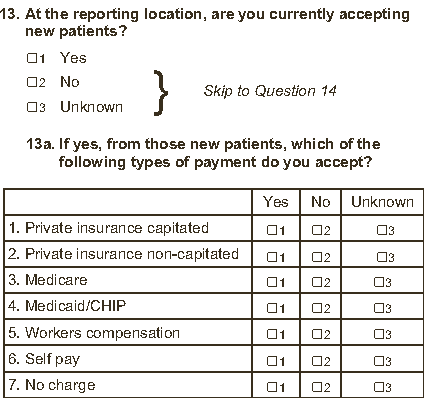
1. The DMCB pulled a copy of the NAMCS survey and found the question that was apparently used to assess physician participation. The screen shot is above. It generically ers to "Medicare," not fee-for-service Medicare. Because many physicians are members of insurance networks, an affirmative answer could be misinterpreted by the respondents as erring to Medicare Advantage.
2. There is a difference between "accepting" new patients vs. welcoming new patients. In this seminal New England Journal study, many respondents "accepted" "new" Medicaid beneficiaries, but moved them to the back of the appointment queue.
That being said, the MedPAC survey suggests that isnt happening - yet - to Medicare beneficiaries. And thats assuming a health care consumers definition of "delay" hasnt been dumbed down since 2005.
3. Last but not least, the NAMCS numbers represent a national average. Many areas of the country have seen consolidation of physician practices into larger groups. The DMCB suspects these entities are more willing to accommodate Medicare beneficiaries. Its very possible that the smaller physician-owned practices - many of whom practice in rural areas - are less likely to do so in 2013 than they were in 2008.
Coda:
In yesterdays post, the DMCB was introduced to "twerking." After additional inquiries of the DMCB spawn, it has learned more about this curious phenomenon.
Which led to this insight:
Q: What is one key similarity between twerking and being an ACO?
A: You better be caul doing both, otherwise you could get screwed.
.
The Institute of Medicine and the Inconvenient Truth of the Real Affordability of the Affordable Care Act
Tuesday, January 28, 2014
 Enshrining a term only an actuary could love, the Affordable Care Act sets health insurance coverage on the basis of "actuarial value" (AV). A good summary can be found in this Consumers Union Health Policy Brief. As the Disease Management Care Blog understands it, AV is the percent of typical medical expenses that a health insurance policy will cover for a typical population. In other words, some individuals will have no out of pocket expenses (deductibles, coinsurance and limits) while other individuals will have end up paying for most of their services. When those expenses are rolled up over thousands of persons and compared to total health care costs, the percent left over is the "AV."
Once the Disease Management Care Blog wrapped its head around the AV, it next tackled the ACA concept of the "essential health benefit" (EHB). This is the minimum package of covered services (outpatient, emergency room, maternity, hospitalization, medications, rehabilitation and the like) that a health insurer must include in its coverage plan. This will ultimately be defined in yet-to-be-determined federal regulations.
Now that we have the jargon nailed down, plans that fail to meet at least 60% of AV on the EHB will be excluded from the exchanges and ineligible for federal subsidies. 60% is "bronze" coverage, while 70%, 80% and 90% are "silver," "gold" and "platinum," respectively. This is important because not only did most members of Congress not understand AV (consumer costs) or EHB (coverage), but because both will determine the future cost of our nations health care bill.
Enter the Institute of Medicine (IOM), which has just released a report on how the Feds should best determine the EHB. A handy summary can be found here.
Bottom line?
The IOM has backed into the EHB, not basing it on notions of optimum health coverage but on affordability. It recommends that the basic affordable EHB be based on a survey of what is typically covered by an insurance plan that is purchased by a small business employer. With that as the baseline, the EHB be further modified (based on scientific evidence and public input) so that the premium ultimately matches 70% of the small business AV. According to John Iglehart writing in the New England Journal of Medicine, that could work out to be about $5000 per year for individuals and about $13,500 for families.
This is significant because the key underlying assumption of the ACA was that forcing everyone in the risk pool (with the Constitutionally suspect "play or pay" provision) with insurance rich in wellness, prevention and services like rehab, mental health and pediatric oral care would, by itself, drive down health costs.
The smart folks over at the Institute of Medicine respectfully disagree. They believe the best approach is to figure out what is affordable first and then define the insurance coverage second.
Its finally happened. While its not explicitly stated, the Federal deficit has noisily bumped into the Affordable Care Act. The IOM has given the ACAs supporters cover over the inconvenient intrusion of costs into coverage, affordability into access and reality into fantasy. Even if the IOM recommendations fall on deaf ears, DMCB readers can expect the the Federal budgets problems to now and forever be part and parcel of the ACA.
What to do? When the Disease Management Care Blog is flummoxed, it likes to break into song. One song that comes to mind is Taxman......
The Truth About Sugar Can you get addicted to sugar
Monday, January 13, 2014
Do you need to quit it cold turkey? Here are expert answers.
Recently, talk show host Ellen DeGeneres declared that she was going on a sugar cleanse, purging her diet of all refined sugars to boost her well-being. While naturally occurring sugars, such as the kind found in sugar snap peas, were still OK to eat, no one was going to catch Ellen letting a Bunt cake cross her lips.
Her sugar cleanse diet inspired many viewers to embark on their own sugar smack downs. Is this the latest food fad, or are the sugar naysayers on to something?
Is sugar addictive?
A coworker with an unshakable candy bar habit might sigh that shes utterly addicted to sweets. Can someone truly become physically dependent on sugar?
Sugar taps into a powerful human preference for sweet taste, says Marcia Pelchat, PhD, a scientist at the Monell Chemical Senses Center, a basic research institute in Philadelphia. "Were born to like sugar," she says.
"Sugar does seem to be special in some ways," Pelchat says, even in the womb. Doctors used to treat the problem of excessive amniotic fluid by injecting a sweet substance into the liquid, she says. The appealing taste would prompt the fetus to swallow more fluid, which was then flushed out through the umbilical cord and the mothers kidneys.
Not only do infants prefer sweet tastes, but when babies drink a sweet solution, it can ease pain through a natural analgesic effect in the body, Pelchat says.
Way back, the preference for sugar may have conferred an evolutionary advantage by leading people to seek out ripe fruits, which are sweet and serve as a good source of calories, she says.
But nowadays, is the coworkers constant hankering for sugar merely a strong liking, or is it a true addiction, with physical dependence and withdrawal symptoms?
"The jurys still out," Pelchat says. Scientists arent sure if people can become physically dependent on sugar, although some animal studies suggest that such a thing is possible, she says. "There are the same kinds of changes in brain dopamine, in these animals given intermittent access to sugar, as in drug addicts."
Unlike with substance abuse, people dont get the shakes when they stop eating sugar. But people with constant sugar cravings do exhibit one symptom of dependence, Pelchat says: "continued use despite knowledge of bad consequences or having to give up certain activities." For instance, people who crave sugary, fatty foods will keep eating them even if obesity makes it uncomfortable to walk or to sit in an economy seat on the plane.
Can sugar worsen cholesterol?
Researchers have found a link between sugar and unhealthy levels of blood fats. “There’s an association between added sugar intake and what we call dyslipidemia -- higher triglycerides and lower HDL ("good") cholesterol, says Rachel K. Johnson, RD, MPH, PhD, a professor of nutrition at the University of Vermont and a spokeswoman for the American Heart Association (AHA).
In a study recently published in the Journal of the American Medical Association (JAMA), people who ate the largest amounts of added sugar had the highest blood triglyceride levels and the lowest HDL (good) cholesterol levels. That study also showed that eating lots of sugar more than tripled the odds of having low HDL cholesterol levels, a strong risk factor for heart disease.
In contrast, people who ate the least sugar had the lowest triglyceride levels and highest HDL levels, a protective factor against heart disease.
But "the study doesn’t prove that added sugars cause dyslipidemia,” says Johnson, who wasnt involved in the JAMA study.
Johnson says that to prove that sugar causes problems with blood fats, scientists would have to conduct a clinical trial in which some people ate a diet high in added sugar and others ate a diet low in added sugar. Then researchers would track their triglyceride and cholesterol levels. Such a study would be expensive and hard to carry out, she says.
However, Johnson points out that weight did not explain the JAMA findings. “Obesity is obviously related to dyslipidemia, but based on the JAMA paper, the added sugars had an independent effect, separate and distinct from the added sugars’ impact on weight," she says.
Does sugar cause diabetes?
"Eating sugar per se does not cause diabetes," Johnson says. But large, epidemiological research has shown an association between intake of sugar-sweetened beverages and diabetes, she says.
The real culprit may be obesity. "It may be because the sugar-sweetened beverages are associated with higher BMIs or associated with overweight and obesity, which we know is a risk factor for diabetes," Johnson says.
Is sugar affecting childrens health?
Pediatricians are concerned that too much sugar is in their young patients diets, Kavey says. But again, sugar by itself is not the problem, she says, but rather the excess pounds.
"The reason that we think of it as a problem is because of the big rise in obesity in childhood, and that rise has occurred over the same time period that theres been a major increase in the amount of simple sugar that children consume," Kavey says. Juices, sodas, sweetened cereals, cookies, and candy are common sources of sugar in childrens diets.
But other factors -- like spending a lot of sedentary time with computers rather than running around and playing -- may also contribute to childhood obesity.
What about the notion that sugar makes some children hyperactive?
"In my own experience, I know there are some children who are very sensitive to sugar. They really are quite wild after they have sugar," Kavey says. "But thats not proof. The literature on it is not conclusive at all."
Are some types of sugar better than others?
Celebrities and high-profile chefs have touted the benefits of replacing refined white sugar with purportedly more natural, healthier sugars, such as honey, maple syrup, or molasses.
But theres no truth to these common misconceptions, Johnson says. "In terms of something being inherently better about those sweeteners as opposed to table sugar or sucrose -- no." The bottom line: All are simple sugars.
"A calorie of sugar is a calorie of sugar, so whether youre getting it from white sugar or some other type of sweetener, youre still adding empty calories to your diet," Johnson says.
However, there may be one redeeming quality, she says. "Some of those sweeteners -- like maple syrup, molasses, honey -- may have a stronger taste, so you might be able to get the sweetness that you want with less of it, using less calories."
What about substituting artificial sweeteners? Despite public worries that they might cause cancer, "Theyve been approved as safe by the FDA and I think that they can be a good tool to lower the calories in your diet," Johnson says. "But you need to be careful that its about the total calories. You always hear about the person who puts the non-nutritive sweetener in their coffee and then has a piece of cheesecake."
How much sugar does the average American eat?
Sugar shows up naturally in lots of foods, but those arent the types of sugars in the spotlight. Instead, its the sugar in the doughnuts and sodas or even in the maple syrup that we drizzle onto our pancakes.
"We do know that Americans are consuming way too much added sugars," Johnson says. "These are the sugars that are added to foods in processing or preparation. Theyre not the naturally occurring sugars, like fructose in fruit or lactose in milk or dairy products."
Johnson led the team of experts that wrote the AHAs 2009 scientific statement on added sugars and cardiovascular health. The report pointed to sodas and other sugar-sweetened drinks as the main source of added sugars in Americans diets.
From 2001 to 2004, the report noted, Americans consumed lots of sugar: an average of 22 teaspoons a day, the equivalent of 355 calories.
Eating too much sugar can create two main problems, Johnson says. "It either adds calories to your diet or it displaces other nutritious foods. Most Americans could benefit from reducing the amount of added sugars in their diet."
Recently, talk show host Ellen DeGeneres declared that she was going on a sugar cleanse, purging her diet of all refined sugars to boost her well-being. While naturally occurring sugars, such as the kind found in sugar snap peas, were still OK to eat, no one was going to catch Ellen letting a Bunt cake cross her lips.
Her sugar cleanse diet inspired many viewers to embark on their own sugar smack downs. Is this the latest food fad, or are the sugar naysayers on to something?
Is sugar addictive?
A coworker with an unshakable candy bar habit might sigh that shes utterly addicted to sweets. Can someone truly become physically dependent on sugar?
Sugar taps into a powerful human preference for sweet taste, says Marcia Pelchat, PhD, a scientist at the Monell Chemical Senses Center, a basic research institute in Philadelphia. "Were born to like sugar," she says.
"Sugar does seem to be special in some ways," Pelchat says, even in the womb. Doctors used to treat the problem of excessive amniotic fluid by injecting a sweet substance into the liquid, she says. The appealing taste would prompt the fetus to swallow more fluid, which was then flushed out through the umbilical cord and the mothers kidneys.
Not only do infants prefer sweet tastes, but when babies drink a sweet solution, it can ease pain through a natural analgesic effect in the body, Pelchat says.
Way back, the preference for sugar may have conferred an evolutionary advantage by leading people to seek out ripe fruits, which are sweet and serve as a good source of calories, she says.
But nowadays, is the coworkers constant hankering for sugar merely a strong liking, or is it a true addiction, with physical dependence and withdrawal symptoms?
"The jurys still out," Pelchat says. Scientists arent sure if people can become physically dependent on sugar, although some animal studies suggest that such a thing is possible, she says. "There are the same kinds of changes in brain dopamine, in these animals given intermittent access to sugar, as in drug addicts."
Unlike with substance abuse, people dont get the shakes when they stop eating sugar. But people with constant sugar cravings do exhibit one symptom of dependence, Pelchat says: "continued use despite knowledge of bad consequences or having to give up certain activities." For instance, people who crave sugary, fatty foods will keep eating them even if obesity makes it uncomfortable to walk or to sit in an economy seat on the plane.
Can sugar worsen cholesterol?
Researchers have found a link between sugar and unhealthy levels of blood fats. “There’s an association between added sugar intake and what we call dyslipidemia -- higher triglycerides and lower HDL ("good") cholesterol, says Rachel K. Johnson, RD, MPH, PhD, a professor of nutrition at the University of Vermont and a spokeswoman for the American Heart Association (AHA).
In a study recently published in the Journal of the American Medical Association (JAMA), people who ate the largest amounts of added sugar had the highest blood triglyceride levels and the lowest HDL (good) cholesterol levels. That study also showed that eating lots of sugar more than tripled the odds of having low HDL cholesterol levels, a strong risk factor for heart disease.
In contrast, people who ate the least sugar had the lowest triglyceride levels and highest HDL levels, a protective factor against heart disease.
But "the study doesn’t prove that added sugars cause dyslipidemia,” says Johnson, who wasnt involved in the JAMA study.
Johnson says that to prove that sugar causes problems with blood fats, scientists would have to conduct a clinical trial in which some people ate a diet high in added sugar and others ate a diet low in added sugar. Then researchers would track their triglyceride and cholesterol levels. Such a study would be expensive and hard to carry out, she says.
However, Johnson points out that weight did not explain the JAMA findings. “Obesity is obviously related to dyslipidemia, but based on the JAMA paper, the added sugars had an independent effect, separate and distinct from the added sugars’ impact on weight," she says.
Does sugar cause diabetes?
"Eating sugar per se does not cause diabetes," Johnson says. But large, epidemiological research has shown an association between intake of sugar-sweetened beverages and diabetes, she says.
The real culprit may be obesity. "It may be because the sugar-sweetened beverages are associated with higher BMIs or associated with overweight and obesity, which we know is a risk factor for diabetes," Johnson says.
Is sugar affecting childrens health?
Pediatricians are concerned that too much sugar is in their young patients diets, Kavey says. But again, sugar by itself is not the problem, she says, but rather the excess pounds.
"The reason that we think of it as a problem is because of the big rise in obesity in childhood, and that rise has occurred over the same time period that theres been a major increase in the amount of simple sugar that children consume," Kavey says. Juices, sodas, sweetened cereals, cookies, and candy are common sources of sugar in childrens diets.
But other factors -- like spending a lot of sedentary time with computers rather than running around and playing -- may also contribute to childhood obesity.
What about the notion that sugar makes some children hyperactive?
"In my own experience, I know there are some children who are very sensitive to sugar. They really are quite wild after they have sugar," Kavey says. "But thats not proof. The literature on it is not conclusive at all."
Are some types of sugar better than others?
Celebrities and high-profile chefs have touted the benefits of replacing refined white sugar with purportedly more natural, healthier sugars, such as honey, maple syrup, or molasses.
But theres no truth to these common misconceptions, Johnson says. "In terms of something being inherently better about those sweeteners as opposed to table sugar or sucrose -- no." The bottom line: All are simple sugars.
"A calorie of sugar is a calorie of sugar, so whether youre getting it from white sugar or some other type of sweetener, youre still adding empty calories to your diet," Johnson says.
However, there may be one redeeming quality, she says. "Some of those sweeteners -- like maple syrup, molasses, honey -- may have a stronger taste, so you might be able to get the sweetness that you want with less of it, using less calories."
What about substituting artificial sweeteners? Despite public worries that they might cause cancer, "Theyve been approved as safe by the FDA and I think that they can be a good tool to lower the calories in your diet," Johnson says. "But you need to be careful that its about the total calories. You always hear about the person who puts the non-nutritive sweetener in their coffee and then has a piece of cheesecake."
How much sugar does the average American eat?
Sugar shows up naturally in lots of foods, but those arent the types of sugars in the spotlight. Instead, its the sugar in the doughnuts and sodas or even in the maple syrup that we drizzle onto our pancakes.
"We do know that Americans are consuming way too much added sugars," Johnson says. "These are the sugars that are added to foods in processing or preparation. Theyre not the naturally occurring sugars, like fructose in fruit or lactose in milk or dairy products."
Johnson led the team of experts that wrote the AHAs 2009 scientific statement on added sugars and cardiovascular health. The report pointed to sodas and other sugar-sweetened drinks as the main source of added sugars in Americans diets.
From 2001 to 2004, the report noted, Americans consumed lots of sugar: an average of 22 teaspoons a day, the equivalent of 355 calories.
Eating too much sugar can create two main problems, Johnson says. "It either adds calories to your diet or it displaces other nutritious foods. Most Americans could benefit from reducing the amount of added sugars in their diet."
Subscribe to:
Posts (Atom)


