Showing posts with label fda. Show all posts
Showing posts with label fda. Show all posts
Mercks Januvia™ Receives FDA Approval
Tuesday, April 15, 2014
 On October 17, 2006, the FDA approved Mercks Januvia™ for type 2 diabetes.
Januvia (sitagliptin) is an incretin enhancer. For a brief primer on how these drugs work, visit our post:
New Diabetes Drugs on the Horizon: Incretin Enhancers
Merck states the recommended dose as 100 mg/day. The 100 mg tablets will be available in pharmacies in the near future. Price: $4.86/tablet.
For FDAs press release:
FDA Approves New Treatment for Diabetes
For Mercks press release:
FDA Approves Once-Daily JANUVIA™, the First and Only DPP-4 Inhibitor Available in the United States for Type 2 Diabetes
For Januvias site:
Januvia


FDA Considers OTC Version of the Fat blocker Xenical
Sunday, April 13, 2014
Xenical® may become the first government-approved weight-loss drug available without a prescription.
In 1999, Roche Laboratories, Inc. received marketing approval for orlistat (brand name: Xenical®) and has sold it as a prescription drug since. This afternoon, an FDA advisory panel is considering making a lower-dose version (60 mg. capsules, prescription strength is 120 mg. capsules) available for sale over-the-counter (OTC), without a prescription.
Xenical works locally in the digestive tract to block absorption of about 25% to 30% of the fat in a meal. One of the FDAs concerns is that the drug would also block absorption of fat-soluble vitamins E, D, K, and beta-carotene.
The FDA lists the most common side effects of orlistat as:
If approved, GSK will market the 60 mg. OTC version of orlistat as "Alli", pronounced ally - a erence to its use as an ally or helper in a total weight-loss program.
________
For an FDA Fact Sheet on Xenical (open as a pdf file):
Xenical (orlistat)
For some news summaries:
FDA Mulling OTC Sale of Fat Blocking Pill
FDA Finds Risk in GlaxoSmithKline PLCs Xenical Diet Pill
In 1999, Roche Laboratories, Inc. received marketing approval for orlistat (brand name: Xenical®) and has sold it as a prescription drug since. This afternoon, an FDA advisory panel is considering making a lower-dose version (60 mg. capsules, prescription strength is 120 mg. capsules) available for sale over-the-counter (OTC), without a prescription.
Xenical works locally in the digestive tract to block absorption of about 25% to 30% of the fat in a meal. One of the FDAs concerns is that the drug would also block absorption of fat-soluble vitamins E, D, K, and beta-carotene.
The FDA lists the most common side effects of orlistat as:
- Oily spotting
- Gas with discharge
- Fecal urgency
- Fatty/oily stools
- Frequent bowel movements
If approved, GSK will market the 60 mg. OTC version of orlistat as "Alli", pronounced ally - a erence to its use as an ally or helper in a total weight-loss program.
For an FDA Fact Sheet on Xenical (open as a pdf file):
Xenical (orlistat)
For some news summaries:
FDA Mulling OTC Sale of Fat Blocking Pill
FDA Finds Risk in GlaxoSmithKline PLCs Xenical Diet Pill
FDA Video On Diabetes Devices
Saturday, March 1, 2014
A quick little video by the FDA on the devices used to check blood glucose and inject insulin:
________
FDA to Define Whole Grains
Wednesday, February 12, 2014
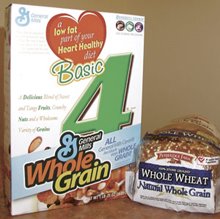 The Dietary Guidelines for Americans, 2005, recommends that Americans consume 3 or more servings of whole grains per day, with a goal of at least half of their grains coming from whole grains.
But whats a "whole grain"?
The FDA has issued a draft document intended "to provide guidance to industry about what the agency considers to be "whole grain" and to assist manufacturers in labeling their products."
In general, a "whole grain" may be ground, cracked, flaked, or intact - but should consist of the grains bran, germ, and starchy endosperm in the same proportions that they exist in the original grain.
Examples of whole grains:
- Amaranth
- Barley
- Buckwheat
- Bulgur
- Corn (including popcorn)
- Millet
- Quinoa
- Rice
- Rye
- Oats (including rolled oats)
- Sorghum
- Teff
- Triticale
- Wheat
- Wild rice
Examples of foods not considered whole grains:
- Flours or meals (e.g. corn meal) are not considered whole grain unless the bran and germ, as well as the starchy interior are present.
- Soybeans, chickpeas, and other beans and legumes are not considered whole grains.
- Barley that is pearled is not considered a whole grain because some of the bran layer has been removed.
You can read the rest of the FDAs draft guidance statement on whole grains here.
Medtronics Insulin Pump with Glucose Monitor Gets FDA Approval
Saturday, February 1, 2014
In a healthy person, the body senses insulin need and dispenses the hormone without the persons conscious thought or action. Future technologies may one day be able to mimic this unconscious sensing and dispensing of insulin for people with diabetes.
Last week, medical science moved a step closer to such a "closed loop" system with the FDAs approval of Medtronics insulin pump and glucose monitoring system.
The MiniMed Paradigm® REAL-Time Insulin Pump and Continuous Glucose Monitoring System sends glucose readings every 5 minutes from a sensor to the pump. These continuous readings allow a user to monitor their glucose throughout the day. The system includes an alarm that vibrates or sounds when blood glucose is too high or too low, especially useful when sleeping. Action can be taken to improve glucose levels after a fingerstick confirmation.
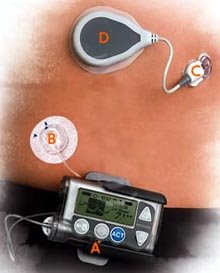 "Integrating an insulin pump with REAL-Time CGM is a major step toward the development of a “closed-loop” insulin delivery system that may one day mimic some functions of the human pancreas."
- Medtronics press release
MiniMeds REAL-Time System is shown at right:
A - Insulin pump
B - Insulin delivery
C - Glucose sensor
D - Transmitter
If youre interested in just continuous glucose monitoring (CGM) without a pump, MiniMed currently sells the Guardian® RT CGM System.
Or you can buy the MiniMed Paradigm 522/722 insulin pump and use it without the glucose monitoring system. Later, if you decide to try continuous monitoring, you can purchase the REAL-Time Continuous Glucose Monitoring Kit, designed to be used with those pumps. The monitoring kit should be available this summer.
For Medtronics press release:
Medtronic Receives FDA Approval for Worlds First Insulin Pump with Real-Time Continuous Glucose Monitoring
FDA Approves Inhaled Insulin In Stores By Summer
Sunday, January 26, 2014
The FDA yesterday approved Exubera®, the powered inhalable insulin developed by Pfizer and Sanofi-Aventis, for the treatment of diabetes. (Pfizer since acquired sole worldwide rights.)
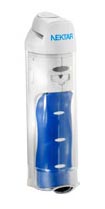 Inhaled insulin is a breakthrough for the drugs administration which until now required injection - by needle, pen, or pump. Insulin cannot be taken orally since the protein is broken down by digestive enzymes. Exubera is designed to enter the lungs though the mouth via an inhaler, originally designed by Nektar Therapeutics (shown).
Inhaled insulin has the potential to ease the burden of injection, but there are a few caveats:
Exubera should be available by prescription this summer. Pfizer has posted the following hotline for consumers or health care providers whod like more information: 1-800-EXUBERA.
________
FDA Press release:
FDA Approves First Ever Inhaled Insulin Combination Product for Treatment of Diabetes
Pfizer press release:
Pfizer Receives FDA Approval for Exubera, the First Inhalable Form of Insulin for Controlling Type 1 and Type 2 Diabetes in Adults
Some news summaries:
US Regulators Approve Insulin in Inhaled Form
FDA Approves Inhaled Insulin for Diabetics
 Inhaled insulin is a breakthrough for the drugs administration which until now required injection - by needle, pen, or pump. Insulin cannot be taken orally since the protein is broken down by digestive enzymes. Exubera is designed to enter the lungs though the mouth via an inhaler, originally designed by Nektar Therapeutics (shown).
Inhaled insulin has the potential to ease the burden of injection, but there are a few caveats:
- Its not recommended for smokers, those with asthma, bronchitis, emphysema, or other unstable lung conditions.
- Currently, it can only replace the short-acting, bolus dose of insulin. If a longer-acting basal dose is needed, that would need to be injected.
"Exubera would cost between $120 and $150 a month, roughly comparable to the price of pills taken by some people with Type 2 diabetes but about three times the price of injectable insulin."
Exubera should be available by prescription this summer. Pfizer has posted the following hotline for consumers or health care providers whod like more information: 1-800-EXUBERA.
FDA Press release:
FDA Approves First Ever Inhaled Insulin Combination Product for Treatment of Diabetes
Pfizer press release:
Pfizer Receives FDA Approval for Exubera, the First Inhalable Form of Insulin for Controlling Type 1 and Type 2 Diabetes in Adults
Some news summaries:
US Regulators Approve Insulin in Inhaled Form
FDA Approves Inhaled Insulin for Diabetics
Update FDA Considers an OTC Version of the Fat blocker Xenical
Sunday, January 19, 2014
The FDA advisory committee voted 11 to 3 today to recommend the OTC version of orlistat* for final FDA approval.
The FDA usually follows the recommendation of its advisory committees. Full FDA approval could be months away.
* If you have diabetes, its advisable to consult with your doctor before taking non-prescription orlistat (Alli). Its use may necessitate changes to diabetes medications.
________
GlaxoSmithKlines Press Release:
FDA Joint Advisory Committee Recommends Approval of Orlistat 60 MG Capsules for Over-the-counter Use
News summaries:
Diet Pill Gets Closer to Store Shelves
FDA Panel Recommends OTC Weight-Loss Pill
The FDA usually follows the recommendation of its advisory committees. Full FDA approval could be months away.
* If you have diabetes, its advisable to consult with your doctor before taking non-prescription orlistat (Alli). Its use may necessitate changes to diabetes medications.
GlaxoSmithKlines Press Release:
FDA Joint Advisory Committee Recommends Approval of Orlistat 60 MG Capsules for Over-the-counter Use
News summaries:
Diet Pill Gets Closer to Store Shelves
FDA Panel Recommends OTC Weight-Loss Pill
Subscribe to:
Posts (Atom)


