Showing posts with label no. Show all posts
Showing posts with label no. Show all posts
Fat What No One Is Telling You
Wednesday, May 14, 2014
In 2004, the CDC published a study that found:
Given the strong correlation between weight and type 2 diabetes, the following documentary might be worth a watch.
PBS is currently broadcasting "Fat: What No One Is Telling You", a film investigating the issues surrounding the obesity epidemic.
From their website:
You can watch a preview here:

Check their site for local listing dates and times.
________
" ... the prevalence of overweight or obesity was 85.2% [among people with diabetes]."
- Prevalence of Overweight and Obesity Among Adults with Diagnosed Diabetes
Given the strong correlation between weight and type 2 diabetes, the following documentary might be worth a watch.
PBS is currently broadcasting "Fat: What No One Is Telling You", a film investigating the issues surrounding the obesity epidemic.
From their website:
"With 66 percent of U.S. adults either overweight or obese, our girth is a serious public health issue. Yet many of us still view being overweight as a character flaw, a lack of self-control, or even a moral crime.
But does fat really equal failure? FAT: What No One Is Telling You explores the myriad psychological, physiological and environmental factors that can make it so tough to shed pounds and keep them off. In this documentary, Executive producer Naomi Boak and producer/director Tom Spain, both Emmy Award honorees, share new scientific knowledge about hunger, eating, and human metabolic operation. This film also explains our psychological responses to food, and shows how external pressures (such as oversized restaurant portions and the unending barrage of food advertisement) make fighting fat so difficult, both on the personal and national levels."
You can watch a preview here:
Check their site for local listing dates and times.


More On Why No One Believes the Numbers and the Uncertainty of Measuring Return on Investment in Disease Management
Saturday, May 10, 2014
 |
| Measuring ROI |
The search for simple answers explains much of the appeal of this book.
According to author, one important solution is the "dummy year analysis" (DYA). This relies on repeated year-over-year measurements of utilization that use multiple comparison pairings of all patients with the condition of interest. When thats combined with a "plausibility" check list, Mr. Lewis says purchasers of the Patient Centered Medical Home (PCMH), disease management or wellness programs should be able to get a better fix on whether they saved any money. You can a sense of that perspective here.
The DMCB isnt too sure about that because a) other factors that have nothing to do with population health management can also impact utilization during and after the dummy years, making it difficult to assign an attributable ROI and b) entire health plan populations can likewise regress toward a regional or national mean.
The DMCB also sees three additional reasons why there may be less to this books methodology than meets the eye:
1. When employers, health plans, accountable care organizations or other buyers have a list of names that have been through a care program, they typically want to understand the outcomes for the individuals on that list. If thats the case, the challenge is to find an adequate comparator that portrays what would have happened in the absence of the care program. Multiple options for identifying a parallel comparator have been used in published science for decades. Thats difficult, imperfect, but not broken. It remains an option.
2. While the book is replete with examples of "actuaries behaving badly," it is impossible to underestimate the influence of actuarial science and trending on premium rate setting, statutory accounting, and the regulation of insurance. As a result, if the actuaries say money is - or is not - being saved, health system leaders ignore their insights at their peril.
3. Isolating the impact of PCMH, disease management or wellness program out of all the other "noise" of a changing economy, evolving consumerism, benefit changes, electronic health record databases, medical advances, inflation and the news media is a function of an increasingly sophisticated and changing statistical sciences and computational technology. Its ironic, but one outcome has been a better description and measurement of the uncertainty surrounding a result.
To the authors credit, Why No One Believes the Numbers is not being promoted as the single best methodology that will lead PCMH, disease management and wellness programs to outcomes certainty. Rather, it is one option among many in asking whether a program had any financial impact.
Ultimately, theore, thats why the DMCB advises that measuring outcomes in PHM - absent an ironclad methodology - comes down to using multiple approaches to triangulate on the truth. After reading Why No One Believes the Numbers, some readers may choose it as one of those approaches.
No Bake Eggless Créme Caramel My guest post for Nalini
Friday, May 9, 2014
Writing a guest post to a co blogger, any blogger can dream about it, thank god its happens quite often to me and am loving it. Recently Nalini of Nalinis Kitchen asked me to write a guest post for her, as she is celebrating her second blog anniversary. How can i miss a chance, i immediately said yes and i did this wonderful dessert for her.

Actually i know Nalini through blogging marathon before few years back,ill never forget to visit her space and she shares mouthwatering recipes with breath taking pictures. Beware dont go to her space while you are hungry,yes each and every pictures of her food will tempt you definitely and you will go crazy. If you are searching authentic dishes, just check her space and you will definitely fallen in love with her post.
When she asked me for the guest post, she wants me to make a French bakes,but sorry Nalini i couldnt keep my words, i prepared a no bake French dessert specially for you.

Crème caramel or caramel custard is a custard dessert with a layer of soft caramel on top, as opposed to crème brûlée, which is custard with a hard caramel top. The dish is eaten throughout the world eventhough is dessert is from French Cuisine.
Crème caramel goes for a plain custard where sugar syrup cooked to caramel stage is poured into the mold before adding the custard base. It is usually cooked in a bain-marie on a stove top or in the oven in a water bath. It is turned and served with the caramel sauce on top, hence the alternate French name crème caramel renversée.
But my version of No Bake Eggless Créme caramel doesnt need a oven and its completely egg free, this dessert goes for custard flour, Full fat milk, sugar and agar agar. Just with 4 ingredients you can make an incredible french dessert even if dont have oven at home. Have you noticed that this dessert is also gelatin free, i used china grass aka agar agar in this créme caramel, if you want to make with gelatin feel free to use it.
Check Nalinis space for my guest post..
Actually i know Nalini through blogging marathon before few years back,ill never forget to visit her space and she shares mouthwatering recipes with breath taking pictures. Beware dont go to her space while you are hungry,yes each and every pictures of her food will tempt you definitely and you will go crazy. If you are searching authentic dishes, just check her space and you will definitely fallen in love with her post.
When she asked me for the guest post, she wants me to make a French bakes,but sorry Nalini i couldnt keep my words, i prepared a no bake French dessert specially for you.
Crème caramel or caramel custard is a custard dessert with a layer of soft caramel on top, as opposed to crème brûlée, which is custard with a hard caramel top. The dish is eaten throughout the world eventhough is dessert is from French Cuisine.
Crème caramel goes for a plain custard where sugar syrup cooked to caramel stage is poured into the mold before adding the custard base. It is usually cooked in a bain-marie on a stove top or in the oven in a water bath. It is turned and served with the caramel sauce on top, hence the alternate French name crème caramel renversée.
But my version of No Bake Eggless Créme caramel doesnt need a oven and its completely egg free, this dessert goes for custard flour, Full fat milk, sugar and agar agar. Just with 4 ingredients you can make an incredible french dessert even if dont have oven at home. Have you noticed that this dessert is also gelatin free, i used china grass aka agar agar in this créme caramel, if you want to make with gelatin feel free to use it.
Check Nalinis space for my guest post..
Old age offers no protection from obesitys death grip
Friday, May 2, 2014
Getting older increases Americans risk of death from excessive BMI, finds new study, correcting flaw in earlier obesity paradox research
Obesity kills, giving rise to a host of fatal diseases. This much is well known. But when it comes to seniors, a slew of prominent research has reported an "obesity paradox" that says, at age 65 and older, having an elevated BMI wont shorten your lifespan, and may even extend it. A new study takes another look at the numbers, finding the earlier research flawed. The paradox was a mirage: As obese Americans grow older, in fact, their risk of death climbs.
Ryan Masters, PhD, and Bruce Link, PhD, at Columbia Universitys Mailman School of Public Health, in collaboration with Daniel Powers, PhD, at the University of Texas published the results online in the American Journal of Epidemiology.
The researchers argue that past studies of longevity and obesity were biased due to limitations of the National Health Interview Survey, or NHIS, which provides information on obesity. The survey excludes individuals who are institutionalized, such as in a hospital or nursing home—a group largely made up of seniors. Consequently, the data is overrepresented by older respondents who are healthy, including the relatively healthy obese. Whats more, many obese individuals fail to make it to age 65—and thus do not live long enough to participate in studies of older populations.
"Obesity wreaks so much havoc on ones long-term survival capacity that obese adults either dont live long enough to be included in the survey or they are institutionalized and theore also excluded. In that sense, the survey data doesnt capture the population were most interested in," says Dr. Masters, a Robert Wood Johnson Foundation Health & Society Scholar at Columbias Mailman School and the studys first author.
In his analysis Dr. Masters matched NHIS data on obesity with corresponding records in the National Death Index using data from close to 800,000 adults surveyed between 1986 and 2004. Next he performed statistical adjustments to account for the survey selection biases. The result: risk for death from obesity increases with age.
The finding jibes with countless medical studies that document how obesity takes a cumulative, even compounding toll on the human body. (Exponents of the obesity paradox have explained their counterintuitive results by suggesting that obesitys extra padding protects seniors from fall-related injuries and provides energy reserves during illness.)
"This study should put to rest the notion that its possible to age out of obesity risk, and provides a powerful counterfactual against those who say concern over obesity is overhyped," says Dr. Link, a professor of Epidemiology and Sociomedical Sciences at the Mailman School.
Going forward, Dr. Masters has set his sites on another possible reason behind the obesity paradox—that some of the older obese captured in NHIS data only put on extra weight later in life.
"The recent obesity epidemic hit all age groups at the same time, meaning many of the elderly obese only gained their excess weight in the last 10 years or so," Dr. Masters says. "To account for this fact, I will take a page from studies of cigarette smokers by looking at life years to measure how long someone has been obese rather than whether or not they happen to be obese at the time of a single snapshot survey."
Apparently eating fat makes no candy!
Recent study says that eating sweets on a regular basis can not trigger a heart attack or even weight gain.
The study was conducted on more than 5,000 Americans. The result did not find an association between poor health and eating candy on a regular basis.
People who eat sweets every day are not at risk of being overweight or developing cardiovascular disease than those who do it once a week or not at all. As reported by the Daily Mail (22/5), this research was supported by the National Confectioners Association.
"We did not find an association between the frequency of sweets consumption and increased body mass index or cardiovascular risk factors among adults," said Mary Murphy, a registered dietitian from the Centre for Chemical Regulation and Food Safety, in Washington DC, USA.
But researchers say that does not mean a person should not eat sweets as much as he wants.
The study was conducted on more than 5,000 Americans. The result did not find an association between poor health and eating candy on a regular basis.
People who eat sweets every day are not at risk of being overweight or developing cardiovascular disease than those who do it once a week or not at all. As reported by the Daily Mail (22/5), this research was supported by the National Confectioners Association.
"We did not find an association between the frequency of sweets consumption and increased body mass index or cardiovascular risk factors among adults," said Mary Murphy, a registered dietitian from the Centre for Chemical Regulation and Food Safety, in Washington DC, USA.
But researchers say that does not mean a person should not eat sweets as much as he wants.
Saturday Throwback 1 Chicken 17 Healthy Meals 26 Bucks No Mayo
Sunday, March 9, 2014
Every Saturday, we post a piece from the CHG archives. This one is from February 2009. Oh, memories.
The stretchability of a whole chicken is a frequently discussed topic among food and frugality bloggers. It’s commonly accepted that a single fowl will feed a family of 11 for weeks, years - even millennia. Even after 20 months of keeping CHG, I’m constantly gobsmacked by how moms and dads can create dinner after dinner from the same bird.
Here’s the thing: sometimes, those dinners aren’t the healthiest meals in the world. There tend to be a lot of quesadillas and casseroles whenever these type of posts pop up, not to mention chicken salads drenched with full-fat mayo. Now, there’s nothing wrong with this whatsoever (except the mayo - blech), but I wanted to see if I could put a healthier spin on it.
In a sentence: I wanted to find out if it was possible to create a gaggle of inexpensive, lower-fat meals with the leftovers from one big ol’ chicken.
Here were my rules:
- The budget – for EVERYTHING - was $25.
- I had to use as much food already in my pantry as possible. (Which accounted for a lot, and saved me mad dough in the long run.)
- Each meal had to feed at least two people (The Boyfriend and me).
- Bonus points for leftovers.
- The chicken had to be used up within a few days, so it wouldn’t go bad.
- The meals had to have reasonable variety, perably from a range of cuisines. It couldn’t be Chicken with Spaghetti on Day 1, then Chicken with Penne on Day 2.
- The meals had to have very little added fat, since the leftover chicken would provide most of it.
However, I did go $0.86 over budget. I’m okay with that, though. Between what we consumed each night and ate for lunch the next day, that $25.86 made 17 full meals, which works out to $1.52 each. That’s less than a cup of Starbucks coffee, so … aces.
What follows is the menu breakdown, complete with pictures and links to four of the five recipes. The last, a Cook’s Illustrated curry dish, isn’t online, so I transcribed it at the very bottom of this post. There’s also a master grocery list, so y’all can see the price breakdown of everything.
With that said, let’s get started with introductions: Charles, these are the CHG readers. CHG readers, this is Charles. He’s my chicken. He’s 6.99 lbs.
 He will not look like this for long.
Day 1
Marcella Hazan’s Lemon Roasted Chicken with Carrots and Potatoes
2 servings
Chicken consumed: 10 ounces
 We kicked everything off with Marcella’s Lemon Roasted Chicken. It’s been featured on the blog before, with good reason. In a world of dry, lame-o poultry, it is the Queen Mum of moist, flavorful goodness. Plus, when you add a few thick-cut carrots and quartered (unpeeled) red potatoes to the pan before it starts cooking, it becomes a whole meal. (Seriously, that’s all you have to do.) Together, The Boyfriend and I polished off all the vegetables and 10 ounces of chicken (five ounces each) for a Sunday night meal.
Afterwards, we stripped the chicken bare. Nude. Butt-naked. There was nothing left on that carcass but skin and gristle. It was a little hyena-like, honestly, but fun nonetheless. In total, our booty came to 2 pounds, 4 ounces of pure, straight-up leftover meat, mostly from the breast. Here’s a shot of the carnage.
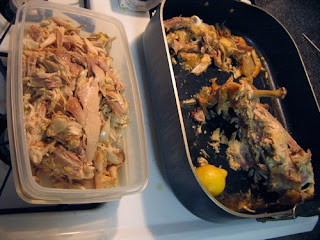 If I had half a brain, I would have saved Charles’ bones to make stock. But I forgot.
To quote the bard, “Duh.”
Day 2
Cooking Light’s Chicken Picadillo with Rice and Black Beans
3 servings
Leftover chicken consumed: 1 pound
 (Note: The experiment almost ended here, since I didn’t go grocery shopping in time for Day 2. Fortunately, for this particular recipe, everything was in my pantry already. [Woo hoo!])
Going in, I had mid-level expectations for Chicken Picadillo, and was super-pleasantly surprised by the results. All in all, it’s supremely easy to cook, and a nice change from the average Tex-Mex dish. Ground chicken, salsa, raisins, and almonds make up the main ingredients, but a dash of cinnamon ties it all together, giving everything a warm, lovely flavor. We ate it with plain rice and mashed black beans (to prepare: heat in pot, mash with masher, add salt and pepa), and used the leftovers to create a chicken/lettuce/salsa wrap the next day for lunch. Good times.
Day 3
White Chicken Chili
2-3 servings
Leftover chicken consumed: 1-1/2 cups
 This tangy, mild, ridiculously simple chili was The Boyfriend’s favorite dish of the bunch. (He is the Chili King. He can do anything.) He slurped a bowl in record time, scarfed leftovers for lunch the next day, and openly wept when I told him he had finished it all. Poor guy.
The key to keeping this dish low-fat is the beans. By lightly mashing them, you create a thicker chili consistency, and don’t have to add as much cheese. FYI: If you like your chilis a little spicier, the heat is eminently adjustable here: just include the jalapeno seeds OR add another pepper altogether.
Day 4
Food Network’s Sesame Noodles with Chicken
5 servings
Chicken consumed: 1 cup
 Three days into this thing, and we were barely halfway through Charles’ leftover meat. That started to change here.
It must be known: I loooooooove noodles. I luff them. I lurve them. I want to kiss them, but they keep falling through my fingers. (Ooo … deep.) Naturally then, this dish from Food Network was my favorite of the experiment. It’s a cross between Ellie Krieger’s Aromatic Noodles and this Noodle Salad from Cooking Light, with just a little more tang. The whole shebang is a tad higher in fat than the experiment’s others (see: butter, peanut), but it’s the healthy, protein-y kind, so I wouldn’t worry too much.
One note: I substituted a pitted, sliced regular cucumber for the Kirby. No harm, no foul, and it worked just fine.
Day 5
Cook’s Illustrated’s Chicken Curry in a Hurry
(recipe at bottom of post)
4 servings
Chicken consumed: 2 cups
 Finally, we had reached the end. Charles was nearly tapped by Day 5, though perhaps surprisingly, we weren’t getting tired of chicken in the least.
It’s a good thing, then, we went with Curry in a Hurry. Served with a side of brown rice, it’s a fast, fantastic, Indian-inspired weeknight meal that will absolutely use up the last of any leftover chicken. Plus, it’s a lot of frigging food. CI claims it serves four people, it’s really more like five or six. Maybe eight or nine if you’re elves.
Note: we skipped the peas because they represent the oppression of the worker by the bourgeoisie, and can only be freed through shared profit and community-wide effort. (Oh wait – that’s not right. Actually, I just forgot to buy them. It didn’t make a difference.)
~~~
And that, my friends, is it. Were full. The chickens gone. The experiment worked.
Here’s our grocery list (just like we promised!), plus the curry recipe, should you be into it. Comments and questions are welcome, and Id love to hear what yall have done with a whole chicken. Enjoy!
~~~
SHOPPING LIST
(* means I already had it in my pantry or fridge)
1 7-lb Oven Stuffer Roaster chicken: $6.92
1 lb thick carrots: $0.67
1-1/2 lbs red or Yukon gold potatoes: $1.42
2 lemons: $0.80
*1 or 2 tablespoons salt: $0.04
*3 teaspoons olive oil: $0.11
*2 tablespoons toasted sesame oil: $0.36
*2 tablespoons vegetable oil: $0.18
*2-1/2 medium onions: $0.30
*9 garlic cloves: $0.30
*2-1/2 teaspoons ground cumin: $0.05
*1/4 teaspoon ground cinnamon: $0.01
*1/2 teaspoon dried oregano or Italian seasoning: $0.02
*Pinch ground cloves: $0.01
*1 teaspoon crushed red pepper: $0.05
*1/2 to 1 tablespoon curry powder: $0.07
*1 cup bottled salsa: $0.99
*1/3 cup golden raisins: $0.79
*1/4 cup raisins: $0.42
*1/4 cup slivered almonds: $0.73
1/4 cup dry-roasted peanuts: $0.35
1 large bunch fresh cilantro: $0.99
*1 14-oz can black beans: $0.67
1 can large white beans: $1.39
*1 (15-ounce) can chickpeas: $0.67
*1-2/3 cup uncooked brown rice: $0.95
1 seeded jalapeño pepper: $0.25
1 cucumber: $0.80
6 scallions: $0.67
2 tablespoons fresh grated ginger: $0.32
1 can (4-ounce) chopped green chilies: $1.49
*2 cups chicken broth: $0.60
*1 pound spaghetti or Chinese egg noodles: $0.80
1/2 cup smooth peanut butter: $0.21
*1/4 cup soy sauce: $0.38
*2 tablespoons dark brown sugar: $0.06
*1 tablespoon rice vinegar: $0.24
*1/2 cup plain whole-milk yogurt (we used low-fat, and it was okay): $0.28
*1/2 cup grated low-fat Monterey Jack or white cheddar cheese: $0.50
TOTAL: $25.86
~~~
Cook’s Illustrated’s Chicken Curry in a Hurry
Serves 4
2 tablespoons vegetable oil
1 onion, sliced thin
1/2 to 1 tablespoon curry powder (mine is hot, so I only use ½)
Salt
4 garlic cloves, minced
1 tablespoon fresh grated ginger
½ cup water
2 cups shredded of thinly sliced cooked chicken
1 (15-ounce) can chickpeas, drained and rinsed
1 cup frozen peas (I left this out, but please use)
1/4 cup raisins
1/2 cup plain whole-milk yogurt (we used low-fat, and it was okay)
1/4 cup minced fresh cilantro
1. In a large skillet, heat oil over medium-high heat. Add onion, curry powder and 1/2 teaspoon salt. Saute about 6 minutes, until onion is browning. Add garlic and ginger. Cook 30 seconds, or until fragrant
2. Add water, meat, chickpeas, peas, and raisins. Stir. Saute 3 to 5 minutes, until warmed through.
3. Kill heat. Add yogurt and cilantro. Serve, over brown rice if you like.
Overweight No Excess of Nutrition
Wednesday, March 5, 2014
Overweight No Excess of Nutrition - Because thin people is synonymous with malnutrition, many people think that obesity means the excess of nutrients. In fact, obesity is included in the category of malnutrition.
Overweight or obese is caused by excess of calories, because the are in excess of fat and sugar. So, the vitamin is less. That is why the overweight is include to malnutrition. said Dr.Fiastuti Witjaksono, Sp.GK, in the ceremony of announcement of winner in The + Project that handle by philips in Jakarta.

Overweight, in spite of genetic factor, but accord to Fiastuti, this is more caused by environment factor. "Usually because of eating pattern in high fat and lifestyle," said the lecturer in the Department of Nutritional Sciences Faculty of Medicine, University of Indonesia.
According to the data "Riskesdas" The Ministry of Health, 2010, current population of overweight people in Indonesia reached 10 percent and reached 11.7 percent obese.
Fiastuti explain, this time, eating have been moved to lifestyle. Now the peoples eat not because of hungry only, but also in others moment." she said.
Overweight or obese is caused by excess of calories, because the are in excess of fat and sugar. So, the vitamin is less. That is why the overweight is include to malnutrition. said Dr.Fiastuti Witjaksono, Sp.GK, in the ceremony of announcement of winner in The + Project that handle by philips in Jakarta.
Overweight, in spite of genetic factor, but accord to Fiastuti, this is more caused by environment factor. "Usually because of eating pattern in high fat and lifestyle," said the lecturer in the Department of Nutritional Sciences Faculty of Medicine, University of Indonesia.
According to the data "Riskesdas" The Ministry of Health, 2010, current population of overweight people in Indonesia reached 10 percent and reached 11.7 percent obese.
Fiastuti explain, this time, eating have been moved to lifestyle. Now the peoples eat not because of hungry only, but also in others moment." she said.
No Benefit from Routine Health Checks
Tuesday, March 4, 2014
Carrying out general health checks does not reduce deaths overall or from serious diseases like cancer and heart disease, according to Cochrane researchers. The researchers, who carried out a systematic review on the subject for The Cochrane Library, warn against offering general health checks as part of a public health programme.
In some countries, general health checks are offered as part of standard practice. General health checks are intended to reduce deaths and ill health by enabling early detection and treatment of disease. However, there are potential negative implications, for example diagnosis and treatment of conditions that might never have led to any symptoms of disease or shortened life.
The researchers based their findings on 14 trials involving 182,880 people. All trials divided participants into at least two groups: one where participants were invited to general health checks and another where they were not. The number of new diagnoses was generally poorly studied, but in one trial, health checks led to more diagnoses of all kinds. In another trial, people in the group invited to general health checks were more likely to be diagnosed with high blood pressure or high cholesterol, as might be expected. In three trials, large numbers of abnormalities were identified in the screened groups.
However, based on nine trials with a total of 11,940 deaths, the researchers found no difference between the number of deaths in the two groups in the long term, either overall or specifically due to cancer or heart disease. Other outcomes were poorly studied, but suggested that offering general health checks has no impact on hospital admissions, disability, worry, specialist errals, additional visits to doctors or time off work.
"From the evidence weve seen, inviting patients to general health checks is unlikely to be beneficial," said lead researcher Lasse Krogsbøll of The Nordic Cochrane Centre in Copenhagen, Denmark. "One reason for this might be that doctors identify additional problems and take action when they see patients for other reasons."
"What were not saying is that doctors should stop carrying out tests or offering treatment when they suspect there may be a problem. But we do think that public healthcare initiatives that are systematically offering general health checks should be resisted."
According to the review, new studies should be focused on the individual components of health checks and better targeting of conditions such as kidney disease and diabetes. They should be designed to further explore the harmful effects of general health checks, which are often ignored, producing misleading conclusions about the balance of benefits and harm. Another problem is that those people who attend health checks when invited may be different to those who do not. People who are at a high risk of serious illness may be less likely to attend.
No Cook Month Greek Antipasto Pita Recipe
Sunday, February 16, 2014
Sweet readers! Todays post is a bit abbreviated for the vacation, but I didn’t want to skip this recipe. It’s a really good one, with absolutely no cooking involved, and it only gets better after a day or two in the fridge. Add a little feta cheese on top for pure Greek pita enjoyment.
Happy 4th! (Er ... or 5th.)
~~~
Greek Antipasto Pita
Serves 4 to 6.
Adapted from Moosewood’s Simple Suppers.
 2 tablespoons olive oil
1 tablespoon red wine vinegar
2 garlic cloves, minced or pressed
1 tablespoon fresh dill, chopped (or 1 teaspoon dried dill or oregano)
1 celery stalk, diced
1 large tomato, seeded and diced
1/2 red bell pepper, diced
1 cucumber (unpeeled), seeded and diced
1/4 red onion, minced
8 kalamata olives, pitted and chopped
Kosher salt
Freshly ground black pepper
4 whole wheat pitas
A few sprinkles reduced-fat feta cheese (optional)
1) Fill a small bowl with ice water. Add red onion and let sit for 10 minutes. Drain, Set aside.
2) To a medium serving bowl, add olive oil, vinegar, garlic, and dill. Whisk to combine.
3) Add celery, tomato, bell pepper, cucumber, red onion, and olives to bowl. Stir to combine. Salt and pepper to taste. Let sit at least 10 minutes.
4) Scoop filling on to pita. (You can toast the pita it if you like.) Sprinkle with feta if desired. Enjoy!
Approximate Calories, Fat, Fiber, Protein, and Price Per Serving
4 servings: 269 calories, 10.7 g fat, 6.7 g fiber, 8.4 g protein, $1.19
6 servings: 179 calories, 7.1 g fat, 4.5 g fiber, 5.6 g protein, $0.79
NOTE: For these calculations, I used Trader Joe’s Whole Wheat Pitas. Your numbers might vary slightly depending on your perred pita.
Calculations
2 tablespoons olive oil: 239 calories, 27 g fat, 0 g fiber, 0 g protein, $0.24
1 tablespoon red wine vinegar: negligible calories, fat, fiber, and protein, $0.03
2 garlic cloves: 9 calories, 0 g fat, 0.1 g fiber, 0.4 g protein, $0.12
1 tablespoon fresh dill: negligible calories, fat, fiber, and protein, $0.40
1 celery stalk: 9 calories, 0.1 g fat, 1 g fiber, 0.4 g protein, $0.19
1 large tomato: 33 calories, 0.4 g fat, 2.2 g fiber, 1.6 g protein, $0.49
1/2 red bell pepper: 21 calories, 0.2 g fat, 1.7 g fiber, 0.8 g protein, $0.61
1 cucumber: 45 calories, 0.3 g fat, 1.5 g fiber, 2 g protein, $0.66
1/4 red onion: 12 calories, 0 g fat, 0.4 g fiber, 0.3 g protein, $0.21
8 kalamata olives: 67 calories, 6.7 g fat, 0 g fiber, 0 g protein, $0.44
Kosher salt: negligible calories, fat, fiber, and protein, $0.01
Freshly ground black pepper: negligible calories, fat, fiber, and protein, $0.01
4 whole wheat pitas: 640 calorie, 8 g fat, 20 g fiber, 28 g protein, $1.33
TOTAL: 1074 calories, 42.7 g fat, 26.9 g fiber, 33.5 g protein, $4.74
PER SERVING (TOTAL/4): 269 calories, 10.7 g fat, 6.7 g fiber, 8.4 g protein, $1.19
PER SERVING (TOTAL/6: 179 calories, 7.1 g fat, 4.5 g fiber, 5.6 g protein, $0.79
Happy 4th! (Er ... or 5th.)
~~~
Greek Antipasto Pita
Serves 4 to 6.
Adapted from Moosewood’s Simple Suppers.
1 tablespoon red wine vinegar
2 garlic cloves, minced or pressed
1 tablespoon fresh dill, chopped (or 1 teaspoon dried dill or oregano)
1 celery stalk, diced
1 large tomato, seeded and diced
1/2 red bell pepper, diced
1 cucumber (unpeeled), seeded and diced
1/4 red onion, minced
8 kalamata olives, pitted and chopped
Kosher salt
Freshly ground black pepper
4 whole wheat pitas
A few sprinkles reduced-fat feta cheese (optional)
1) Fill a small bowl with ice water. Add red onion and let sit for 10 minutes. Drain, Set aside.
2) To a medium serving bowl, add olive oil, vinegar, garlic, and dill. Whisk to combine.
3) Add celery, tomato, bell pepper, cucumber, red onion, and olives to bowl. Stir to combine. Salt and pepper to taste. Let sit at least 10 minutes.
4) Scoop filling on to pita. (You can toast the pita it if you like.) Sprinkle with feta if desired. Enjoy!
Approximate Calories, Fat, Fiber, Protein, and Price Per Serving
4 servings: 269 calories, 10.7 g fat, 6.7 g fiber, 8.4 g protein, $1.19
6 servings: 179 calories, 7.1 g fat, 4.5 g fiber, 5.6 g protein, $0.79
NOTE: For these calculations, I used Trader Joe’s Whole Wheat Pitas. Your numbers might vary slightly depending on your perred pita.
Calculations
2 tablespoons olive oil: 239 calories, 27 g fat, 0 g fiber, 0 g protein, $0.24
1 tablespoon red wine vinegar: negligible calories, fat, fiber, and protein, $0.03
2 garlic cloves: 9 calories, 0 g fat, 0.1 g fiber, 0.4 g protein, $0.12
1 tablespoon fresh dill: negligible calories, fat, fiber, and protein, $0.40
1 celery stalk: 9 calories, 0.1 g fat, 1 g fiber, 0.4 g protein, $0.19
1 large tomato: 33 calories, 0.4 g fat, 2.2 g fiber, 1.6 g protein, $0.49
1/2 red bell pepper: 21 calories, 0.2 g fat, 1.7 g fiber, 0.8 g protein, $0.61
1 cucumber: 45 calories, 0.3 g fat, 1.5 g fiber, 2 g protein, $0.66
1/4 red onion: 12 calories, 0 g fat, 0.4 g fiber, 0.3 g protein, $0.21
8 kalamata olives: 67 calories, 6.7 g fat, 0 g fiber, 0 g protein, $0.44
Kosher salt: negligible calories, fat, fiber, and protein, $0.01
Freshly ground black pepper: negligible calories, fat, fiber, and protein, $0.01
4 whole wheat pitas: 640 calorie, 8 g fat, 20 g fiber, 28 g protein, $1.33
TOTAL: 1074 calories, 42.7 g fat, 26.9 g fiber, 33.5 g protein, $4.74
PER SERVING (TOTAL/4): 269 calories, 10.7 g fat, 6.7 g fiber, 8.4 g protein, $1.19
PER SERVING (TOTAL/6: 179 calories, 7.1 g fat, 4.5 g fiber, 5.6 g protein, $0.79
No Rules About the Food Who would have thought
Wednesday, February 12, 2014
Hi,
Im still curious about other "diet" programs and I found one that is chock full of really practical advice about losing weight. I mean REALLY practical. It is one of those reads that continually turns on the light bulb above my head. It is almost hard to put down, it is that good. It is called: The "Anything Goes Diet," and was written by John Barban and Mike Cecchin,
(Here is a link to their blog, but it is not as good a read as the AGD system, itself: http://www.anythinggoesdiet.com/blog/ -- once you get there click on "AGD System" near the top of the page and view their commercial -- try leaving the page for a better offer, too.)
I found out about AGD from an e-mail from the guy who wrote "Eat Stop Eat" (Brad Pilon) who said that if he had written the food side of his "fasting" program it would have been the AGD system. You know me, Ill bite, just to see what gives and I am really glad I did.
Their premise is that there is no "bad food." It does not really matter whether you eat low carb, high carb, low fat, or high fat, high protein, vegan, carnivore, five meals a day or three.... What matters is less calorie intake all together. But they dont advocate "counting calories" either, they recommend "calorie guessing."
They propose that it has been proven that people always underestimate how many calories they consume in a day or week, and overestimate how many calories they burn through exercise. They couple that with the fact that the calorie counts on processed food labels have to be "at least" what is listed on the package, but could be more, and often are. So no one really knows exactly how many calories they consume anyway -- there are just too darn many variables to know -- so calorie guessing is as close as a person can get.
Then they start with the hints and tricks that might actually help you cut down on your calorie intake without depriving yourself of any particular food group or food that you enjoy eating. You also do not have to eat any food that you do not personally like.
They share dozens of tips and practical ideas, but I am only going to reveal this one as an example of how far out of the box they think: They recommend that you buy your gas at the pump. Why? Because if you never go inside the quick mart, you are not tempted by all the calories that line the walls and shelves. Out of sight. Out of mind. -- Out of mind. Out of mouth. -- Out of mouth. Off the waist. Period.
So what about those of us who know they cannot have a bag of cookies in the house because the whole bag will be inside the stomach before it gets a chance to actually "be" in the house? They show you a method that will help you address this problem yourself. If you actually do as they suggest, it is bound to work. You do not have to follow someone elses meal plans and eating guides. They help you make your own.
They show you how to actually eat less food and give you plenty of guidelines to make this happen for yourself. There are no imposed rules. They help you figure out what works for you, so you can actually DO what works for you. You eat the food you love, in smaller, more practical portions and you begin to lose weight.
What you get when you buy their program is five different PDF books of various sizes that help you to understand the program, and also apply it to your life. I was especially attracted to their "Thinking Thin" and their "Social Eating Guide" pamphlets and I was not disappointed with their very practical methods. I was, in fact, quite amazed.
Look. I know this sounds like Im selling their program, but, again, as you know, they dont know me, and I have no affiliation with them. I am simply excited to have found something that I think might actually work for me. As usual, I will have to try it out, to find out for sure, but so far, it looks very good to me and Im excited about it.
I have discovered that I can do 16 hour daily fasts for many days in a row without too much hassle. I did not know that before. Ive discovered that fasting is natural and is nothing to be afraid of. Im actually beginning to per the feeling of fasting more than the feelings I get after having eaten -- but, if during the eight hours a day that you eat, you over eat, like a Sumo Wrestler, you will continue to look like a Sumo Wrestler. So, it is not as much about the fast, as it is about the quantity of consumption in between the fasts. But, you also do not have to starve yourself. You just need to eat a little bit less, to see results that make you smile. That is my take on the matter.
In the AGD they help you figure out how many calories per day will create a calorie deficit (and weight loss) for you, personally. The only thing I had a problem with was their generic metabolism charts. Ive actually had my resting metabolism measured at my doctors office and discovered that I burn 2400 calories every day, just laying around breathing so if I were to consume 2200 or even 2000 calories, I should lose weight. If I had not known that, I would have been stuck trying to live on 1400 calories per day. I know me. I need more food than that and cannot stick to a diet that is 1000 calories less per day. I really do begin to feel like Im starving and in a very short time I will abandon that program.
So here is what Marcia recommends: Dont use their generic charts. Go to your doctor and find out what your actual resting metabolic rate (RMR) is for real and then base your program on a calorie deficit that you can live with. If you cant live with it, you wont do it. Plain and simple. My doctor had a machine that I stood on in my bare feet, while I placed my hands on two electrified handles (dont worry, I did not feel a thing). It then printed out all kinds of information about me that I did not know before.
If your doctor does not have this kind of a device, then find a place that does. There are some health clubs and weight-loss centers that can do this, but I dont know how much it might cost. They often have an apparatus that you breathe into as you sit in a chair which will give you an accurate reading of your own RMR.
Changing your weight will be so much easier to do if you base your caloric intake count on real information and not those generic charts that only take your gender and your height into consideration. There are equations that can be done that are based on your gender, your height, and your weight but they are formulated for "normal" sized people and may not be accurate for the obese.
I feel very confident in saying that I think the AGD system has lots of useful stuff that will help you accomplish the task youve so long desired to accomplish: losing weight and keeping it off.
They have a 365-day money back guarantee, too. So... try it and see if they dont have a system that works for you. If not, then get your money back.
They even recommend that you eat as they suggest, and add to that a once a week 24-hour fast to really speed up your progress.
Im hoping it works for me.
Ill be letting you know.
Be back soon,
Marcia
Im still curious about other "diet" programs and I found one that is chock full of really practical advice about losing weight. I mean REALLY practical. It is one of those reads that continually turns on the light bulb above my head. It is almost hard to put down, it is that good. It is called: The "Anything Goes Diet," and was written by John Barban and Mike Cecchin,
(Here is a link to their blog, but it is not as good a read as the AGD system, itself: http://www.anythinggoesdiet.com/blog/ -- once you get there click on "AGD System" near the top of the page and view their commercial -- try leaving the page for a better offer, too.)
I found out about AGD from an e-mail from the guy who wrote "Eat Stop Eat" (Brad Pilon) who said that if he had written the food side of his "fasting" program it would have been the AGD system. You know me, Ill bite, just to see what gives and I am really glad I did.
Their premise is that there is no "bad food." It does not really matter whether you eat low carb, high carb, low fat, or high fat, high protein, vegan, carnivore, five meals a day or three.... What matters is less calorie intake all together. But they dont advocate "counting calories" either, they recommend "calorie guessing."
They propose that it has been proven that people always underestimate how many calories they consume in a day or week, and overestimate how many calories they burn through exercise. They couple that with the fact that the calorie counts on processed food labels have to be "at least" what is listed on the package, but could be more, and often are. So no one really knows exactly how many calories they consume anyway -- there are just too darn many variables to know -- so calorie guessing is as close as a person can get.
Then they start with the hints and tricks that might actually help you cut down on your calorie intake without depriving yourself of any particular food group or food that you enjoy eating. You also do not have to eat any food that you do not personally like.
They share dozens of tips and practical ideas, but I am only going to reveal this one as an example of how far out of the box they think: They recommend that you buy your gas at the pump. Why? Because if you never go inside the quick mart, you are not tempted by all the calories that line the walls and shelves. Out of sight. Out of mind. -- Out of mind. Out of mouth. -- Out of mouth. Off the waist. Period.
So what about those of us who know they cannot have a bag of cookies in the house because the whole bag will be inside the stomach before it gets a chance to actually "be" in the house? They show you a method that will help you address this problem yourself. If you actually do as they suggest, it is bound to work. You do not have to follow someone elses meal plans and eating guides. They help you make your own.
They show you how to actually eat less food and give you plenty of guidelines to make this happen for yourself. There are no imposed rules. They help you figure out what works for you, so you can actually DO what works for you. You eat the food you love, in smaller, more practical portions and you begin to lose weight.
What you get when you buy their program is five different PDF books of various sizes that help you to understand the program, and also apply it to your life. I was especially attracted to their "Thinking Thin" and their "Social Eating Guide" pamphlets and I was not disappointed with their very practical methods. I was, in fact, quite amazed.
Look. I know this sounds like Im selling their program, but, again, as you know, they dont know me, and I have no affiliation with them. I am simply excited to have found something that I think might actually work for me. As usual, I will have to try it out, to find out for sure, but so far, it looks very good to me and Im excited about it.
I have discovered that I can do 16 hour daily fasts for many days in a row without too much hassle. I did not know that before. Ive discovered that fasting is natural and is nothing to be afraid of. Im actually beginning to per the feeling of fasting more than the feelings I get after having eaten -- but, if during the eight hours a day that you eat, you over eat, like a Sumo Wrestler, you will continue to look like a Sumo Wrestler. So, it is not as much about the fast, as it is about the quantity of consumption in between the fasts. But, you also do not have to starve yourself. You just need to eat a little bit less, to see results that make you smile. That is my take on the matter.
In the AGD they help you figure out how many calories per day will create a calorie deficit (and weight loss) for you, personally. The only thing I had a problem with was their generic metabolism charts. Ive actually had my resting metabolism measured at my doctors office and discovered that I burn 2400 calories every day, just laying around breathing so if I were to consume 2200 or even 2000 calories, I should lose weight. If I had not known that, I would have been stuck trying to live on 1400 calories per day. I know me. I need more food than that and cannot stick to a diet that is 1000 calories less per day. I really do begin to feel like Im starving and in a very short time I will abandon that program.
So here is what Marcia recommends: Dont use their generic charts. Go to your doctor and find out what your actual resting metabolic rate (RMR) is for real and then base your program on a calorie deficit that you can live with. If you cant live with it, you wont do it. Plain and simple. My doctor had a machine that I stood on in my bare feet, while I placed my hands on two electrified handles (dont worry, I did not feel a thing). It then printed out all kinds of information about me that I did not know before.
If your doctor does not have this kind of a device, then find a place that does. There are some health clubs and weight-loss centers that can do this, but I dont know how much it might cost. They often have an apparatus that you breathe into as you sit in a chair which will give you an accurate reading of your own RMR.
Changing your weight will be so much easier to do if you base your caloric intake count on real information and not those generic charts that only take your gender and your height into consideration. There are equations that can be done that are based on your gender, your height, and your weight but they are formulated for "normal" sized people and may not be accurate for the obese.
I feel very confident in saying that I think the AGD system has lots of useful stuff that will help you accomplish the task youve so long desired to accomplish: losing weight and keeping it off.
They have a 365-day money back guarantee, too. So... try it and see if they dont have a system that works for you. If not, then get your money back.
They even recommend that you eat as they suggest, and add to that a once a week 24-hour fast to really speed up your progress.
Im hoping it works for me.
Ill be letting you know.
Be back soon,
Marcia
A Law That Wont Get No Respect
Tuesday, January 28, 2014
Talk about a law that wont get no respect. The President is quietly ignoring the Affordable Care Acts two year anniversary while leaving it to the controversial Ms. Pelosi to apply her unique rhetorical style to its defense. To add insult to injury, the U.S. House has just voted to repeal a signature feature of the law, the Independent Payment Review Commission (IAPB). If the repeal werent linked to HR 5s medical malpractice orms, theres a chance that enough of Mr. Obamas Democratic Senate would abandon him and force a Presidential veto.
The late Rodney Dangerfield would have a lot to say.....
"When ACA supporters talk about the ACA, they have to wear two paper bags over their heads... in case one falls off!"
"When the ACA passed, critics said it was unaffordable. Its supporters wanted a second opinion, so thats when the critics said its unconstitutional too!"
"One ACA supporter told his psychologist that ever since he voted for the ACA, everyone he knows hates him! He said he was being ridculous - not everyone knows that he voted for it!"
Happy Friday!
The late Rodney Dangerfield would have a lot to say.....
"When ACA supporters talk about the ACA, they have to wear two paper bags over their heads... in case one falls off!"
"When the ACA passed, critics said it was unaffordable. Its supporters wanted a second opinion, so thats when the critics said its unconstitutional too!"
"One ACA supporter told his psychologist that ever since he voted for the ACA, everyone he knows hates him! He said he was being ridculous - not everyone knows that he voted for it!"
Happy Friday!
You Never Want to Feel That Kind of Panic When You Have No Insurance
Sunday, January 26, 2014
 This isnt exactly what I wanted to write about, tonight. Im not exactly an "on-schedule" blogger, but I know this is definitely not what I was expecting to write about, tonight.
[Before I proceed, though... I just want to say that I dont want ANY pity. No pity... No feeling sorry for me... No hurting for my circumstances. No advice on what I could have done better (I will rip you a new one, if you do, just be forewarned). Life is what it is, and we are all dealt... what we are dealt, sometimes. Whatever that is. There are people, right now, going through a LOT more difficult circumstances. They deserve our support... so dont you worry about me. Also, this post might have a lot of swearing.]
I just need to process, and I need to vent. So to heck with it.
... Where do I start, I dont know. Its such a blur, now.
Last Sunday.
Last Sunday, running my hands through my hair, while wanting to put it up in a clasp, I found a large, swollen lump or area on the upper right side above the nape of my neck. It wasnt entirely dissimilar to the one on my left side, but distinctly swollen feeling, and sore if one put gentle pressure on it... and irradiating discomfort.
Of course, being The Angry Type 2 Diabetic that I am, I freaked out... said a few choice phrases rhyming with "What the fructose??" and sort of felt the clammy feel of panic rising up my spine. (You never want to feel that kind of panic when you have no insurance.)
I decided, though... that I was going to remain calm. (HA!) Just monitor it for the week, and wait until Thursday (today), for the Free Clinic, to get it checked out. As things sometimes go, I started feeling... unwell. "Woozy," feverish... just uncomfortable from the growing pressure in that area of my head... The "soreness" was starting to radiate down to my right shoulder, down my neck... And today, well, it was just difficult to focus, at work, and I noticed I couldnt really walk a good distance without feeling... just weird. Light-headed. Nauseated. "Its okay, though," I thought... "Today is the Free Clinic, and theyll have a look at it."
Now, the Free Clinic in my town is basically a rat pack of some medical professionals of various ilks who volunteer to provide some basic/minimal health care to uninsured people, no questions asked, and which only generally meets on Thursday evenings, from 6-8 pm. You have to arrive at 4 pm, though, and make quite the long line. Waiting for care often averages between 4-6 hours... and its first come first served, of course. They can only see about 15 people.
The problem is... they used to have a somewhat permanent building, which has since been torn down by their tenant -- the next door church, while they make some new additions and changes to their facilities. So, the Free Clinic now has to share space with the next door church, and can only meet whenever the heck the church is not having some event. Which basically means... whenever a magic 8-ball decides.
I walk out there... just praying, praying under my breath that they are meeting. Lo and behold, as Murphys Law loves me so much... They are not meeting. I think its because of some stupid Pancake Day crap. I dont know. (Insert your personal sensibilities approved curses here.)
Then you have to make the tough decisions. Is this something that you think will go away; get better on its own? Am I overreacting? Is this... something that... could potentially get worse very quickly, and kill someone? Is this something that can be stopped, but it just needs immediate attention? I dont know... Do I go to the ER (because the local medical clinic is closed... and, even if it was open, they wont see me because I have no insurance and a hefty past medical bill that I cant prioritize to pay right now (dont judge me... you dont know me... and they wont let me pay anything less than an outrageous amount, every month...), while so underemployed and on food stamps...)? Or do I chance it?
Reluctantly, I decide... Im going to go to the ER. I dont want to be the freak on tomorrows front cover story that died within days, from something simple, or who knows what. The worst they can do is turn me away. And I was wrong. The worst they can do is shame me, while turning me away.
The doctor didnt even really look, or touch the area much. He basically pushed my hair around, said it looked exactly like the left side of my head, that he didnt see any physical injuries, and then asked have I ever cared to examine the left side of my head...
(Yes, doctor, the rest of us who arent doctors are certainly idiots... We go entire lifetimes NOT touching our own bodies.)
....and then proceeded to tell me it was probably just me being worried about it, or at the very most a resented lymph node. He dismissed my other symptoms with the wave of a hand, gave me a smirk and a suppressed laugh, and said that I need to just let it stay like that, and come back in a week if it got much worse (with big disbelief all over his face).
I tried, very unsuccessfully to get his attention. He just basically acted like I was bullshitting him, and walked off.
Nurse Patronizer walks in. Nurse Patronizer notices Im quite angry. I dont recall whatever tipped it off... (pffft!) But... Nurse Patronizer says to me "I dont know what you two discussed," and boy do I let the flood gates go... and I start crying, right there. She begs me to give her 5 minutes and goes off, basically to talk to Full of Himself Doctor, who says "Oh, she needs to just watch the area for 2 or 3 days (yeah, rather than a week, like he had said before... hmmm)..."
Nurse Patronizer repeated over and over again how it wasnt that I had no insurance, while at the same time pushing a flyer on me to go to the Free Clinic tonight.... After I had spent a good chunk of time explaining to them that the Free Clinic was closed. They wouldnt believe me, and kept asking me *why* it was closed. Now how in the &#$@ should *I* know?! All they had was a sign posted about "We will have No Free Clinic Tonight, 03/01/2012." Im not their schedule keepers!
So, really... hmmm... If you are not punishing me for not having insurance, then perhaps you were punishing me for your perceived notion that Im using the ER as a PCP providers office, and not waiting until whenever the heck THEY would have given me an appointment (should I had been able to get one, which I know from experience, that I would have not, because of my outstanding bill. I know how those jerks work, too.)
So, off they sent me... With apparently, a few "lessons" for the road:
- Youve lived with your body for 35 years... and are quite educated, Liz, but you dont know your own head;
- You have no insurance, and are underemployed, so you must be subhuman, or some mentally unstable person making stuff up... abusing our services;
- You are nothing more than money;
- I hope you dont die, but good luck. Suck it up, butter cup.
And THAT is the reality uninsured people have to put with... in America.
I am, at home, and still feel... Odd... Feverish. Sick.
Off and on, it goes. I feel even more special I will get a nice, hefty bill in the mail, for absolutely nothing. For the theater of a mans arrogance, and a womans patronizing. Ive had more pleasant experiences there, before, but not today.
Not today.
No Cook Month Watermelon and Feta Salad with Mint
Tuesday, January 21, 2014
NOTE #1: Hello, readers from Get Rich Slowly! Welcome to Cheap Healthy Good. Its nice to have you here. If youre looking for a good place to get to know us, this post is a good start. Thanks for visiting and enjoy!
NOTE #2: Today on Serious Eats: Zucchini Carpaccio with Feta and Pine Nuts, an excellent alternative to a green salad.
Dude. It’s watermelon season.
Last week, it went on sale for $0.39/pound, so I dragged a 13-pounder home from a supermarket half a mile away. Its been parked on my kitchen table ever since, like some giant, edible bowling ball.
Yesterday, I finally cowboyed up and gutted the thing. And now, as you can see from this picture, we have enough watermelon to fill two man-sized storage containers.

The problem is, Husband-Elect and I are but two people. True, we’re two people who really like watermelon, but we’re two people nonetheless.
Consequently, over the next week, we’re gonna have to get creative with this thing. I’m thinking Watermelon Margaritas, Watermelon Salsa, and of course, more Watermelon and Feta Salad with Mint.
I have to admit: I didn’t think dropping feta into a bowl of fruit would do much. But it adds two things: salt and creaminess, which are both unexpected and very welcome. The mint and lime provide additional freshness and lightness, which keep the dish from being murky.
Beyond that, the dish boasts three huge pluses:
- It takes less than 10 minutes to make.
- There are no mandatory ratios. You can tailor the amount of feta, melon, mint, and lime to your liking.
- If you’re feeling adventurous, the recipe can be expanded to include olives, red onions, olive oil, balsamic vinegar, basil, cilantro, cotija cheese, jicama, and many, many more exciting ingredients. Guidelines abound online.
And with that, readers, any suggestions for watermelon recipes? We, uh, could use ‘em right now.
P.S. All-watermelon barbecue at my house tomorrow!
~~~
If you’re thinking about making this, you might also whip up some:
- Plums with Orange and Mint
- Strawberry and Avocado Salad
- Sublime Fruit Salad and Mint
Watermelon Feta Salad with Mint
Serves 1 or more.
Adapted from many, many sources, but especially Whipped.

A few cups watermelon, balled or cut into 2-inch chunks and chilled
A small block of feta cheese
A small handful mint leaves, chopped
Fresh lime juice
1) Place desired amount of watermelon in a bowl or on a plate.
2) Crumble desired amount of feta over watermelon. (The more, the better.)
3) Sprinkle mint over watermelon-feta mixture.
4) Squeeze lime over it all.
5) No. Seriously. That’s it.
Approximate Calories, Fat, Fiber, Protein, and Price Per Serving
147 calories, 6.5 g fat, 1 g fiber, 5.5 g protein, $0.79
NOTE: As this recipe is totally/completely adaptable to your tastes and perences, I’m making up some arbitrary numbers for calculations, just to give y’all an idea of the nutrition/price breakdown. Your numbers will undoubtedly be different, so please take this as a rough guide, only.
Calculations
1-1/2 cups watermelon: 69 calories, 0.5 g fat, 0.9 g fiber, 1.4 g protein, $0.26
1 ounce feta cheese: 75 calories, 6 g fat, 0 g fiber, 4 g protein, $0.37
1 tablespoon mint leaves, chopped: 1 calorie, 0 g fat, 0.1 g fiber, 0.1 g protein, $0.10
1 teaspoon lime juice: 2 calories, 0 g fat, 0 g fiber, 0 g protein, $0.06
TOTAL: 147 calories, 6.5 g fat, 1 g fiber, 5.5 g protein, $0.79
Subscribe to:
Posts (Atom)


